Fees and pricing
Priced on what you deploy, not on how many clients you win
Pricing follows the shape of the deployment — how many products, how many environments and how much of the operation you want us to run. It does not scale with your success, because a vendor taking a cut of growth is a vendor with a claim on your business.
The figures on this page are sample values used while the commercial model is finalised. They are registered as placeholders and are not a quote.
What scales with tier
Limits step down the same way leverage does
Rate limits, seats and support response times are tiered the same way trading limits are — a schedule, not a negotiation.
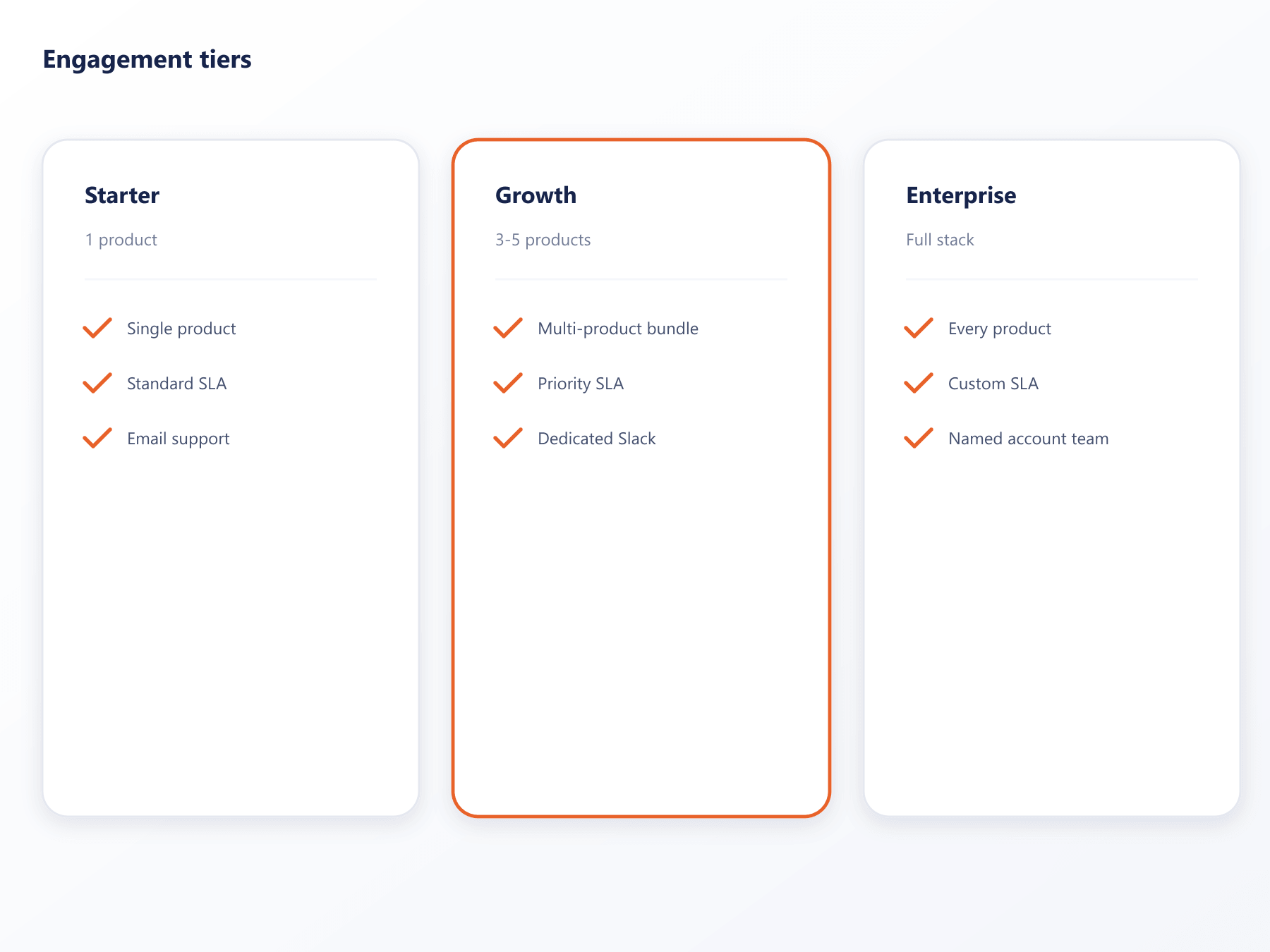
Engagement tiers
Three shapes, decided by what you deploy
Starter
One product, one environment
A firm filling a single gap — a platform, a client area or payments.
One product, fully configured
One live environment
Standard onboarding and training
Business-hours support
Growth
Most commonMultiple products, one account model
A brokerage running a real stack — platform, operations and payments together.
Three or more products
Live and staging environments
Priority support with named contact
Configuration changes included
Enterprise
Full stack, multiple entities
Multi-entity groups, white label operators and anyone we run end to end.
The full product range
Multiple entities and environments
Managed hosting and operations
Agreed response commitments
One-off setup on a standard deployment
Minimum term, indicative
What moves a quote
Four factors, in the order they matter
How many products
The single largest factor. Each additional product adds configuration and support surface, though far less than the first one did because the account model underneath is already there.
How many environments
A live server alone is one price. A live plus a standby, or two running side by side through a migration, changes the shape of the work rather than simply doubling it.
How much we operate
Administering the platform for you costs more than handing you the console. Which of those you want is a real choice rather than an upsell.
How many entities
One brand in one jurisdiction is straightforward. Several entities with different rules and reporting is a different deployment and is priced as one.
Never billed separately
Four things that are part of the arrangement
Each of these is commonly sold as an extra elsewhere. Charging for them changes how a broker behaves, and never for the better.
Updates and patching
New versions and security patches are part of the arrangement, not a maintenance line that appears later.
Configuration changes
Instrument lists, account groups, fee schedules and onboarding rules change constantly. Charging per change would make you avoid making them.
Incident response
When something breaks we fix it. A support contract that excludes incidents is not really support.
Reporting and exports
Your data, in the formats your regulator and your finance team need, without a reporting module sold separately.
Per product
What each one adds to a deployment
Platform tier depends on instruments and environments
Scales with entities rather than with client count
Custom and volume-based, with free setup. Included when you take Prime Liquidity
Provider integrations quoted per corridor
Priced on flow, not on a monthly line
Included at Growth and above
Added per programme
FAQ
Fees and pricing: common questions
6 short answers to what teams ask before a demo.
No. They are sample values shown while the commercial model is being finalised, and they are flagged as placeholders in our own claim register. A real number comes from a scoping conversation, not from this page.
No. Pricing follows what you deploy rather than how well you do with it. A vendor whose bill grows with your client base has an interest in your growth that is not the same as yours.
Not on a standard deployment. Configuration, integration and training sit inside the monthly figure on every plan. Work that is not standard, such as migrating off an existing stack, is a one-off quoted once the scope is settled.
Third-party costs that are genuinely somebody else's — platform vendor licensing where you run a third-party terminal, payment provider fees, and any liquidity you take from another provider.
Yes, and it is the most common path. Because the products share one account model, the second and third are configuration rather than fresh integrations, and the pricing reflects that.
Because a standard deployment is standard, and hiding its price wastes a call on both sides. The five plans and their figures sit on the store. What stays behind a conversation is the work that is genuinely bespoke, because a headline number there would be wrong for most readers.
Still have a question?
A specialist will answer it directly, with your set-up in mind.
Ask a specialistGet a number that applies to you
Tell us which products, how many environments and how much you want us to run. That is enough to quote properly rather than approximately.