White label
Funding is where brokerages quietly lose clients
A trader who cannot deposit does not complain. They leave, and nothing in your funnel records why. This puts the whole funding experience under your brand and gives you the routing controls that turn success rate into something you manage.
On your domain, in your design. No redirect to somebody else's page.
Balances, holds and history presented as part of your client area.
Confirmations and failures sent from you, worded by you.
Transaction records carrying your entity details.
See it live
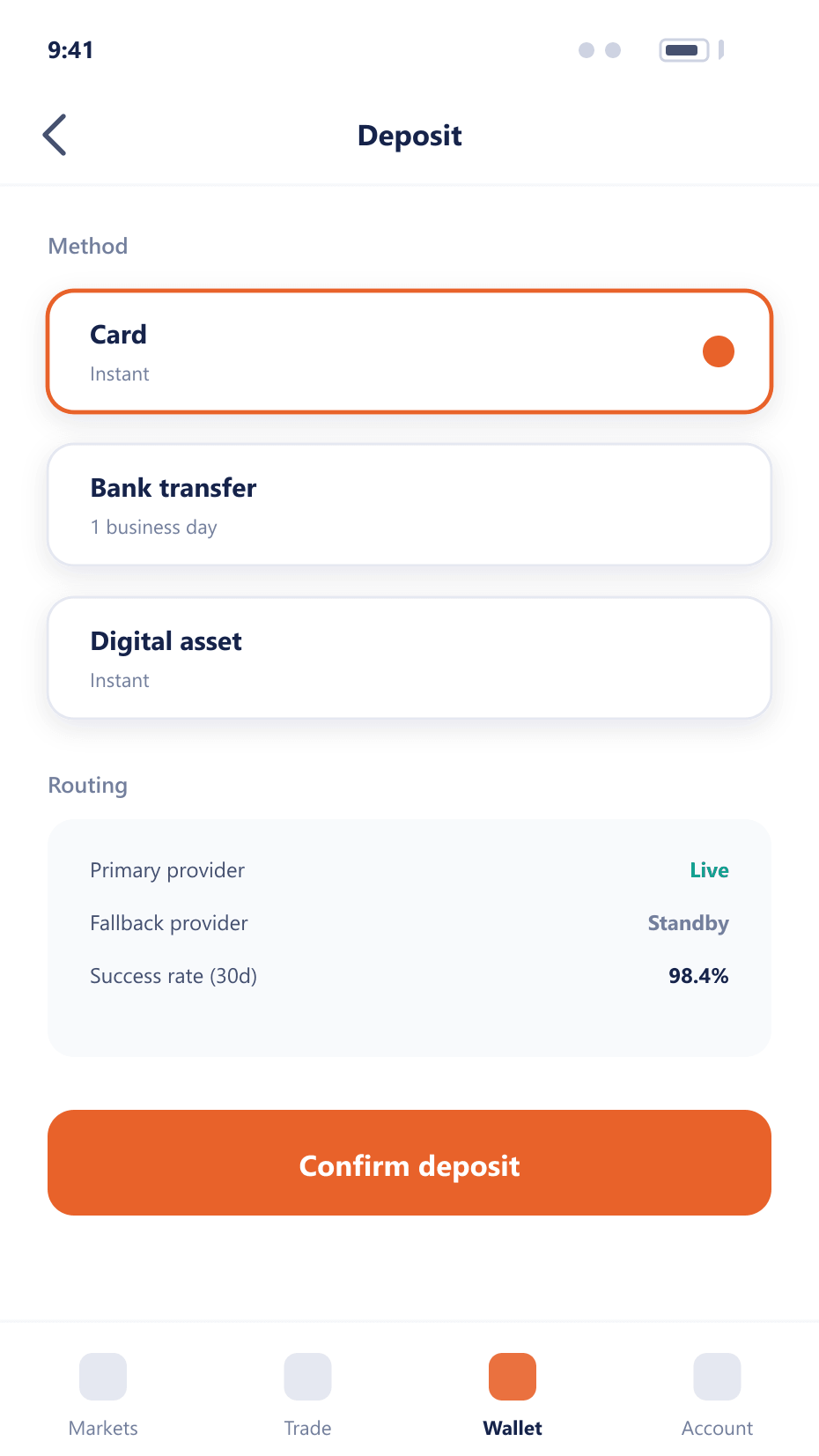
A deposit flow that stays on your domain
Checkout, method selection and confirmation branded end to end, so funding never hands the client to somebody else’s page.
Why this one matters more than it looks
Three things about payments nobody measures
A failed deposit is rarely reported
Clients who cannot fund do not open a ticket; they leave. That makes payment failure the most expensive problem in a brokerage and the one least visible in the numbers you already watch.
Routing decides the success rate
The same card can succeed through one provider and fail through another depending on corridor and issuer. Routing across several providers, with automatic retry, is what turns that from luck into a rate you manage.
Withdrawals are a trust event
How fast and how predictably money comes back is what clients tell each other about. An approval workflow with clear states beats a faster average with unexplained delays.
What you operate
Four controls, all configurable
Provider routing
Which provider handles which corridor, currency and method — changed without a release.
Approval workflow
Thresholds, who signs off and what evidence is attached, all logged.
Reconciliation
Provider statements matched against your ledger rather than by hand at month end.
Failure handling
Retries, fallbacks and a client-facing message that says what to do next.
FAQ
Payments white label: common questions
6 short answers to what teams ask before a demo.
Your own, ours, or both. The routing layer is provider-agnostic by design, because the commercial terms you negotiate with a provider are yours and should not be bundled into a software decision.
Not for checkout. The payment surface runs on your domain in your design, which is both a conversion and a trust difference against a redirect to a third-party page.
Through a workflow you configure — thresholds, approvers and the evidence attached to each decision. Every approval is logged, because money movement is where an unrecorded decision causes the most trouble later.
Yes. It connects to the client records and trading accounts you already operate, so this can fill the funding gap without touching the rest of your setup.
Traffic routes to a fallback and the client sees a message rather than a spinner. Handling this well is most of the difference between a payment layer that looks fine in testing and one that holds in production.
Yes, including conversion and on and off ramps, treated as another rail rather than as a separate system with its own reconciliation.
Still have a question?
A specialist will answer it directly, with your set-up in mind.
Ask a specialistDo you know your deposit success rate?
Most firms do not, and it is usually the cheapest number to improve. That is a better starting point than a provider comparison.