Infrastructure & Integration
Every string, every language, without a release
Translating a financial product is not a text problem. It is a terminology problem, a review problem and a delivery problem, and most localisation tooling solves only the first one.
The same value, written the way each market expects to read it. Getting this wrong is noticed long before a mistranslated sentence is.
See it live
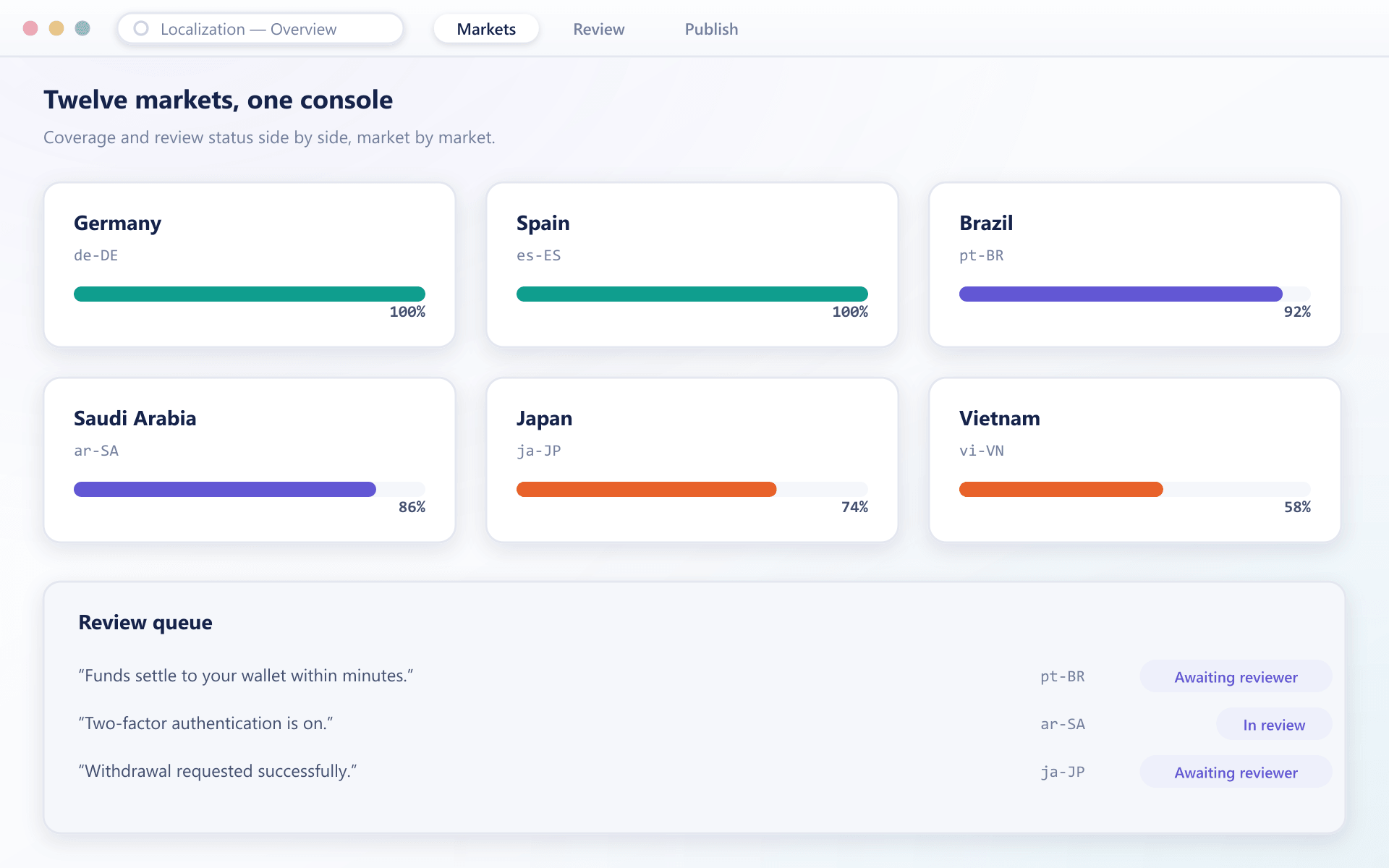
Coverage and review status, market by market
Every market shows translation coverage and review status at a glance, down to the reviewed string sitting next to its source.
Four ways localisation fails
None of them is a bad translator
Terminology drifts
The same regulated term is translated three different ways by three translators over two years, and the version a client sees depends on which screen they opened.
Right-to-left is faked
Text is reversed inside a layout that still runs left to right. Navigation, tables and charts stay where they were, and the result reads as obviously foreign.
A typo needs a release
Copy lives in the codebase, so correcting one word waits for the next deployment window. Small errors survive for weeks because fixing them is disproportionate.
Half the product is translated
The platform is localised and the emails are not, or the client area is and the statements are not. A partially translated product reads worse than an English one.
One string, end to end
From an identifier to a client screen, without a deployment
- 01
Key
The string is addressed by an identifier, never by its English text, so changing the English does not orphan every translation.
- 02
Draft
A machine draft is produced with your glossary and product context applied, as a starting point rather than an answer.
- 03
Review
A reviewer who is not the author approves it, with regulated wording requiring review by policy rather than by habit.
- 04
Publish
The change merges and reaches running applications through the API. Nothing is redeployed and nobody waits for a window.
Where this sits
The engine, not the outcome
Each product describes its own translated experience. This is the system that produces all of them, and it will serve your own applications too.
The engine
This product: key management, review workflow, glossary and delivery. It serves every MultiPrimeX product and your own applications from one source.
The result
Each product's own localisation page describes what a translated version of that product looks like. Those are outcomes; this is the machinery underneath them.
TradeX localisationFAQ
Localization Module: common questions
6 short answers to what teams ask before a demo.
The Localization Module is the MultiPrimeX translation management system for financial interfaces: key-based strings, reviewed translation workflows, a locked terminology glossary and delivery to running apps without a redeploy.
One translation source covers the trading platform, client area, mobile apps, emails, statements and your own applications, so a language is never half-applied.
Yes. Layouts mirror properly, charts and tables are direction-aware, numerals are handled per locale, and mixed-direction text is covered.
Machine translation produces a first draft with your glossary and product context applied, and every string is routed to human review before it reaches a client.
Through an API into running applications, with caching, versioning and a fallback chain, so publishing a translation is not a deployment.
Plans are based on translation keys and languages, and the module is included at no cost with any other MultiPrimeX product.
Still have a question?
A specialist will answer it directly, with your set-up in mind.
Ask a specialistSend us your densest screen
One interface full of margin, swap and liquidation wording. We will show you what it looks like translated properly, which is a more useful demonstration than a feature list.