Workflow
Nobody approves their own words
This is not a statement about trust. It is that authors read what they intended rather than what they wrote, which is why every serious review process separates the two roles.
Draft and edit inside a branch. Cannot approve or publish, including their own work.
Approve a branch for a language they are scoped to. Cannot approve what they wrote.
Change locked terms. A deliberately narrow role, usually held by compliance rather than by the localisation team.
Manage roles, languages and settings. Administrative rights do not include bypassing review.
See it live
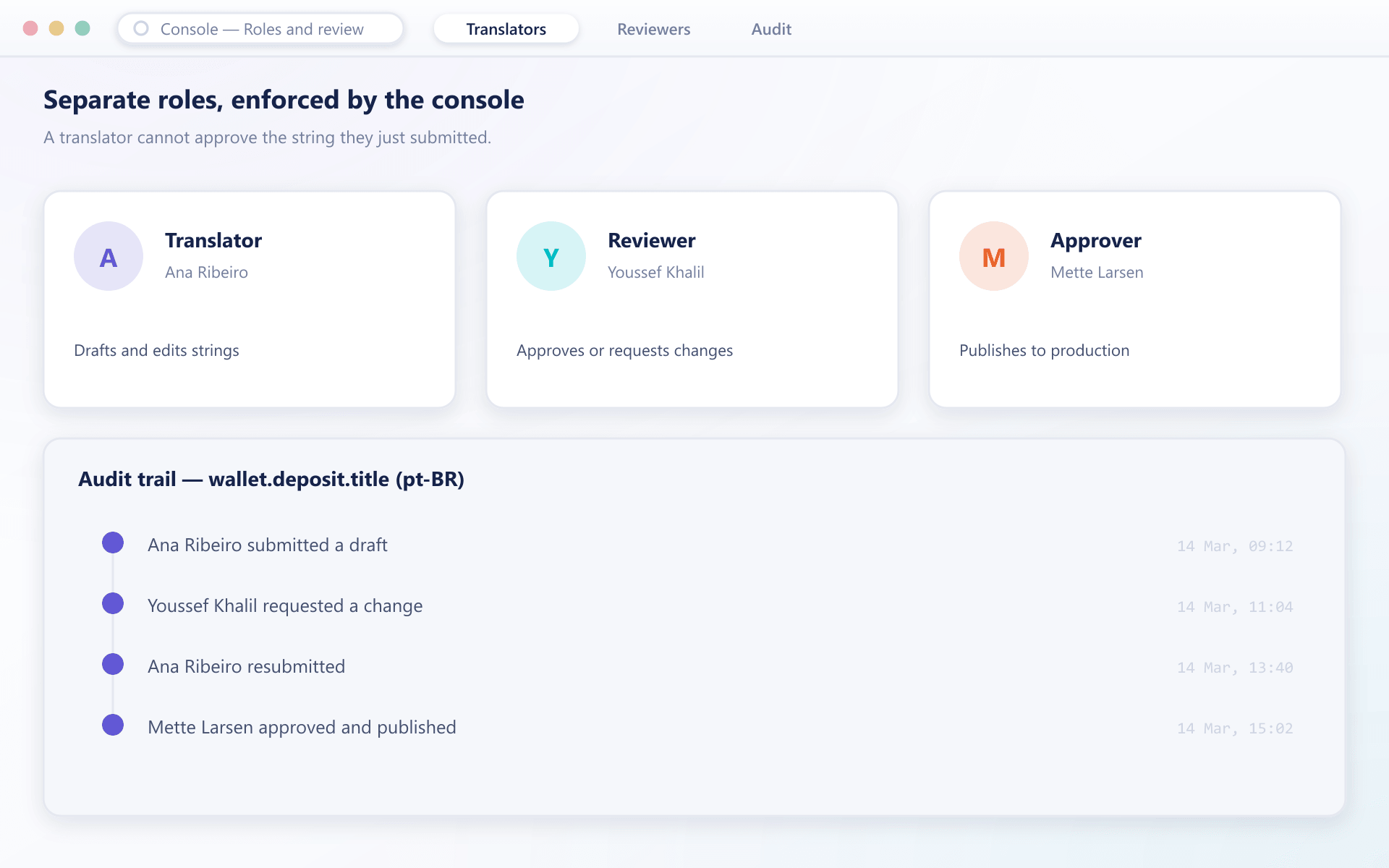
Every approval attributed, every role scoped
The review panel shows who translated, who approved and when, with a translator never able to see their own submission marked as reviewed.
Three reasons for the separation
Each one prevents a specific failure
Authors are poor reviewers of their own work
Not a comment on translators specifically. The person who wrote something reads what they meant rather than what is on the page, in any language and any discipline.
Scoping keeps expertise where it belongs
A reviewer fluent in one language should not be approving another because the interface allowed it. Language scoping makes the correct behaviour the easy one.
Compliance owns the words that matter
Regulated wording belongs with the people accountable for it. Separating the terminology owner from the localisation team is what makes that ownership real rather than nominal.
FAQ
Roles and review: common questions
6 short answers to what teams ask before a demo.
No, and the platform enforces it rather than relying on convention. It is not a comment on translators — the person who wrote something reads what they meant instead of what is on the page.
Yes. A reviewer is granted specific languages, so somebody fluent in one cannot approve another simply because the interface permitted it. The correct behaviour becomes the easy one.
Usually compliance or legal rather than the localisation team, at least for locked terms. Separating that role from the people doing translation work is what makes accountability meaningful.
No. Administrative rights cover roles, languages and settings — not publishing without approval. An administrator who can skip review makes the control optional.
Yes, with who approved what, when, and what the text was at that moment. For regulated wording this record is the point rather than a by-product.
Yes. Agency staff are given translator access scoped to their languages, so they work inside the same review structure as your own team rather than sending files back and forth.
Still have a question?
A specialist will answer it directly, with your set-up in mind.
Ask a specialistWho can change a regulated term today?
On most setups the answer is anyone with access to the file, which is not the answer compliance expects to hear.