Brokerage Operations
Rules the platform enforces, not rules you police
Every prop programme lives or dies on whether a breach is a fact or an argument. If the rule was checked after the trade, you are negotiating; if it was applied to the order, there is nothing to negotiate about.
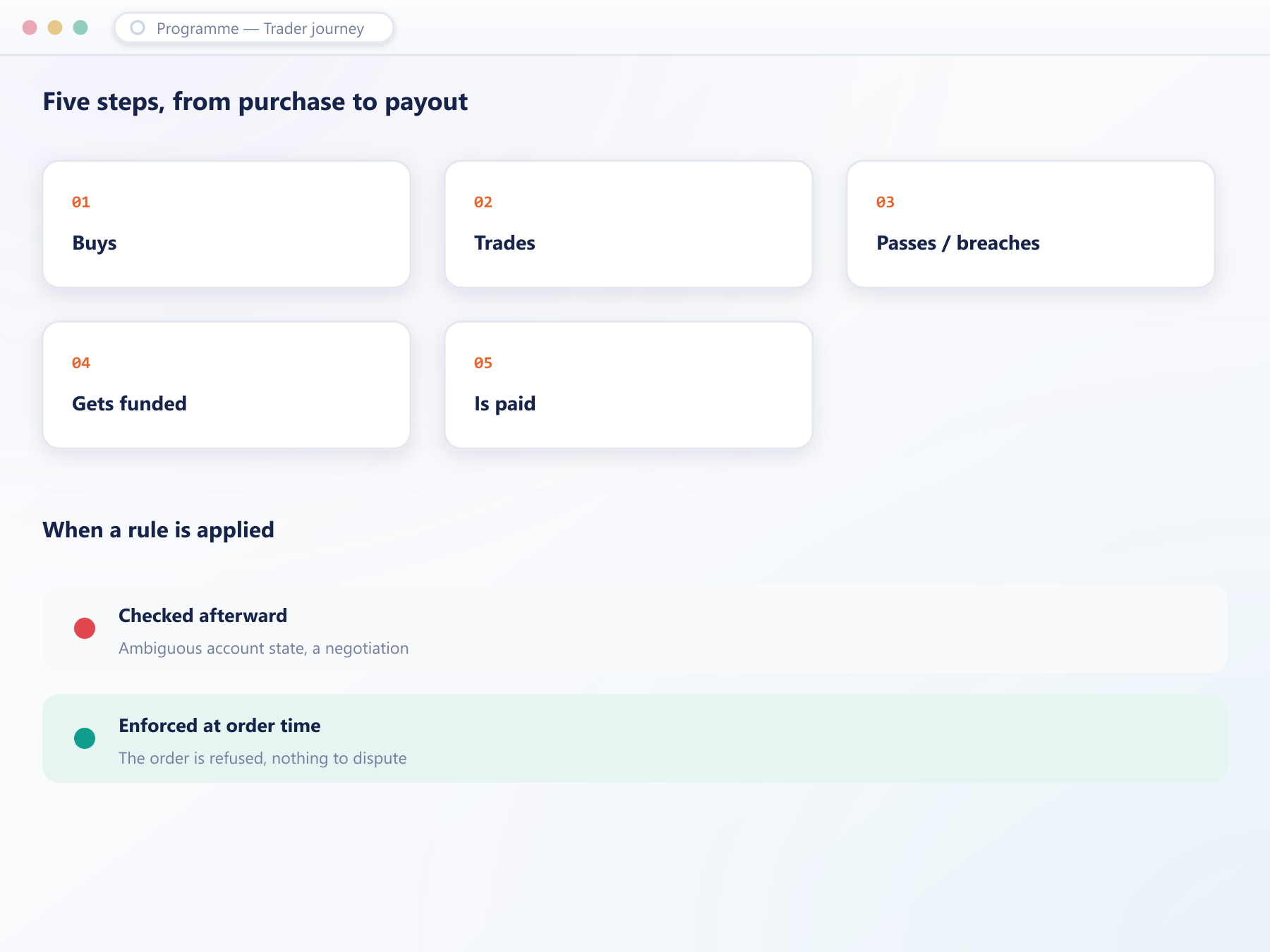
- 01Buys
A trader purchases an evaluation. The fee is revenue whether or not they pass.
- 02Trades
Rules are applied at the moment of each order rather than reviewed afterwards.
- 03Passes or breaches
Either outcome is automatic, evidenced, and defensible to the trader.
- 04Gets funded
A funded account is provisioned with the rules that continue to apply.
- 05Is paid
Payouts are checked against the programme before approval, not after.
See it live
Rules defined once, enforced at order time
Challenge tiers, drawdown limits and payout rules sit in one schedule the engine checks before an order is accepted, not after a breach is found.
The difference that decides everything
When a rule is applied
A rule reviewed at the end of the day means the trader kept trading past the breach, the account state is ambiguous, and every enforcement becomes a negotiation.
The order that would breach a limit is refused, with the rule and the threshold named. There is nothing to dispute because nothing happened.
Where the revenue comes from
Three streams, and only one of them is predictable
Evaluation fees
The predictable line. Volume-driven, independent of outcomes, and the reason challenge design has to be modelled rather than guessed.
Profit share
Your share of what funded traders make. Variable, occasionally large, and entirely dependent on the rules having been enforceable in the first place.
Retention and referral
Traders who feel fairly treated return and bring others. A programme with disputed breaches loses both, which is a slower and larger cost than the disputes themselves.
Evaluation phases are configurable from 1–3, which is one of the levers that decides how the first stream behaves.
Not the same as your own risk system
One protects the firm. The other is what you sell.
Both apply rules to trading, which is why they get confused. They answer completely different questions and most prop firms need both.
RiskDesk
Firm-wide exposure, pre-trade controls and the desk's own limits. It protects the business from what the whole client base is doing.
About RiskDeskRisk Rules & Evaluations
The rules a trader agrees to when they buy an evaluation, and the funded relationship afterwards. It is a product, not a control.
Explore
The challenge, and what happens after it
FAQ
Risk Rules & Evaluations: common questions
6 short answers to what teams ask before a demo.
Risk Rules & Evaluations is the MultiPrimeX prop trading evaluation module: challenge design, trading rules enforced by the platform at order time, defensible breach handling, funded accounts and payout controls.
Daily loss limits, maximum drawdown, position sizing, prohibited instruments, news-event windows and consistency requirements, applied when the order is placed rather than checked afterwards.
The platform acts automatically and records the evidence: which rule, which trade and the account state at the time, so the outcome can be shown to the trader without a dispute.
Yes. Profit targets, drawdown limits, duration, phases and fees can be modelled against expected pass rates before a single evaluation is sold.
Payout requests are checked against the programme rules before approval, including eligibility windows, profit-split calculation and consistency checks, with a decision record behind every payment.
A funded account is provisioned with its capital allocation, the rules that still apply and the agreed profit split, and scaling is earned on recorded performance.
Still have a question?
A specialist will answer it directly, with your set-up in mind.
Ask a specialistBring the rule set you intend to run
We will tell you which rules the engine can enforce at order time and which ones will end up in a dispute. That conversation is worth having before launch.