Evaluations
Every breach arrives with its own evidence
The dispute is never really about whether a rule was broken. It is about whether you can show it, in a way the trader recognises, without either side relying on memory.
See it live
The alert that fires at the moment it happens
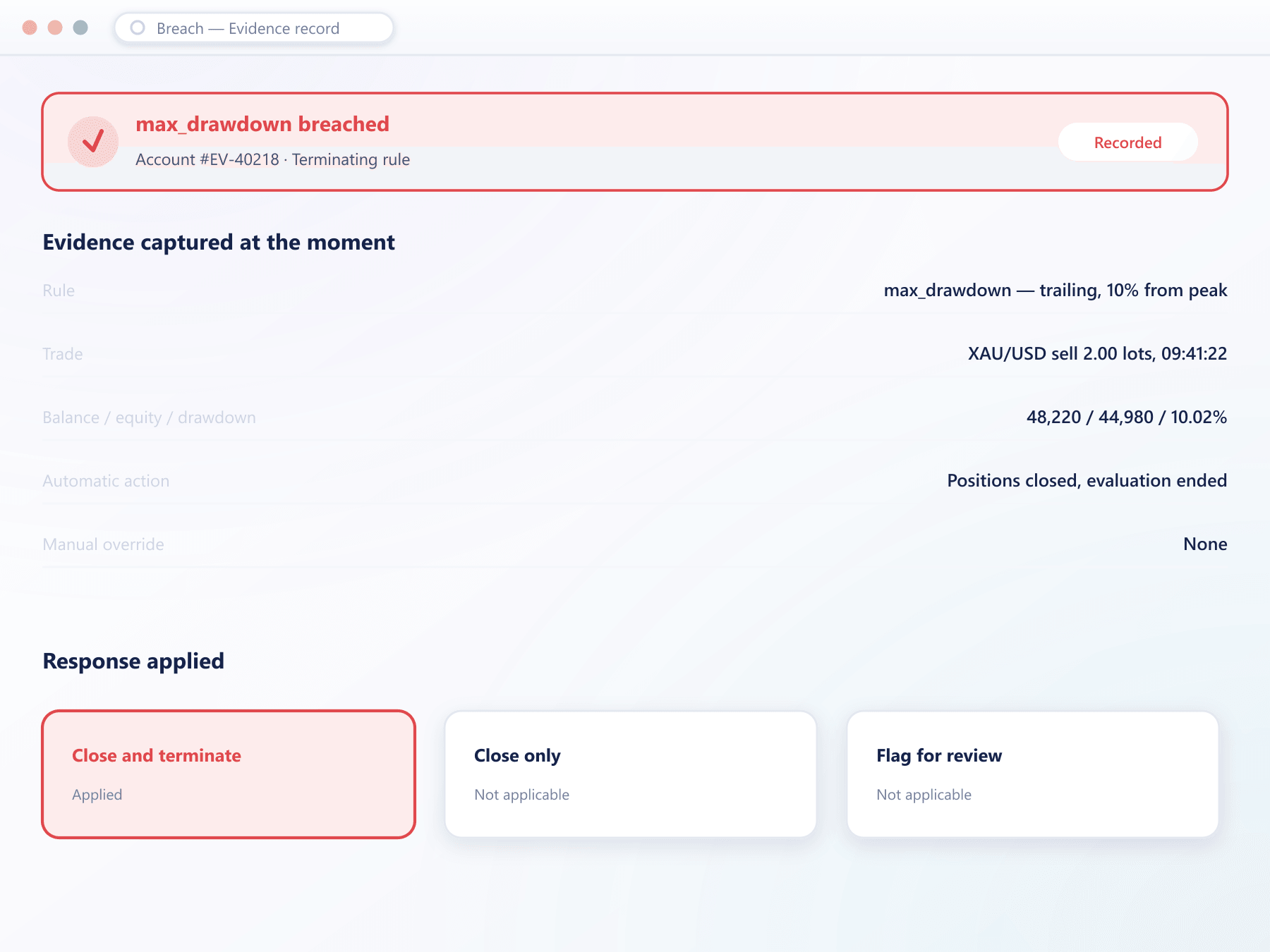
A breach shows up the instant the threshold is crossed, with the rule and the account state attached — not reconstructed afterwards from a support ticket.
What is captured
Five things, recorded at the moment rather than reconstructed
Reconstructing an account state weeks later produces a plausible answer rather than a correct one, and a trader can tell the difference.
The rule, named exactly as it appears in the terms the trader accepted
The order or position that caused it, with its exact timestamp
Balance, equity and drawdown at that instant, not at the end of the day
What the platform did automatically, and in what order
Any manual override, who made it and the reason they gave
Three responses
Not every breach should end the attempt
Close and terminate
A hard breach of a terminating rule
Positions are closed, the evaluation ends and the account is locked to further trading. The trader is notified with the evidence attached rather than left to discover it.
Close only
A softer breach, or a programme that allows recovery
Existing positions can be managed but nothing new opens. Useful where your rules allow a trader to trade back rather than ending the attempt outright.
Flag for review
A completion rule or a pattern requiring judgement
Routed to a person with the evidence assembled. For anything that cannot be assessed mechanically, a human decision with a record is better than an automatic one that is wrong.
FAQ
Breach handling: common questions
6 short answers to what teams ask before a demo.
The rule they breached, the trade that caused it, and the account state at that moment. Showing the evidence immediately is both fairer and cheaper than a support exchange days later where memories and screenshots disagree.
A decision can be overturned by someone with the authority, and the reversal is recorded as its own action with a reason. What cannot happen is a quiet change with no trace, because that is indistinguishable from the rule never having existed.
On a terminating breach, yes, unless you configure otherwise. Leaving positions open on a breached account means the outcome keeps changing while somebody decides what to do about it.
It is recorded with the market context, which is exactly the case that needs a human. Whether a gap-induced breach should stand is a policy question for your firm; the platform records enough for that decision to be made properly.
Yes. Breach records are retained for your retention period and include the account state at the time, so the question is answerable from evidence rather than recollection.
Yes, and it is worth doing. A trader who learns of a breach immediately, with the reason, complains less than one who logs in the next morning to a locked account and no explanation.
Still have a question?
A specialist will answer it directly, with your set-up in mind.
Ask a specialistHow does your last dispute read now?
If resolving it required screenshots and recollection, the record was not good enough — and the next one will go the same way.