Models
One order, many accounts, no pooling
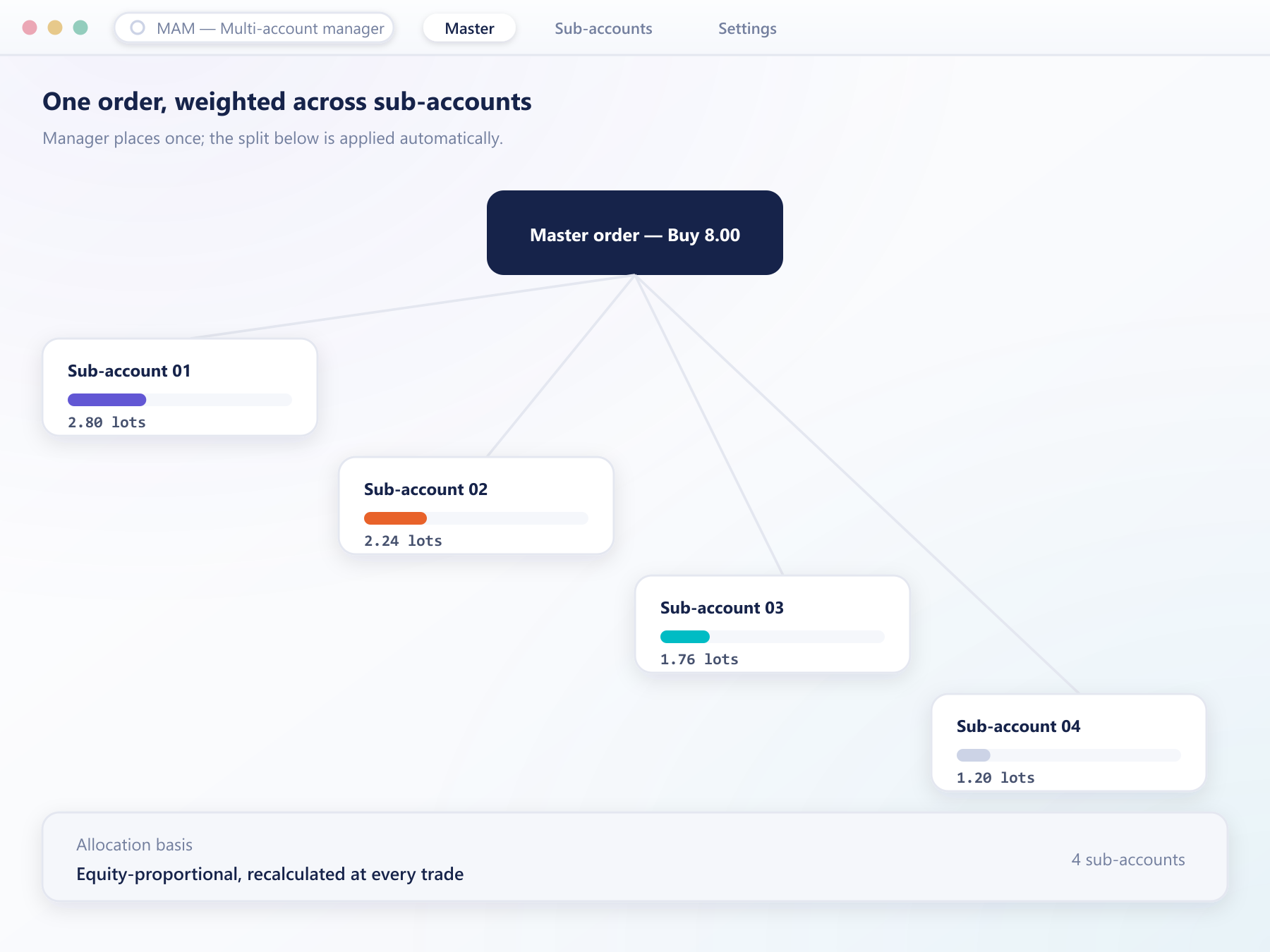
It sits between the other two, and that is genuinely where some managers need to be: one execution for fairness, separate accounts for reporting.
Own account
Separate order each
Instant
Own account
One order, allocated
By arrangement
Share of a pool
One order for the pool
At valuation
See it live
Every mandate ranked on the same fill
One order allocated across separate accounts, with each manager’s track record shown against real fills rather than a self-reported summary.
Who it suits
Three situations where MAM is the right answer
Managers with mandates
A manager running discretionary accounts for identifiable clients, each of whom needs their own statement and their own tax position. Pooling would remove exactly what those clients are paying for.
Accounts of very different sizes
Allocation by equity handles a range that copying handles badly. A large account and a small one both get a proportionate fill from the same order rather than a rounding problem.
Reporting obligations per client
Each account keeps its own history, its own statements and its own identity. Where the client relationship is individual, that is not a convenience — it is a requirement.
FAQ
MAM: common questions
6 short answers to what teams ask before a demo.
Accounts stay separate. The manager places one order and it is allocated across individual accounts, rather than trading a single pooled account and distributing shares. Each client keeps their own positions, statements and identity.
The manager places one order rather than each account generating its own. Everybody is allocated from the same execution, which removes the variation in fills that separate orders produce in fast markets.
By a configured method — equity, balance, lot ratio or a fixed proportion. Which is right depends on how similar the accounts are; equity handles a wide range of sizes best.
Handled explicitly, because it is where allocation quietly goes wrong. Without minimum-size rules a small account can be rounded to nothing and silently excluded from a trade its owner believes they are in.
Managers running discretionary mandates for identifiable clients who each need their own reporting. Where the client relationship is individual, pooling removes precisely what they are paying for.
By arrangement rather than instantly. Their positions are theirs, so unwinding is a matter of closing them — but since the manager placed the order, the exit is usually a conversation rather than a button.
Still have a question?
A specialist will answer it directly, with your set-up in mind.
Ask a specialistDoes each client need their own statement?
If yes, MAM rather than PAMM. That single question resolves the choice more often than any feature comparison does.