Asset Classes
Two groups that share a name and little else
Precious metals trade like currencies. Base metals trade like industrial contracts. Filing both under one heading is convenient on a price list and wrong everywhere else.
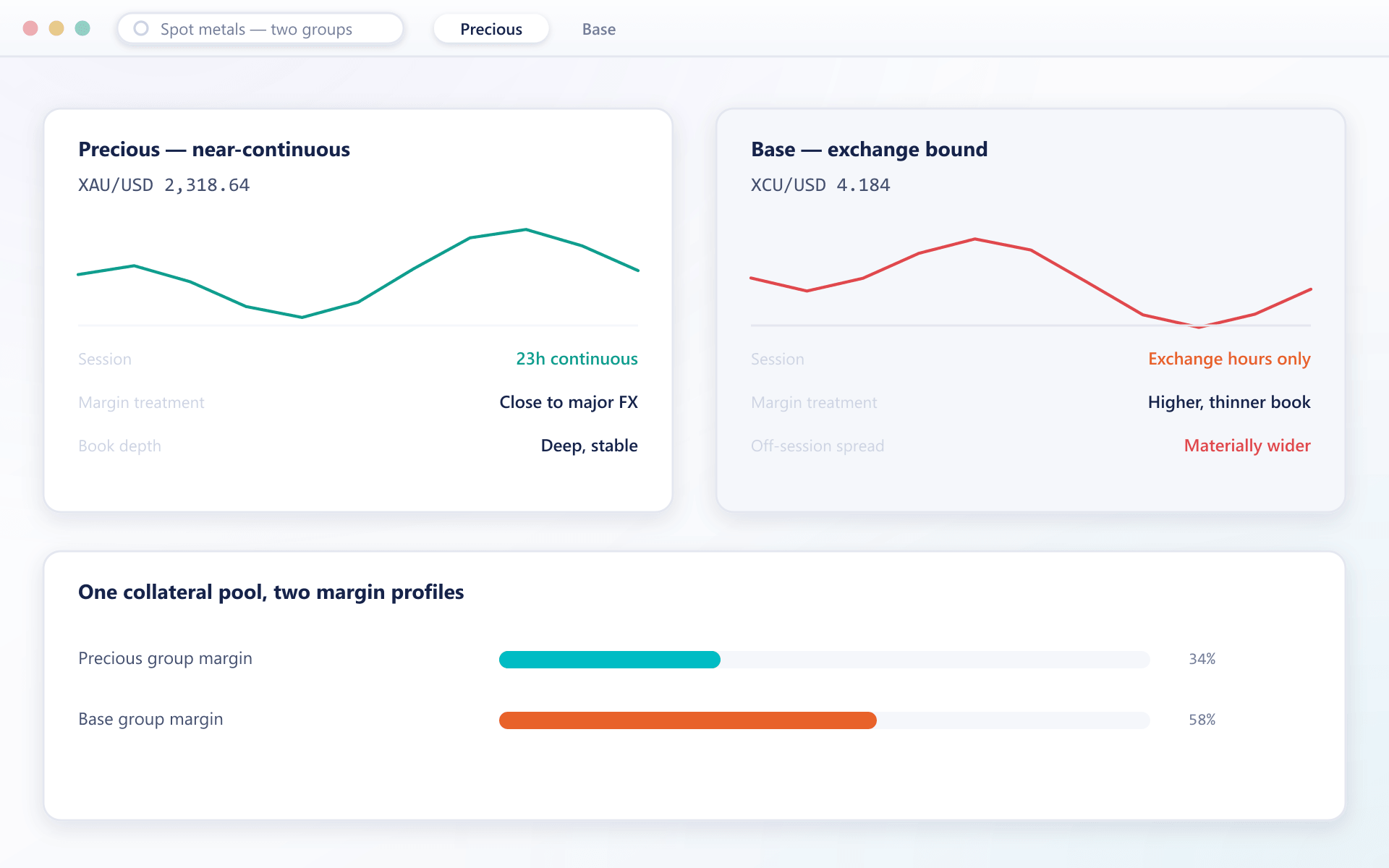
Near-continuous through the week
Bound to the listing exchange
Trades much like a currency pair
Trades like an industrial contract
Rates, currency strength, risk sentiment
Industrial demand and supply disruption
Deep, and stable outside events
Thinner, and materially wider off-session
Closer to major currency treatment
Higher, reflecting the thinner book
What it means operationally
Three consequences of treating them as one group
The precious group is not a commodity in practice
It behaves like a currency, prices around the clock and reacts to the same macro inputs. A desk that files it under commodities and applies commodity session rules to it will be quoting a closed market that is in fact wide open.
Base metals thin out sharply off-session
Inside exchange hours the book is workable. Outside them it is not, and a quote that stays tight through the gap is a quote that will be rejected the moment somebody tries to hit it in size.
One collateral pool, two margin profiles
The two groups carry different requirements because they carry different risk, but both draw on the same consolidated account rather than each demanding its own funded balance.
See it live
Precious and base metals, priced on their own terms
Near-continuous precious-metal pricing and exchange-bound base-metal pricing shown side by side, each with its own spread and margin.
FAQ
Spot metals: common questions
6 short answers to what teams ask before a demo.
Because operationally they are different markets. The precious group prices near-continuously and responds to macro inputs; the base group follows exchange hours and responds to industrial demand. Applying one set of rules to both produces the wrong session calendar and the wrong margin.
Close to it through the trading week, which is why they behave more like a currency pair than like the rest of the commodity complex. That is a genuine difference and the platform treats it as one.
Materially wider, because the book genuinely thins. We would rather show that than quote through it, since a tight price nobody will honour costs more than an honest wide one.
For the precious group it is close. For the base group it is higher, reflecting a thinner book and sharper reaction to supply news. Both draw collateral from the same consolidated account.
Spot, which is what separates this page from energies. There is no expiry to manage and no rollover cost, so a position can be held without a calendar event forcing a decision.
The liquid ones in each group. A short list quoted well is more useful than a long one where half the entries widen dramatically the first time somebody trades size.
Still have a question?
A specialist will answer it directly, with your set-up in mind.
Ask a specialistWhich group are you actually trading?
The answer changes the session calendar, the margin and the spread you should expect. Tell us the metals and we will quote each one on its own terms.