Platform comparison
Three ways to run a platform, and none of them is wrong
Most comparison pages are written by whoever benefits from one answer. This one is not. Below are the three routes a brokerage can take, the criteria that actually separate them, and an honest note on where each one costs you something.
See it live
The same modules, whichever route you pick
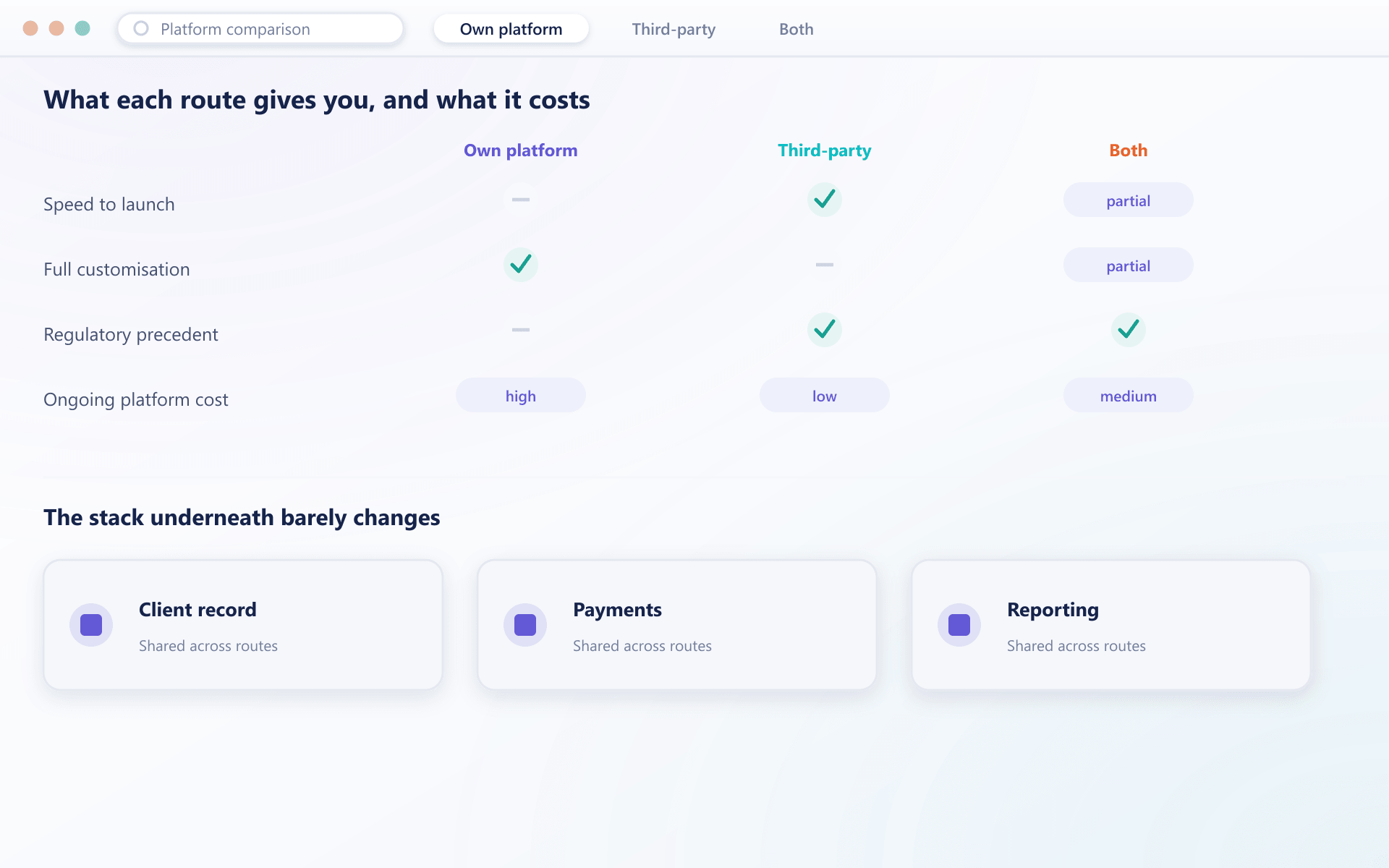
Client record, payments and reporting stay identical underneath — this is the module layout that barely changes no matter which front end you land on.
The three routes
What each one gives you, and what it takes back
Run your own platform
A terminal that carries your brand, your instrument list and your account model, with the matching engine and admin console underneath it.
- Suits
- Brokers who want the interface to be part of the product rather than a commodity every competitor also ships.
- You gain
- The roadmap. What ships next is your decision, not a vendor release cycle.
- It costs you
- Traders arriving from elsewhere have to learn a new screen. That is a real acquisition cost and it should be planned for, not dismissed.
Integrate a third-party platform
Keep the platform your target traders already know, and put the integration, configuration and monitoring work on us.
- Suits
- Brokers entering a market where traders arrive with a platform preference already formed.
- You gain
- Familiarity. Nobody has to be taught where anything is, which shortens the path from signup to first trade.
- It costs you
- You inherit someone else's release cycle and licensing terms. Anything you want changed in the terminal itself is a request, not a decision.
Run both side by side
Offer the familiar platform to traders who ask for it and your own terminal to everyone else, with one client record and one back office behind both.
- Suits
- Brokers with an existing book on a third-party platform who want their own terminal without forcing a migration.
- You gain
- Optionality. You can move traders across when they are ready rather than on a cut-over date.
- It costs you
- Two front ends to support and two sets of behaviour to explain. It only stays manageable because the account layer underneath is shared.
Side by side
The criteria that actually separate them
Feature checklists rarely decide this. These eight do, and every one of them is answered differently depending on the market you are entering.
New interface to learn
Already known to the target trader
Trader picks
Yours
The platform vendor's
Split by front end
Branding, layout and instrument presentation
Within what the platform exposes
Full on one, bounded on the other
None beyond your own stack
The platform vendor's terms apply
Applies to the third-party side only
Configuration of a stack that is already built
Integration and certification against your environment
Sequenced — one route goes live first
One vendor for platform and back office
Split between platform vendor and us
Split, with one client record
Traders must be moved
None if they are already there
Deferred until you choose
Predictable against your own stack
Carries third-party licensing
Both, until you consolidate
What you actually deploy
The rest of the stack barely changes
Whichever front end you land on, the client record, payments and reporting underneath it are the same. That is why this decision stays reversible.
Before you decide
Three things worth saying out loud
The interface is not usually the deciding factor
Traders leave over funding delays, execution they do not trust and support that does not answer. A better terminal does not rescue a brokerage that is weak on those three, and a familiar one does not sink a brokerage that is strong on them.
Familiarity is worth more in some markets than others
In markets where traders arrive with a platform already in mind, asking them to learn a new one is a real cost. In markets where they are new to trading entirely, that cost is close to zero and the calculation changes completely.
This decision is reversible, and it should be
Because the client record, payments and back office sit underneath both routes rather than inside either one, changing your mind later means changing a front end — not rebuilding a brokerage.
FAQ
Choosing a platform: common questions
6 short answers to what teams ask before a demo.
It depends far more on the market than on the technology. Brokers targeting traders who already have a platform preference tend to integrate first; brokers building a new audience tend to start with their own terminal. Neither pattern is a recommendation for your case.
Yes, and that is the reason the account model, payments and back office are shared rather than built into either front end. Changing route means changing what the trader sees, not migrating the brokerage.
No. One client record, one set of documents and one wallet sit behind both front ends, which is what keeps the two-platform setup manageable rather than doubling your operations work.
No. It means the terminal is configured for you rather than licensed from a third party. The engineering is already done; what you decide is the instrument list, the account model, the branding and what ships next.
Integration and configuration against your environment, connection into your back office and client area, and ongoing monitoring. The platform itself remains its vendor's product under its vendor's terms.
Tell us the market you are entering, whether you already have a trading book, and where your traders are coming from. Those three answers narrow it to one route more often than any feature list does.
Still have a question?
A specialist will answer it directly, with your set-up in mind.
Ask a specialistTell us the market, not the feature list
Which jurisdiction, which traders, and whether you already have a book to protect. We will tell you which of the three routes fits and, more usefully, which one does not.