White label
An investment product without building an allocation engine
Copy trading turns a brokerage into somewhere clients can invest rather than only trade. The engine, the fee handling and the risk limits arrive built; what you supply is the brand and the managers.
Each follower trades their own account
Retail clients who want to stay in control
One pool, one execution, proportional shares
Managers running a single strategy at scale
One order allocated across segregated accounts
Clients who must keep their own statement
See it live
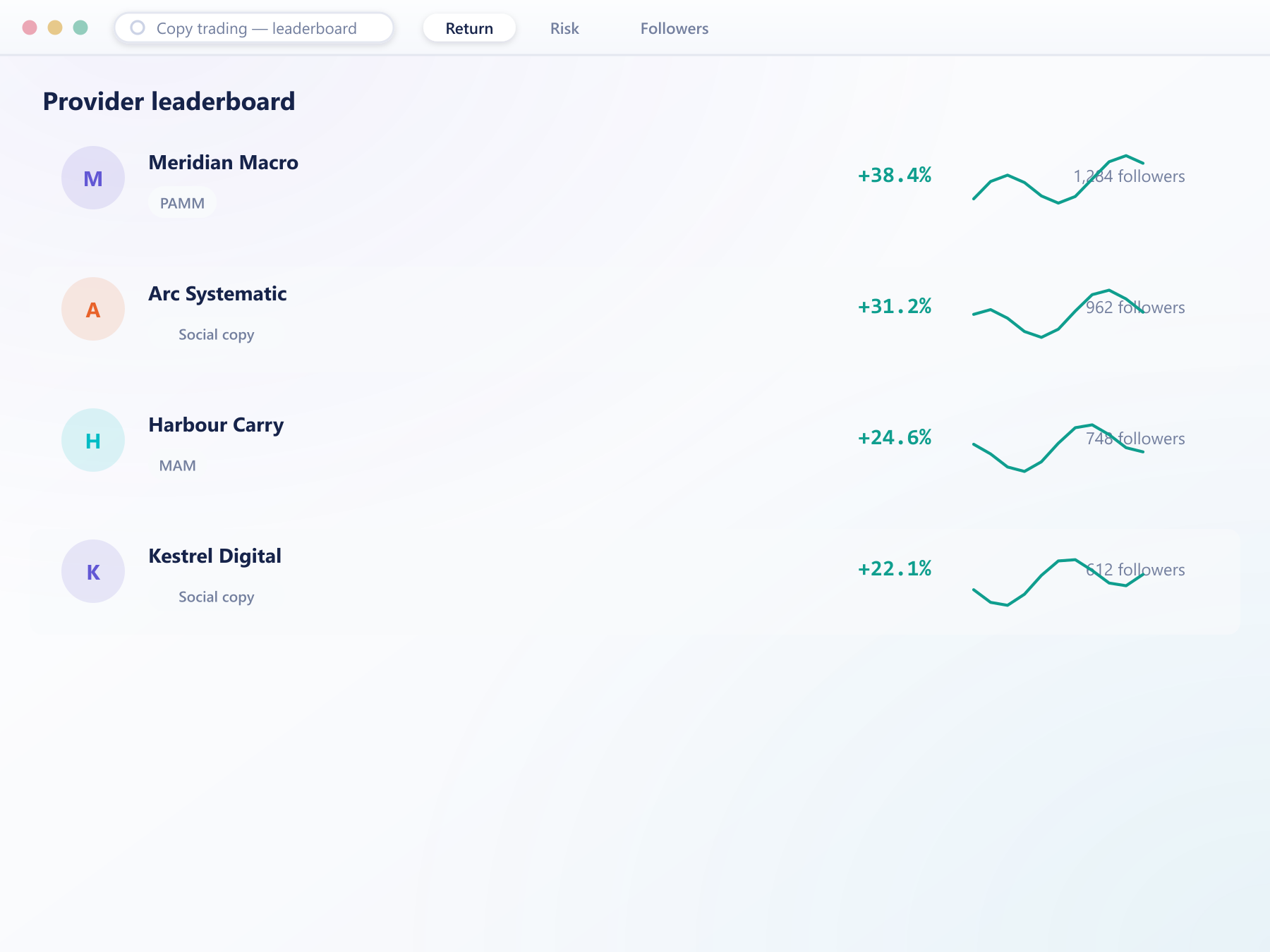
Providers ranked the way a follower actually decides
Track record, drawdown and consistency shown side by side, so an allocation decision is made on performance rather than on which name is listed first.
Under your brand
Everything the investor sees
Investment area
Your domain and brand, from browsing providers to allocating funds.
Performance display
Track records presented your way, with the disclosures you require.
Investor statements
Allocation, fees and results in your format and under your name.
Notifications
Allocation, breach and payout alerts sent from you.
What running it involves
Three responsibilities that come with the product
Providers have to be onboarded, not just listed
Anyone whose track record is shown to your clients is effectively being recommended by you. Approval, review and the ability to suspend a provider are the parts that protect the brand.
Fees are the product's commercial shape
Performance fees, management fees and your own share are configured per programme. Getting this wrong quietly is how an investment product becomes popular and unprofitable at the same time.
Risk limits protect the follower and you
Maximum allocation, drawdown stops and instrument restrictions apply per follower rather than per provider, so one aggressive strategy cannot take a conservative client with it.
FAQ
Copy trading white label: common questions
6 short answers to what teams ask before a demo.
Often more than one. Social copying suits retail clients who want to keep control, PAMM suits a manager running one strategy at scale, and MAM suits clients who need their own statement. All three run on the same engine.
Yes, and that is the real work in this product. The platform handles onboarding, approval, performance tracking and suspension; finding managers worth showing to your clients is a commercial job that stays with you.
In your clients' eyes, effectively yes, whatever the disclosure says. That is why approval and review workflows exist here, and it is worth treating listing as a decision rather than an automatic consequence of signup.
Performance fee, management fee and your own share are all configured per programme, calculated automatically and shown to both sides. A fee a client cannot verify becomes a support ticket.
Yes. It connects to the trading accounts you already operate, so this can be an added product rather than a replacement for anything.
Pooling client funds is treated differently from copying trades in most jurisdictions, and sometimes very differently. That is a question for your counsel before it is a configuration question for us.
Still have a question?
A specialist will answer it directly, with your set-up in mind.
Ask a specialistStart with the managers, not the models
Who you can credibly list decides which models make sense. Tell us that and the rest of the configuration follows.