Models
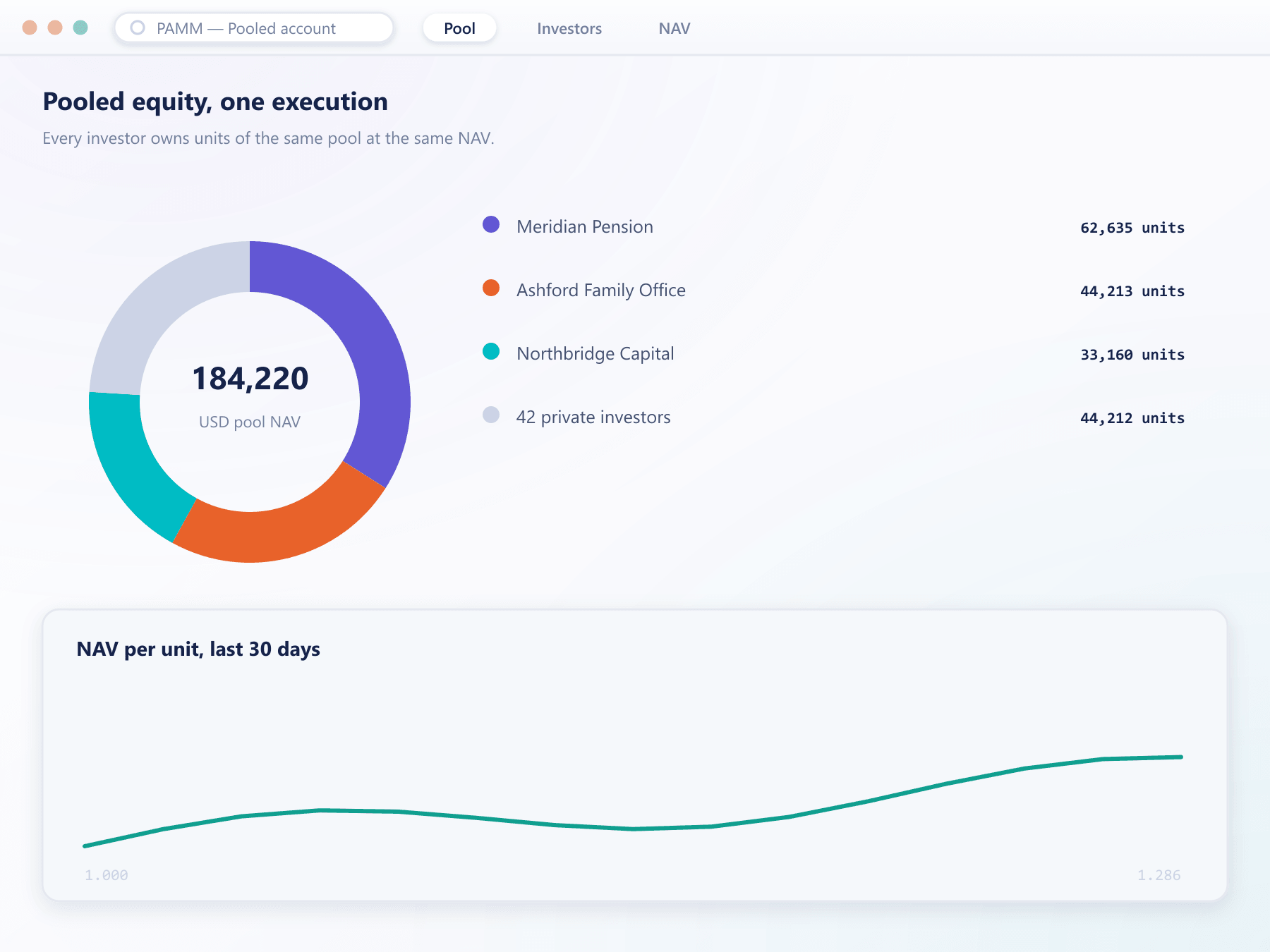
One pool, one execution, one price for everybody
The most efficient of the three models and the heaviest to license. Every investor gets the same fill because there is only one fill, which is exactly why it looks like fund management to a regulator.
- 01Contribute
An investor adds capital and receives a share of the pool calculated at the current valuation.
- 02Trade
The manager trades the pool as one account. One order, one fill, one price for everybody.
- 03Value
The pool is revalued on a defined schedule, and each share moves with it proportionally.
- 04Distribute
Profit and loss reach investors by share, with fees applied against the high-water mark.
See it live
Pool managers ranked on the same fill everyone received
Because every investor in a pool gets the same execution, the leaderboard reflects exactly what an investor entering today would actually experience.
What pooling buys you
Three genuine advantages over copying
Everyone gets the same price
One execution for the whole pool means no investor gets a worse fill than another. In social copying, a hundred separate orders in a fast market produce a hundred slightly different outcomes.
Efficient at size
One order rather than a hundred is lighter on the platform and on the market. It is the model that scales best when a strategy attracts serious capital.
The manager trades once
No allocation logic between the decision and the market. For a manager running size, this is materially simpler than watching an order fan out across accounts.
What it costs you
Three obligations that come with the efficiency
It is closer to fund management
Pooling other people's money and trading it as one account looks like collective investment to most regulators. That is a licensing question and it should be settled before the product one.
Valuation timing matters
When the pool is revalued determines what an entering or exiting investor receives. It has to be defined, disclosed and applied consistently rather than decided case by case.
The high-water mark is not optional
Without it, a manager charges performance fees on the same profit twice after a drawdown and recovery. Investors notice, and it is the fastest way to lose a pool.
FAQ
PAMM: common questions
6 short answers to what teams ask before a demo.
By their contribution against the pool's valuation at the moment they entered. From then on, the share moves proportionally with the pool, which is what makes the outcome identical in percentage terms for everybody.
It is the previous peak value the manager was last paid on. Without it, a pool that falls and recovers generates a performance fee on the same profit twice. Investors notice this quickly and it destroys trust in the manager.
Usually, and it is the most important question on this page. Pooling client money and trading it as one account resembles collective investment management in most jurisdictions. Settle the licensing question before the product one.
At the next valuation point, on whatever schedule you define. Unlike social copying there is no instant exit, because leaving means the pool has to be valued and a share redeemed.
Yes, and investors generally expect it. A manager with their own capital at risk alongside the pool is a stronger proposition than one earning only from fees.
Every share falls proportionally, and no performance fee accrues until the high-water mark is regained. Your own risk limits still apply on top, because a manager having a bad month is a firm exposure as well as an investor one.
Still have a question?
A specialist will answer it directly, with your set-up in mind.
Ask a specialistDoes your licence cover pooling?
It is the first question on this model and the one most likely to change the answer. Worth asking before any of the product conversation.