Turnkey
Your own order book, not somebody else’s
An exchange is a different business from a brokerage. Clients trade with each other rather than with you, which changes the technology, the licence and — more than anything — what makes the launch succeed or stall.
See it live
An order book, not a dealer’s price feed
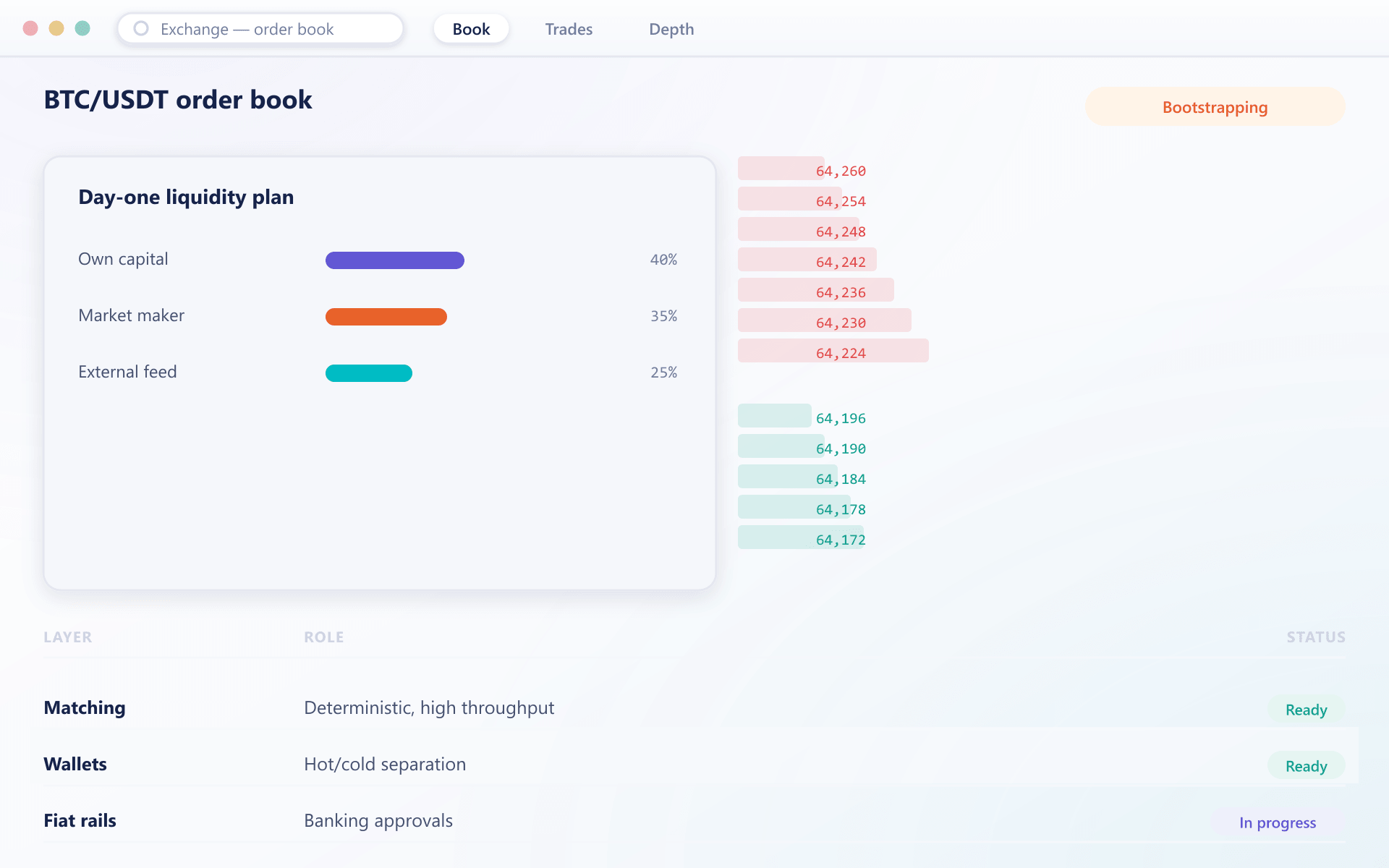
Bids and asks meeting directly, with the depth that tells a trader whether the exchange is actually liquid.
The four layers
What an exchange is actually made of
Orders meet each other rather than a dealer
Determinism and throughput matter more than features
Assets are received, held and released
Hot and cold separation is the whole security design
Who is allowed to trade, and from where
Jurisdiction rules applied at signup, not after
Money enters and leaves
Usually the longest lead time in the whole project
The part nobody sells you
Getting the first trades onto an empty book
The matching engine is the easy half. What decides whether an exchange launches successfully is whether there is anything to trade against on the first day.
An empty book is the real launch problem
Matching engines are solved technology. What stops most exchanges is that the first traders arrive, see nothing on either side, and leave. That has to be planned for before launch rather than discovered afterwards.
Market making is an arrangement, not a feature
Depth on day one comes from somebody committing to quote. Whether that is your own capital, a hired firm or an external feed is a commercial decision, and the platform supports all three.
External liquidity can seed a book
Aggregated pricing from other venues can populate the book while organic flow builds. It is a legitimate bridge, provided it is understood as one rather than mistaken for real depth.
Where the money comes from
Four revenue lines, all configurable
Trading fees
Maker and taker schedules, tiered by volume or account type.
Deposit and withdrawal
Network and processing fees, set per asset and per rail.
Conversion
Spread on fiat and asset conversion, priced as a service rather than buried.
Listings
Fees for admitting an asset, with the review process that should accompany them.
Worth being clear about
Three things this package does not give you
Operating an exchange is heavily regulated
In most jurisdictions this is the most demanding licence on this site. The platform is configured against what you hold; obtaining it is a long, expensive process that belongs to you and your counsel.
You are holding other people's assets
Custody obligations do not transfer to a software vendor. Key management, insurance and proof of reserves are yours to operate, and the platform gives you the tooling rather than the responsibility.
Liquidity does not come with the software
This is the honest version of the biggest question about launching an exchange. We can help you structure market-making and external feeds, but no vendor can hand you a liquid book.
FAQ
Exchange turnkey: common questions
6 short answers to what teams ask before a demo.
A broker quotes a price and takes the other side or passes it on. An exchange runs an order book where clients trade with each other. That single difference changes the technology, the regulation and, most of all, the launch problem.
Through a market-making arrangement, your own capital, external aggregated pricing, or a combination. None of these comes free with the software, and any vendor suggesting otherwise is selling you a matching engine and calling it an exchange.
Wallet and custody infrastructure is, including hot and cold separation and approval workflows. The operational responsibility for holding client assets stays with you, because that is not something a software arrangement can transfer.
Payment rails are integrated through the payments layer. Realistically this is the longest lead time in the project, because banking and provider approvals for an exchange take longer than the technical work.
Technically yes. Whether you should is a compliance and reputational question, and the platform includes a listing workflow so that decision is recorded and reviewed rather than made ad hoc.
More than a launching exchange will generate, which is deliberately not the interesting question. Determinism, correct ordering and clean recovery after a fault matter far more at your stage than a headline throughput number.
Still have a question?
A specialist will answer it directly, with your set-up in mind.
Ask a specialistTell us your liquidity plan first
If there isn’t one yet, that is the conversation worth having before any technical scoping. We would rather raise it now than after the build.