Turnkey
A brokerage, assembled and handed over
A turnkey package is the same products you could buy separately, with the integration already done and one party accountable for the whole thing. The value is not the software; it is that nobody has to argue about whose problem a cross-system failure is.
From contract to console
A deployment timeline, not an open-ended build
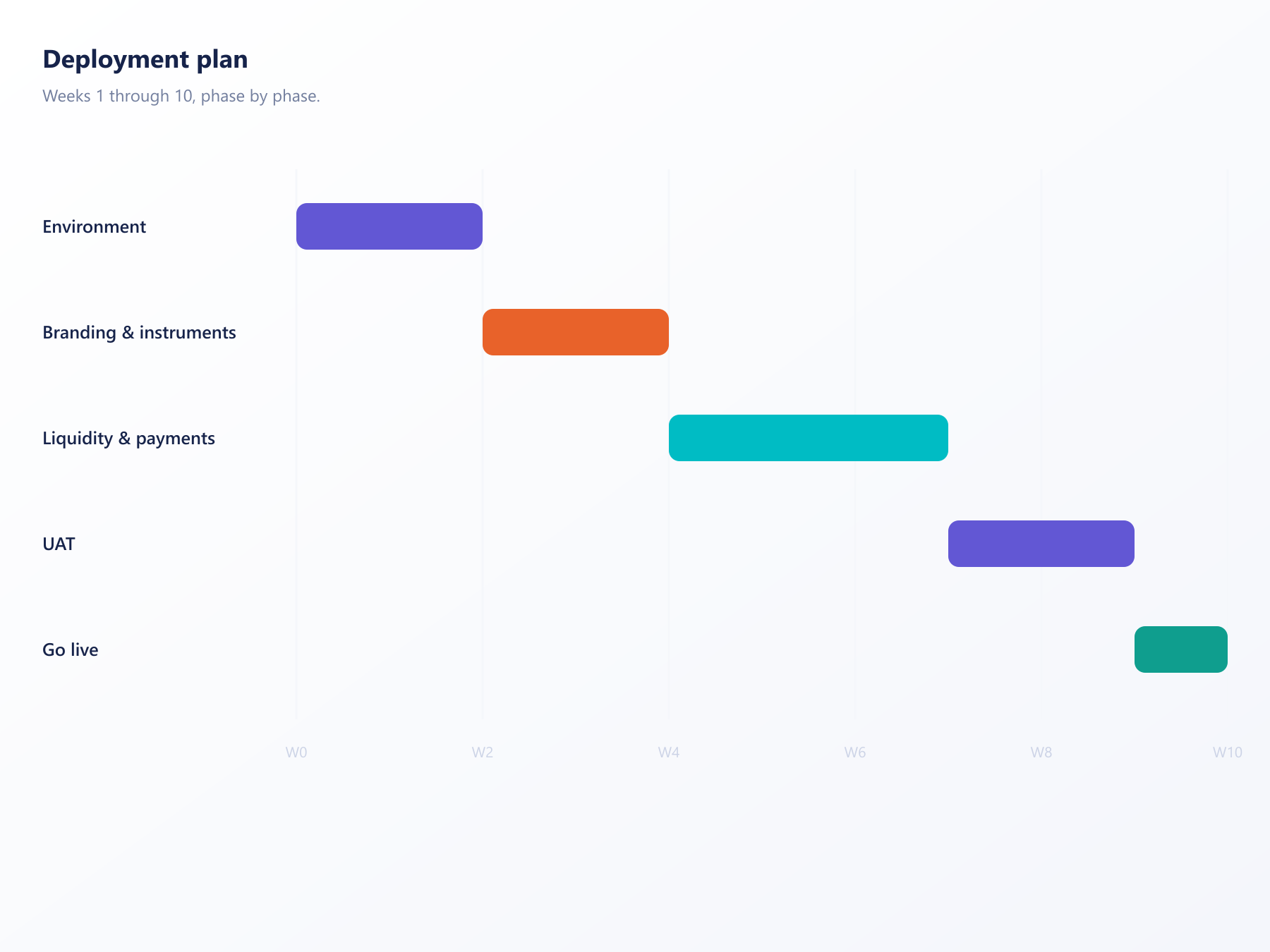
Every package follows the same staged rollout, so you know what happens in week one versus week eight before you sign anything.
The packages
Five shapes, and none of them is fixed
These are the businesses people most often come to us to launch. Each one is a starting configuration that gets adjusted to what you are actually building.
In every package
What does not change between them
One account model underneath
Client records, wallets and trading accounts mean the same thing across every product in the package, which is what keeps a five-product deployment from behaving like five deployments.
Configured for your jurisdiction
Onboarding rules, document requirements and reporting are set against where you are licensed rather than against a generic default you then have to unpick.
Your brand, end to end
The trader never sees our name. Terminal, client area, statements and emails all carry yours.
Swap-free accounts where you need them
Account groups can be configured without overnight financing, with the administrative fee model that replaces it set by you. It is a jurisdiction and client-base requirement rather than an add-on, so it is part of the standard configuration.
One party accountable
When something breaks across two products, there is no argument about whose problem it is. That is most of what a package is actually buying you.
How a deployment runs
Four stages, and the first one decides the other three
Scope
Jurisdiction, instruments, client types and which products the business actually needs. Packages are a starting shape, not a fixed bundle.
Configure
Instrument lists, account groups, margin, onboarding rules and payment routes set against your business rather than a template.
Connect
Liquidity, payment providers and any third-party systems you already run are integrated and certified before anything goes live.
Go live
A staged cutover with your team trained on the administration console, not a handover document and a wish of good luck.
indicative only — confirmed once scope is agreed
Worth being clear about
Three things a package does not give you
A licence
We configure the stack for the jurisdiction you are licensed in. Obtaining that licence is your work, and any provider implying otherwise is describing something they cannot deliver.
Clients
A package gives you the machinery to serve clients well. It does not bring them. Acquisition remains the hardest and most expensive part of launching, and it stays yours.
A risk policy
The tooling to run A-book, B-book or a hybrid is included. Deciding which one your business runs, and at what limits, is a commercial judgement we can advise on but not make.
Where the money comes from
Six revenue lines, and most desks underestimate two of them
A package gives you the machinery for all of these. Which ones you actually run is a commercial decision, and it is worth making deliberately rather than defaulting into spread alone.
Spread markup
A markup applied over the aggregated price, set per instrument and per client group. It is the most common earner and the easiest to get wrong, because a markup that looks small on majors is uncompetitive on a thin pair.
Commission per volume
A charge per lot or per notional traded, alongside a tighter spread. Institutional clients usually prefer this shape because it separates the price of the instrument from the price of your service.
Overnight financing
The difference between the swap you are charged and the swap you pass on. Carrying clients hold positions for days, so this compounds quietly in a way the daily numbers do not show.
Partner and IB rebates
A share of what a referred client generates, paid out of your own revenue. It is a cost line that buys distribution, and the package meters it so you can see what each partner actually returns.
Risk retained on the book
What you keep rather than hedge. It is the largest and most volatile of these, which is exactly why it belongs behind limits rather than behind optimism.
Payment and conversion
A margin on deposits, withdrawals and currency conversion. Small per transaction, and material once volume arrives.
Your brand, concretely
Six places our name would otherwise appear
What we can introduce you to
Help that is an introduction, not a promise
Licensing partners
We do not obtain your licence and will not claim to. We can introduce you to firms who handle applications in the jurisdictions our clients commonly use, and configure the stack for whichever one you land in.
Banking and payment relationships
Introductions to banking and payment partners who work with regulated brokers. Whether they accept you depends on your licence, your jurisdiction and your own diligence, not on our introduction.
Payment providers already integrated
The payment layer arrives with a catalogue of providers already connected, so onboarding one is a commercial conversation and a configuration change rather than an integration project.
FAQ
Turnkey packages: common questions
6 short answers to what teams ask before a demo.
The products are the same. What a package adds is that the integration between them is already done, configured against one jurisdiction and one account model, with one party accountable when something spans two systems.
Yes, and most deployments do. The five packages are the shapes that come up most often rather than fixed bundles. If you already run a CRM you are happy with, that piece comes out and the rest is configured around it.
It depends far more on your licence, your payment provider approvals and your instrument list than on the software. We give a window once the scope is settled rather than quoting one before we know what is being built.
Not to run it. You need someone who owns the commercial configuration — instruments, margin, fees, onboarding rules — because those are business decisions that live in the administration console rather than in code.
Either. Managed hosting is available, and if your infrastructure already sits where it needs to be relative to your providers, we administer the platform on it instead.
Monitoring, configuration changes and incident response continue under an agreed arrangement. A package that ends at go-live is a project, not a platform, and the difference shows up in the first month.
Still have a question?
A specialist will answer it directly, with your set-up in mind.
Ask a specialistStart with the business, not the package
Tell us the jurisdiction, the clients and whether you already have a book. The right package usually falls out of those three answers.