Turnkey
Price it yourself and distribute to others
Moving from consuming liquidity to providing it changes what your business is. You stop being somebody’s client and start carrying their exposure, which is a larger shift than the technology suggests.
You are a client
You are the provider
They are your clients
See it live
Aggregated depth, priced and distributed from one book
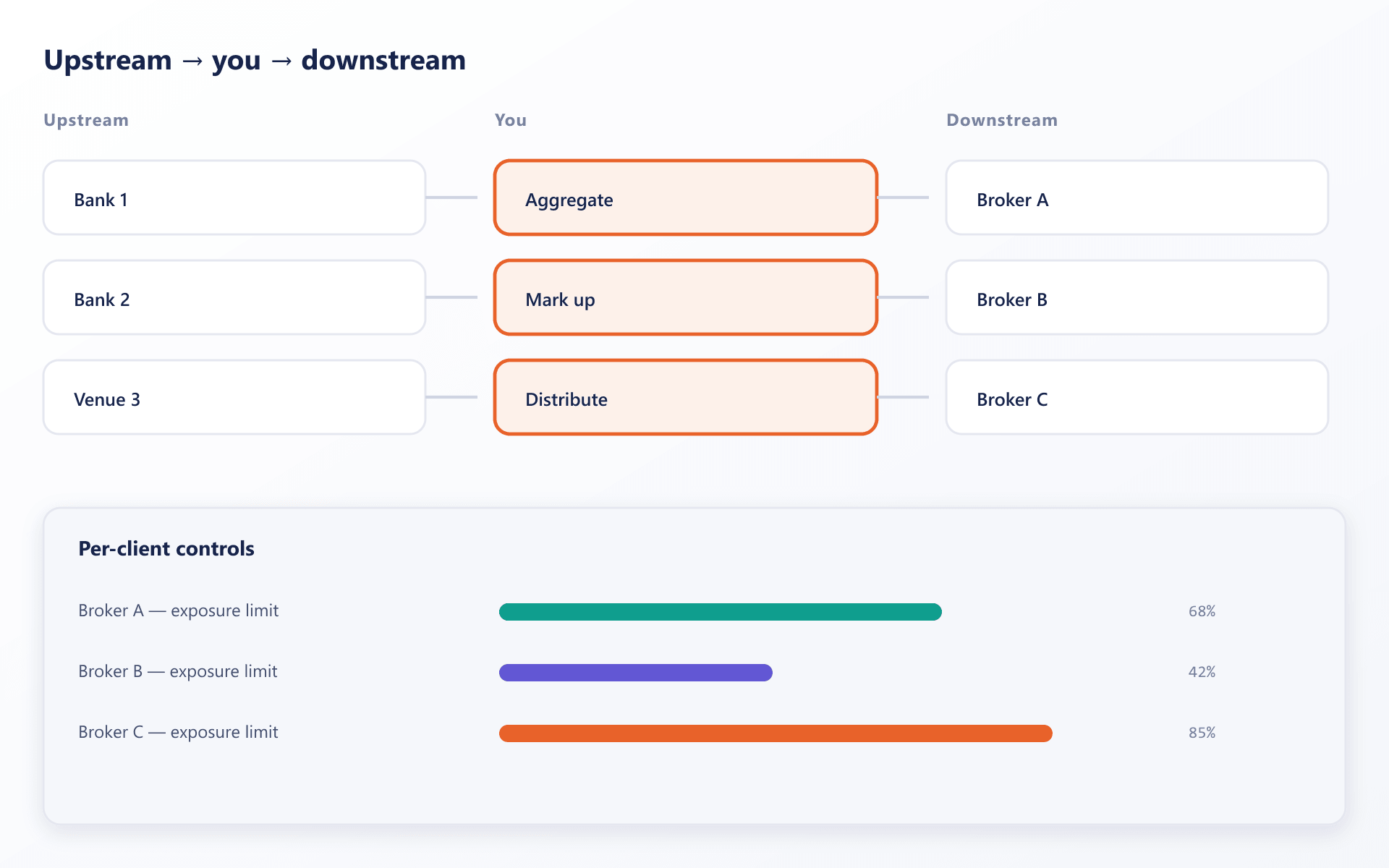
Multiple upstream feeds combined into a single price your downstream clients receive, with the depth that makes it worth taking.
What you can distribute
11 asset classes from one hub
Every class arrives on the same connection and is priced, marked up and limited by the same rules, so adding one to your offer is configuration.
What the job actually is
Three things that separate a provider from a broker
Aggregation is where the product is made
Several upstream feeds become one book. How you normalise symbols, handle a source going quiet and decide which price wins is the actual engineering, and it is what your downstream clients are paying for.
Markup per client, not per instrument alone
Different downstream brokers get different terms, and those terms change as their volume does. That has to be configurable per relationship rather than negotiated in code.
Credit exposure moves to you
When you are upstream of somebody, their losses can become your problem. Limits, margin monitoring and the ability to stop a client quickly are not features here; they are the business.
What the package contains
The building blocks of a provider business
Each block is a product in its own right, already connected to the others, so the launch is configuration rather than integration.
What you control
Four controls, and the last one matters most
Per-client limits
Exposure and margin thresholds set per downstream relationship, monitored continuously.
Distribution controls
Which instruments and which depth each client sees, without maintaining separate feeds.
Flow analytics
What each client sends you, and what it costs you to fill, measured rather than assumed.
Fast disconnect
The ability to stop a relationship immediately, which is the control that matters most on a bad day.
Where the money comes from
Revenue lines for a provider, and the catch in each
Markup over the aggregated price
Set per downstream client and instrument group. It is the core earner, and it only holds if your aggregated price is genuinely better than what the client could reach alone.
Commission per million
A charge on notional traded alongside a tighter price, which institutional takers usually prefer because it separates the instrument from the service.
Financing differential
The gap between the swap you pay upstream and the swap you pass on. Small per night, material across a book of positions held for weeks.
Platform sublicensing
Fees for the trading platform, back office or copy-trading engine you supply to downstream brokers, which also make the relationship harder to replace.
Flow you choose to keep
Exposure retained rather than passed upstream. It can be the largest line and the most volatile, which is why it belongs behind limits.
Who takes your pricing
Downstream clients are not only brokers
The same hub serves firms with very different flow, which is why limits and markup are set per relationship rather than per client type.
Platforms you can sublicense
Supply the technology, not only the price
Brokers that run on platforms you supply are slower to move their pricing elsewhere. Each of these can be offered downstream under the client’s own brand.
Licences and banking
Introductions, stated as introductions
A licence and a bank account are yours to obtain. We can shorten the search for the people who help with both.
Licensing partners
We do not obtain licences and will not claim to. We can introduce firms that prepare applications in the jurisdictions our clients commonly choose, and we configure the stack for whichever one you land in.
Banking relationships
Introductions to banking partners used to working with liquidity businesses. Whether they accept you depends on your licence, jurisdiction and their diligence, not on our introduction.
Worth being clear about
Three reasons this is the hardest package here
Being a provider is a regulated activity
Taking on downstream clients and their credit exposure usually sits under a different permission from running a brokerage. That is a conversation for your counsel before it is one for us.
Capital requirements go up
Standing between upstream and downstream means holding positions and posting collateral in both directions. This is the package on this site with the highest balance-sheet demand.
Downstream clients are a sales problem
The technology lets you distribute. Finding brokers willing to move their pricing relationship to a new provider is slow relationship work, and the software does not shorten it.
How the launch runs
From scope to the first live client
- 01 · Scope
Markets, takers and limits
Which asset classes you will distribute, who your first downstream clients are and how much exposure you are prepared to carry for each.
- 02 · Configure
Hub, accounts and risk
Upstream sources are connected and aggregated, counterparty accounts are created with their terms, and limits are set before any session opens.
- 03 · Certify
Sessions tested end to end
Each downstream client works through their order flows on a staging hub, including rejections, disconnects and a simulated stop-out.
- 04 · Distribute
Live, one client at a time
Production starts with one relationship and widens as flow and analytics confirm the book behaves the way the limits assumed.
Questions by topic
Liquidity provider turnkey: common questions
Distribute. A brokerage consumes pricing for its own clients; a provider aggregates, marks up and passes pricing to other firms, then carries the credit and margin exposure that relationship creates.
Rarely. It carries the highest capital and regulatory demands of anything on this site, and it usually makes sense for a firm that already runs a brokerage and understands its own flow before it starts taking on somebody else's.
Yes. The trading platform, back office, copy-trading engine and hub can be sublicensed to downstream firms, which adds a revenue line and makes your pricing relationship harder to replace.
No. A licence is granted to you by a regulator, not by a technology supplier. We can introduce firms that prepare applications, and we configure the platform for the jurisdiction you choose.
That depends on who your downstream clients are and where they are regulated, which is a question for your counsel. The stack itself does not constrain the choice.
It keeps the records a regulator asks about: every order, fill, limit change and operator action with timestamps, exportable for whatever reporting regime applies to you.
You need at least one, and realistically several so that one source going quiet does not empty your book. We can be one of them, and the aggregation layer is deliberately indifferent to whose feeds it is combining.
Yes. FIX is how most downstream brokers will want to connect, with per-session configuration, certification before go-live and full message logging on both sides.
That is the risk this package is built around. Limits, continuous margin monitoring, automatic stop-out and immediate disconnect are the controls; whether you extend credit to a given firm in the first place is your commercial call.
Scope, configure, certify, then distribute one client at a time. The elapsed time depends mostly on how quickly upstream credentials arrive and how quickly your first takers can certify, so we agree it once those are known.
Over FIX or the API, each with its own session and credentials. They certify against a staging hub before production, so their first live order is not their first order.
Per downstream client, per instrument group, configurable without a release. Different relationships carry different terms and those terms change with volume, so this has to be operational rather than structural.
As a quote built on the products you need, your expected volume and your deployment. We set it out in writing, including how it changes as the business grows.
Do you already understand your own flow?
Firms that make this work almost always ran a brokerage first. If that is you, the conversation is a short one.