Asset Classes
A contract with no expiry still has a daily cost
Perpetuals never settle, so something else has to keep them tied to spot. That something is a funding payment between the two sides of the market, and it is the part clients are most often surprised by.
Periodic, in both directions, shown before it is charged
Derived from the wider market, not one venue's last trade
Aggregated across venues rather than taken from one book
Into the same consolidated margin account
See it live
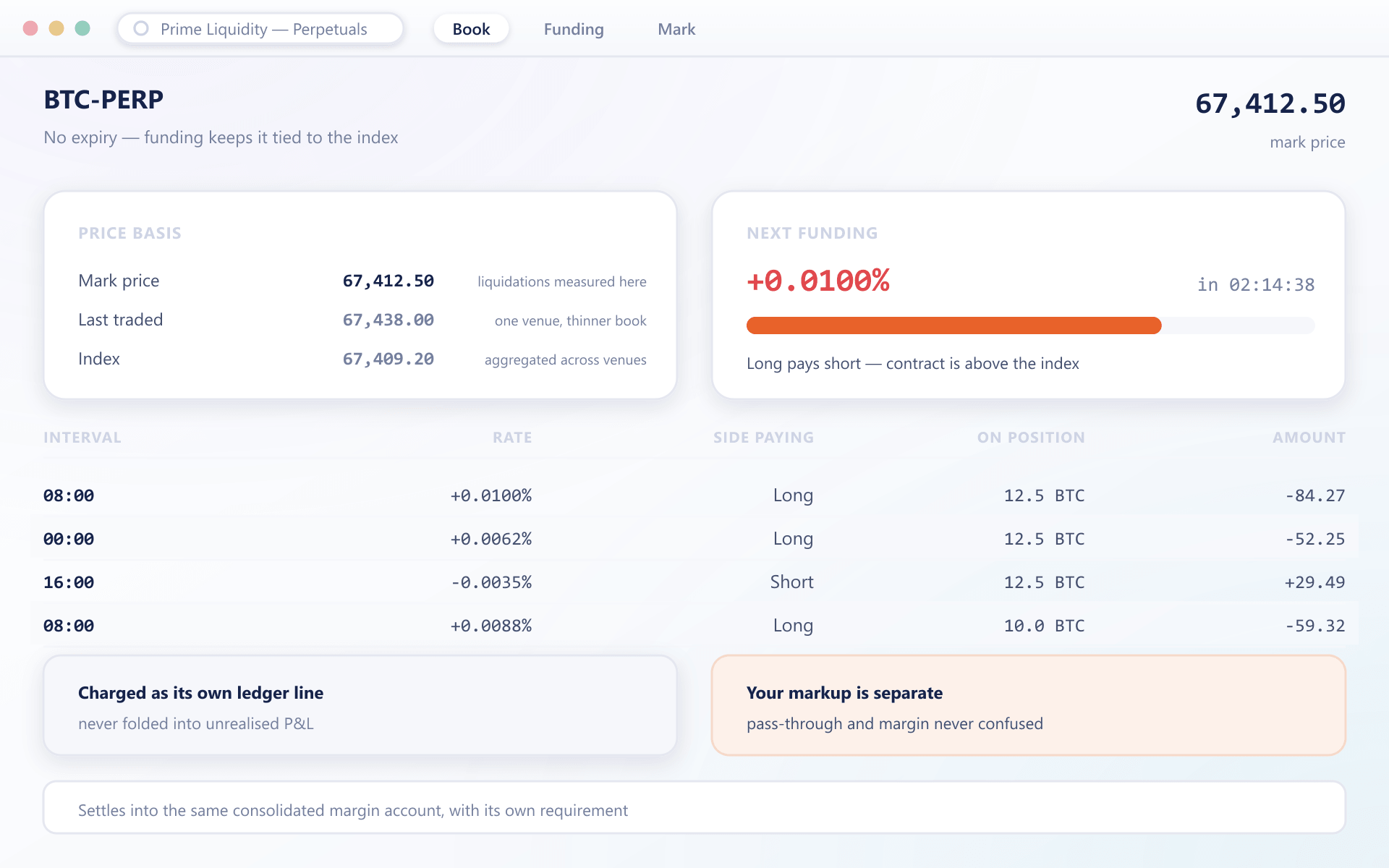
Funding, mark price and the position it applies to
The next funding interval, the rate that will apply and which side pays it, alongside the mark that liquidation is measured against.
Three real differences
What changes when a contract never expires
Funding is the price of holding
With no expiry to pull the contract back to spot, a periodic funding payment does it instead. Whoever is on the crowded side pays the other. It is a real, recurring cash flow, and a client who does not know it exists will eventually ask where their balance went.
Mark price, not last price
Liquidations are calculated against a mark derived from the wider market, not against the last trade on one venue. Without that separation, a thin book is a liquidation engine for anyone willing to push it.
Margin sized for indefinite carry
A position with no expiry can be held through conditions a dated contract would have settled out of. Requirements reflect the exposure actually being carried rather than the day it was opened.
How funding is handled
The part that has to be explainable on a statement
Periodic, both directions
At each interval the side holding the crowded position pays the other. Long pays short when the contract trades above the index, and the reverse when it trades below.
Known before it applies
The applicable rate and the time it will be charged are visible ahead of the interval, so a desk can close or hedge before paying rather than discovering the charge afterwards.
Its own ledger line
Funding appears as a distinct entry rather than being folded into unrealised profit and loss, which is what makes a client statement explainable.
Configured separately
Any spread you apply over the venue funding rate is set by you and recorded separately, so the pass-through and the margin are never confused with each other.
FAQ
Perpetual futures: common questions
6 short answers to what teams ask before a demo.
A perpetual has no expiry, and that single difference creates the funding mechanism. Dated contracts converge to spot by settling; a perpetual converges by charging whichever side is crowded. Everything operationally distinctive follows from that.
Whichever side of the position is crowded pays the other side, and it passes through to whoever holds the position on your book. How you present and mark it up is your decision, and both are configured separately.
Because liquidations run against it. If liquidation used the last traded price on a single venue, a thin book could be pushed to trigger client liquidations deliberately. A mark derived from the wider market removes most of that incentive.
It settles into the same consolidated margin account with its own requirement. Collateral is shared across classes; the requirement is calculated for what perpetual exposure actually is rather than at a blended rate.
Nothing stops. Funding intervals continue and positions carry, so weekend coverage is a policy question to settle before listing rather than after a Sunday move.
Yes. They are separate instruments with separate margin treatment, and a broker can carry either, both, or a different subset per client group.
Still have a question?
A specialist will answer it directly, with your set-up in mind.
Ask a specialistDecide how funding reaches the client first
Whether you pass it through at cost, mark it up, or absorb it is a commercial decision worth settling before the first interval is charged.