Investment Solutions
Your best traders become your acquisition channel
Somebody on your platform is good, and other people would pay to follow them. Copy trading is the mechanism that turns that into volume, retention and a reason for both of them to stay.
See it live
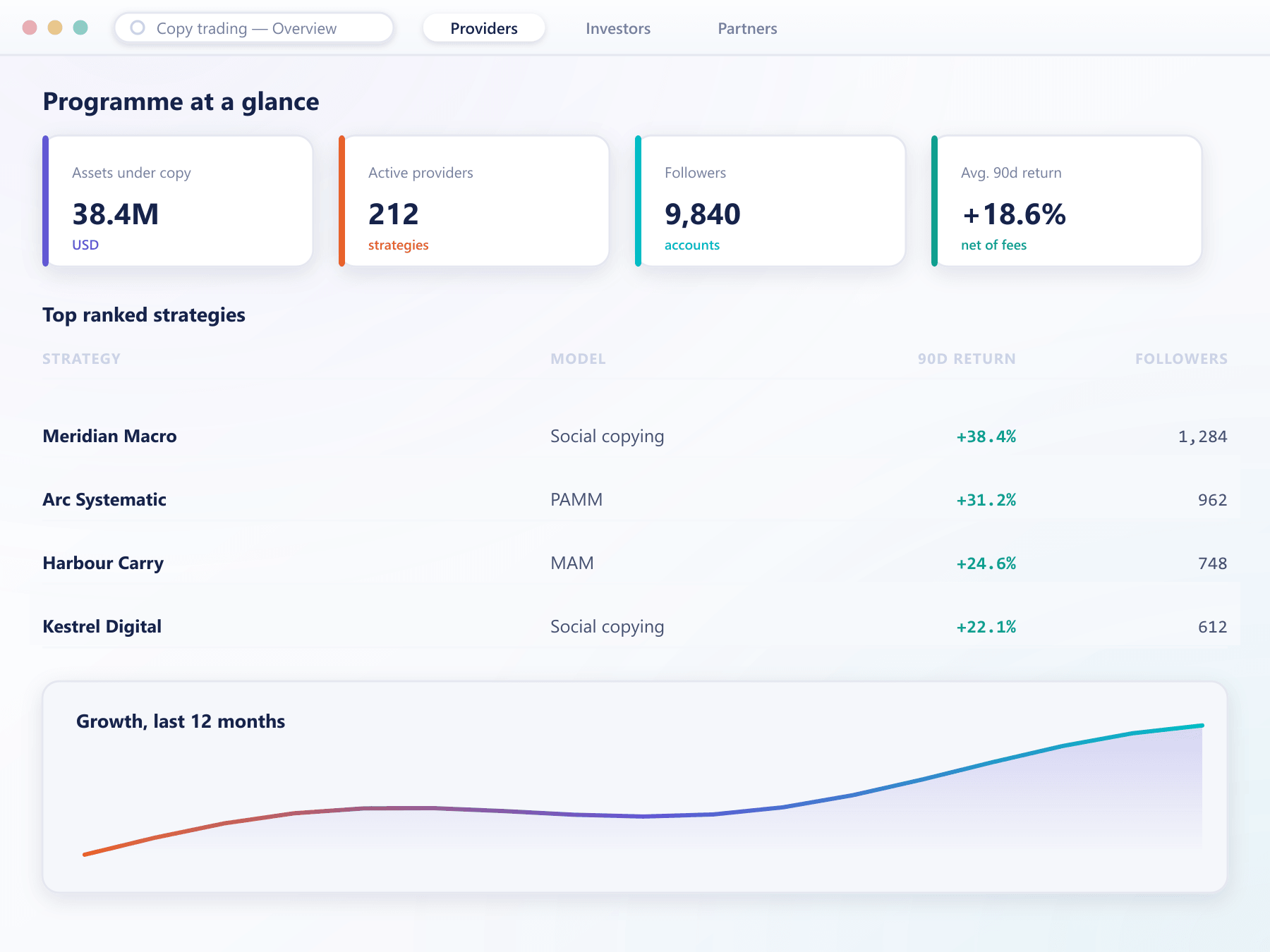
A live track record, not a self-reported one
Every strategy is ranked on real fills — return, risk and follower count update from the same engine that executes the trades.
Three audiences, one product
A copy programme fails when it is designed for only one of them
The strategy provider
To be paid for being followed
A trader who is good and knows it. They will go wherever the fee structure is fair and the reporting makes their record visible.
The investor
To see what they are buying
Not just the return — the drawdown, the fees and the ability to leave. Programmes that hide the second and third lose them after one bad month.
Your desk
Volume it can price and control
Copying multiplies one trader's decisions across many accounts, which multiplies both the commission and the exposure. Both need to be visible.
Three models
One engine, and most desks eventually run more than one of them
Social copying
Own accountEach follower holds their own positions proportionally. The lightest arrangement and usually the easiest to offer.
PAMM
PooledCapital is pooled, traded once and distributed by share. Efficient, and a heavier regulatory proposition.
MAM
Separate accountsOne order allocated across separate accounts by rule. Each account keeps its own identity and its own statement.
Why it is worth running
Three effects, and the third is usually the largest
Providers recruit for you
A trader with a following brings that following with them. The acquisition cost of an investor who arrived to copy somebody is a fraction of one acquired directly.
Volume multiplies
One provider's decisions become a hundred accounts trading. The commission is real and so is the correlated exposure, which is why the risk limits matter as much as the fee model.
Retention improves
An investor following a strategy has a reason to stay through a bad month that a lone trader does not. That is worth more over a year than the copying volume itself.
Not the same as your partner programme
An introducer brings clients. A provider brings followers.
They are frequently confused because both pay somebody for growth. The difference is that a strategy provider is also generating the trading, which makes them a risk question as well as a commercial one.
Explore
Models, mechanics and operations
FAQ
Copy Trading Engine: common questions
6 short answers to what teams ask before a demo.
The MultiPrimeX Copy Trading Engine runs social copying, PAMM and MAM on one engine, so strategy providers earn from being followed, investors can see what they are buying, and your desk controls fees and risk.
In social copying each follower mirrors a provider proportionally in their own account. In PAMM investors pool money into one account that the manager trades once. In MAM the manager places one order that is allocated across separate client accounts.
Performance fees with high-water marks, management fees and volume-based fees are configured per strategy or tier, and the split between provider, partner and brokerage is calculated on the ledger.
Yes. A provider on one server or platform can be followed by investors on another, with symbol mapping, timing tolerance and reporting of copy slippage.
Plans combine a monthly subscription with an included copied-volume allowance and a published rate per million beyond it, with hosting, updates, monitoring and support included. The ROI calculator models breakeven for your own book.
Per-follower drawdown caps, exposure limits, instrument exclusions and automatic unsubscribe, plus brokerage-level limits that apply whatever a follower configured.
Still have a question?
A specialist will answer it directly, with your set-up in mind.
Ask a specialistWhich model fits your licence?
Copying, PAMM and MAM carry genuinely different regulatory weight. That question is worth settling before the product conversation, not after it.