Operations
Clients should never see a second product
A second login, a second brand or a visible redirect all raise the same question in a client’s mind: who am I actually dealing with? That question has no good answer.
Embedded widgets inside your existing navigation
The manager view, under your brand
The same components, sized for a phone first
Subscription and performance notices in your templates
Programme administration alongside your other operations
The same operations over gRPC, with client stubs generated from the schema
See it live
The API behind every embedded surface
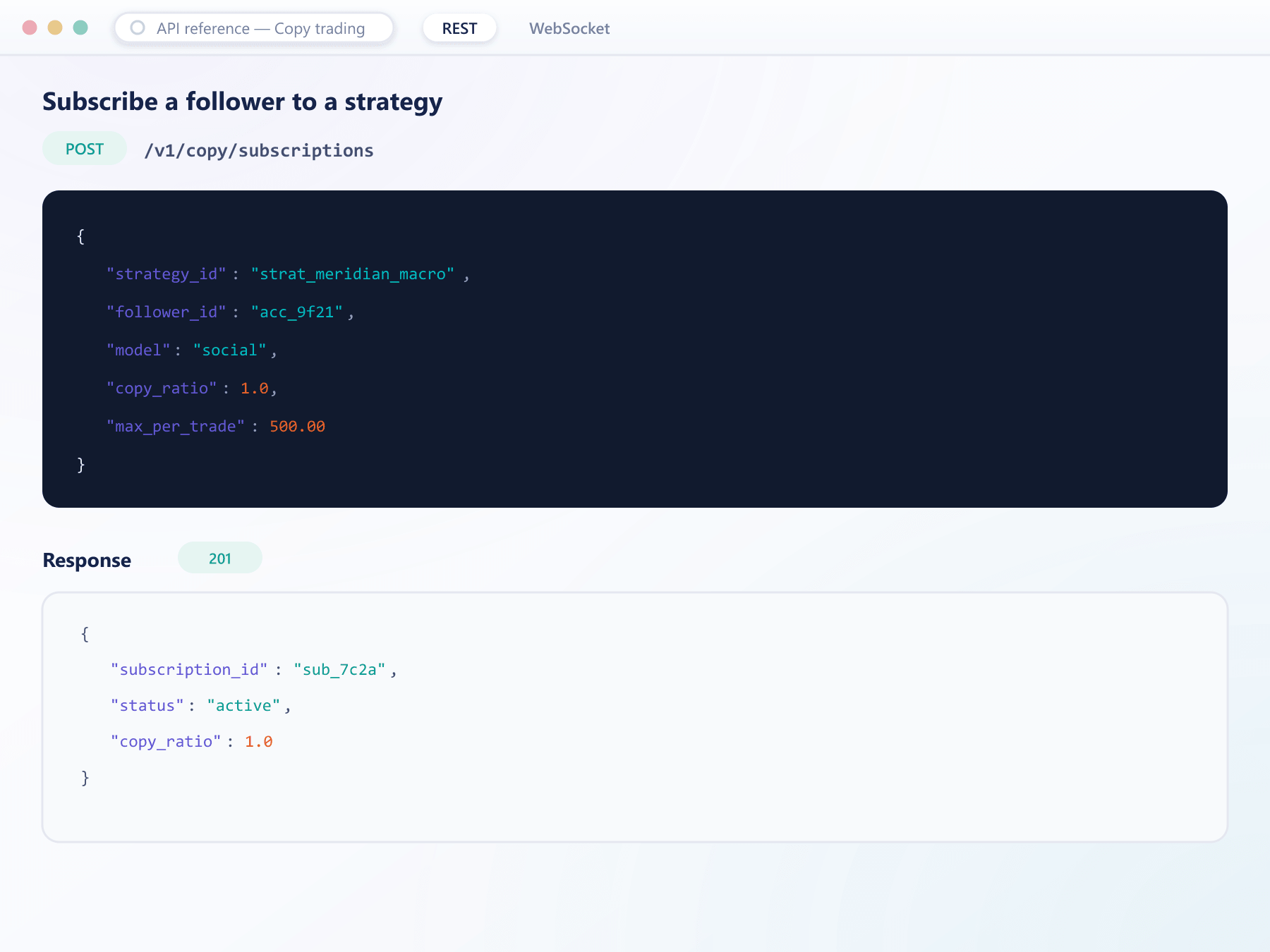
Strategy data, follower state and fee calculations are all reachable the same way, whether you use our components or build your own view on top of them.
Three requirements
Any one of them missing and the illusion breaks
Single sign-on, not a second login
A client who has to log in again has left your product. Session identity carries across, so copy trading is a section of your platform rather than a destination they navigate to.
Your brand, entirely
Colours, typography and language come from your system. There is no attribution to us anywhere a client can see, because a second brand in the client area invites a second question.
An API for everything underneath
Strategy data, follower state, fee calculations and performance history are all available programmatically, so you can build your own view rather than accepting ours.
FAQ
Integration: common questions
7 short answers to what teams ask before a demo.
They should not. Single sign-on carries session identity across, the branding is entirely yours, and the copy trading views sit inside your existing navigation as a section rather than a destination.
No. Embedded components are the fastest route, and everything underneath is available through the API if you would rather build your own views. Most firms start with the components and replace selectively.
If you run BrokerOS, it is a native section. If you run your own, the components embed and the API provides the data. Either way the client sees one product.
The same components, designed for a phone first. Copy trading is browsed more on mobile than most brokerage functions, so treating mobile as the secondary case produces the wrong result.
Yes, and it draws from the same translation source as the rest of your platform through Localization Module, so a language is never applied to some surfaces and not others.
With embedded components, days rather than months. Building custom views against the API takes as long as building any interface, and the API is designed so that is a reasonable choice rather than a struggle.
Yes. The copy trading sections can be surfaced inside other client-area and CRM systems through the same components and API, so investors manage subscriptions from the portal they already log in to and your team keeps one client record.
Still have a question?
A specialist will answer it directly, with your set-up in mind.
Ask a specialistSee it inside your own client area
Bring your branding and we will show you the embedded version rather than a screenshot of ours. It is a more useful ten minutes.