Features
Rounding decides whether small accounts get filled at all
It sounds like an implementation detail and it is the difference between a client following a strategy and a client believing they are following one.
See it live
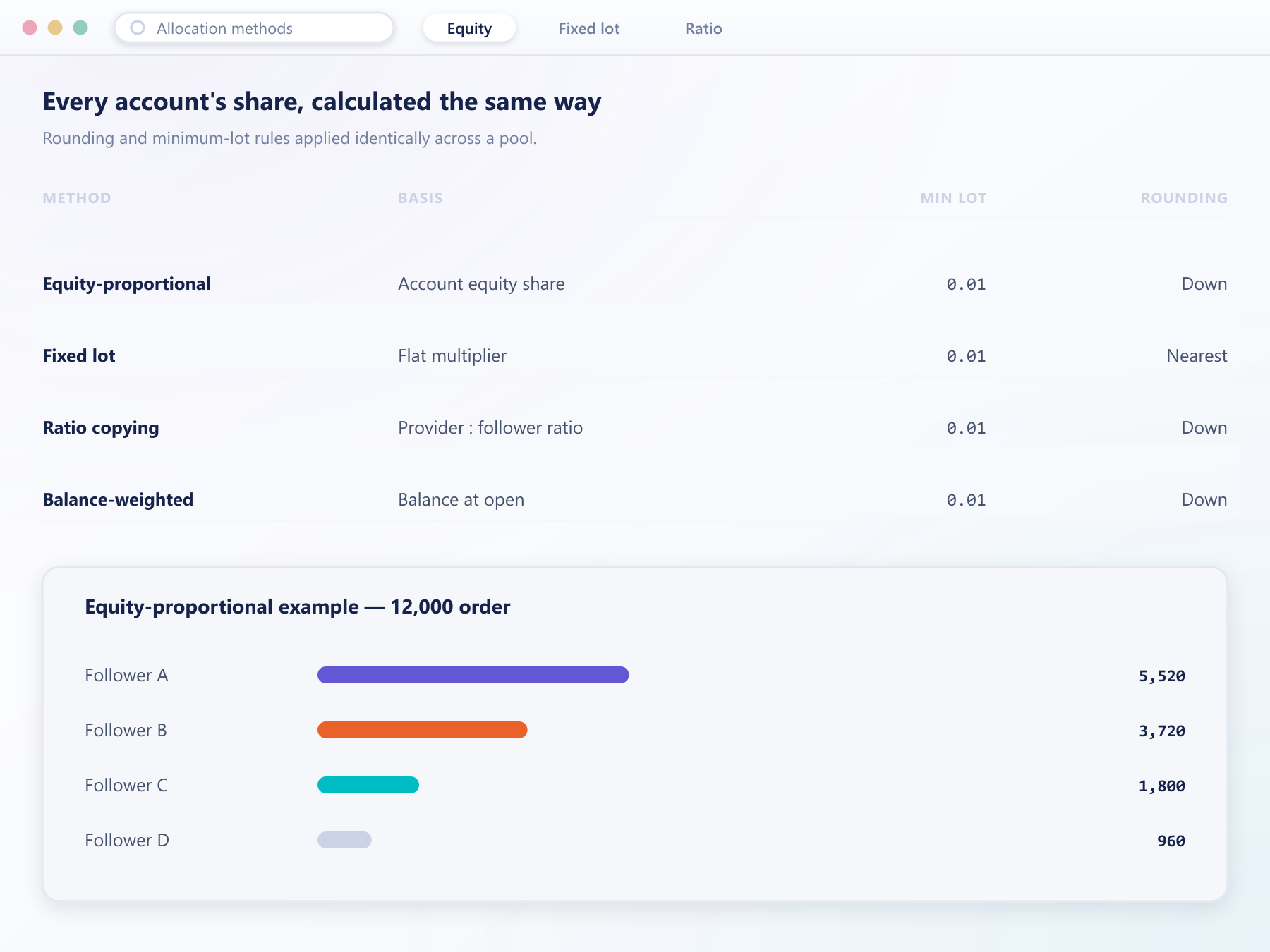
Every account’s share, calculated the same way every time
The allocation table shows the method, the tier and the resulting share side by side, so a rounding decision is never something you have to take on trust.
Four methods
And the first one is right more often than the rest
By equity
Accounts of very different sizes
Each account receives a share proportional to its current equity. The most commonly correct choice, because it adjusts as accounts grow and shrink.
By balance
Accounts where open exposure varies
Allocation follows balance rather than equity, so an account with large unrealised positions does not have its share distorted by them.
By lot ratio
Accounts with agreed fixed multiples
Each account takes a set multiple of the manager's size. Predictable, and it does not adjust as an account grows away from the others.
Fixed proportion
A small number of similar accounts
A defined percentage per account regardless of size. Simplest to explain and the first to become wrong as the accounts diverge.
The part nobody specifies
Three rounding decisions that have to be made explicitly
Somebody has to absorb the remainder
Ten lots across seven accounts does not divide evenly. Whether the remainder goes to the largest account, rotates, or is dropped is a decision — and if you do not make it, the software makes it for you.
Minimum size protects small accounts
Without a minimum, an account whose share rounds below the smallest tradeable size is silently excluded. Its owner believes they are following a strategy and is not, which they discover eventually.
Exclusion should be visible
When an account cannot participate in a trade, that should be recorded and surfaced rather than passing quietly. A gap in a client's copy history needs an explanation attached to it.
When the pool changes size
Deposits and withdrawals move everyone else’s share
An allocation that is only calculated when a trade opens drifts the moment money enters or leaves. These are the adjustments that keep it honest.
Reallocation on deposit
When an investor adds funds, their share of the pool is recalculated and open positions are resized so the new balance is actually working rather than sitting idle until the next trade.
Reallocation on withdrawal
A withdrawal reduces that investor's share and trims their portion of open exposure, so the remaining investors are not left carrying risk that was funded by money which has left.
Autocorrection
Where a partial fill or a rounding step leaves an allocation slightly off, it is corrected on the next cycle rather than accumulating into a drift that only shows up at month end.
Lot, equity or percentage
Managed accounts can be allocated by fixed lot, by equity proportion or by a set percentage. The choice changes who carries the rounding, so it is set per account rather than globally.
FAQ
Allocation methods: common questions
6 short answers to what teams ask before a demo.
Equity, in most cases. It adjusts as accounts grow and shrink, which the fixed methods do not. The alternatives suit specific circumstances — large unrealised exposure, or a small set of accounts with agreed multiples.
It follows a rule you configure — to the largest account, rotating between accounts, or dropped. This is the detail most systems leave implicit, and implicit means the software decided it and nobody knows what it decided.
It is excluded from that trade and the exclusion is recorded. The alternative is silent omission, where a client believes they are following a strategy while quietly missing a share of its trades.
That is configurable, and we recommend it. A gap in a copy history with no explanation is a support enquiry at best and a complaint at worst.
Yes, per strategy. A manager running a small number of similar mandates and one with hundreds of retail followers should not be constrained to the same method.
Under equity or balance methods, continuously. Under lot ratio or fixed proportion, no — which is why those quietly become wrong once accounts diverge in size.
Still have a question?
A specialist will answer it directly, with your set-up in mind.
Ask a specialistDoes your smallest account get every trade?
Check one. If some trades are missing and nobody can say why, rounding is making a decision that nobody configured.