Models
The follower keeps their own account, and their own control
They are not buying into somebody else’s account. They are trading their own, with a better trader’s decisions, and they can change the terms or leave without asking permission.
See it live
Followers ranked on what they actually received
Return, drawdown and follower count come from the same execution engine that fills each individual account, not a provider’s own summary of their performance.
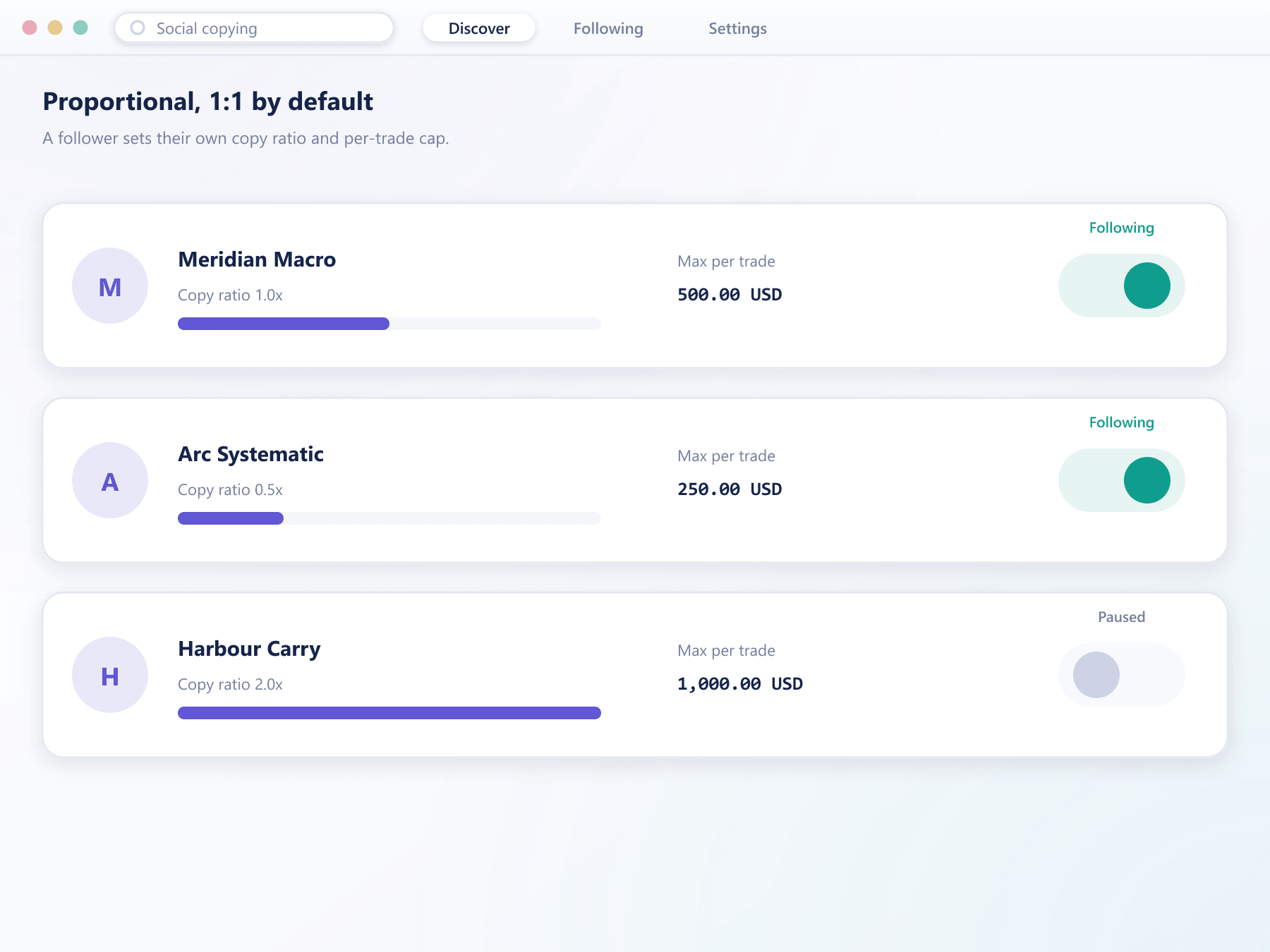
What the follower controls
Four things, and the last one matters most
Their own size
A follower sets what proportion of the provider's size they take. Somebody with a tenth of the capital does not need a tenth-sized version of every decision imposed on them.
Their own exclusions
Instruments a follower does not want to trade can be excluded without leaving the strategy. It is a better outcome than an unsubscribe caused by a single uncomfortable market.
Their own limits
A drawdown ceiling that stops copying automatically. It exists because a follower who watches an account fall without an exit blames the platform rather than the strategy.
The exit, at any moment
Stopping is instant and needs nobody's approval. Anything else turns a product into a trap, and the reputation cost of that arrives faster than the revenue.
Honest trade-offs
What this model gives up in exchange
Position ownership
The follower holds their own. Simplest to explain, simplest to report and usually the lightest regulatory position of the three models.
Execution
Each follower gets their own fill. In fast markets those fills differ from the provider's, and pretending otherwise is how expectations get set wrongly.
Efficiency
Less efficient than pooling, because one hundred followers means one hundred orders. That is the price of each of them holding their own account.
FAQ
Social copying: common questions
6 short answers to what teams ask before a demo.
Yes, in their own account. That is what separates this from pooling — the follower is trading their own account with somebody else's decisions, rather than owning a share of somebody else's account.
Close, but not identical, and it is worth being clear about this up front. Each copied order is its own execution, so in fast markets fills differ. Copy slippage is measured and reported rather than glossed over.
Yes, if you allow it. Manual positions and copied positions coexist in the account and are reported separately, so the performance of the strategy is not confused with the client's own trading.
The copied order is reduced or skipped according to your configuration, and the follower is notified. Silently failing to copy is worse than either outcome, because the client believes they hold a position they do not.
Yes, without approval from anyone. Whether open positions close or remain is their choice. A product people cannot leave easily acquires a reputation that costs far more than the retention it bought.
This one, generally. Followers holding their own positions is easier to explain to a regulator and easier to report than pooling, which is why most desks start here and add PAMM later.
Still have a question?
A specialist will answer it directly, with your set-up in mind.
Ask a specialistMost desks start here
It is the lightest of the three to explain and to report, and adding a pooled model later is straightforward once the programme is running.