Asset Classes
The quote is a price, the decision is a yield
Fixed income is the asset class where the conventions do most of the work. Nothing about a bond position is difficult, but almost all of it is different from the rest of the book.
Rate expectations, almost entirely
Rate expectations plus the issuer's credit
Deep in benchmark issues, thinner off the run
Varies issue by issue, sometimes sharply
Duration
Duration and credit together
Stable outside rate events
Widens on issuer news, not only on market news
Which issues along the curve are quoted
Whether your specific issue is covered at all
Conventions that matter
Three that catch out desks arriving from equities
Accrued interest is part of what you pay
The quoted price is not the settlement amount. Interest accrues daily between coupon dates and is added on top, which is why a bond bought at the same price on two different days costs two different amounts.
Duration decides how much a rate move hurts
Two bonds with the same face value do not carry the same risk. A long-dated issue moves several times more for the same shift in rates, and margin follows that rather than the notional.
Coverage is per issue, not per issuer
A name being available does not mean every one of its issues is. This is the asset class where the gap between a provider's category list and its actual coverage is widest, so it is worth checking at instrument level.
See it live
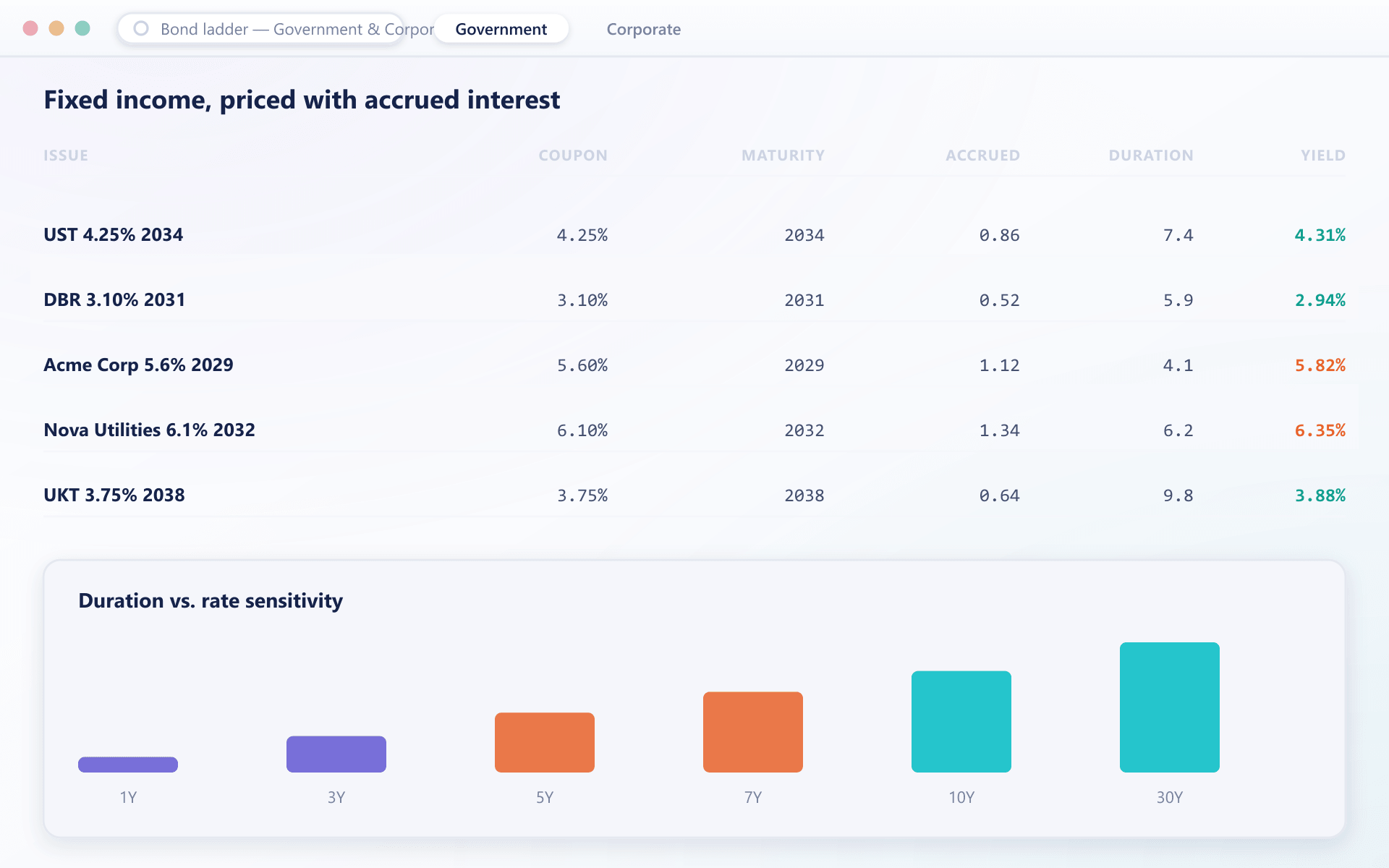
Government and corporate issues, side by side
Accrued interest, coupon dates and duration-aware margin tracked at instrument level, not averaged across an issuer.
FAQ
Bond liquidity: common questions
6 short answers to what teams ask before a demo.
Because interest accrues between coupon dates and is added to the price at settlement. The price is the market's view of the bond; the settlement amount is that price plus whatever interest has built up since the last coupon.
Primarily on duration rather than notional, because duration is what determines how much the position moves when rates do. A long-dated issue and a short-dated one of the same size are not the same risk and are not margined as though they were.
A government issue moves mostly on rate expectations. A corporate issue moves on those plus the market's view of the issuer, which means it can widen on news that has nothing to do with rates at all.
No, and this is the asset class where assuming otherwise causes the most disappointment. Coverage is decided issue by issue, so the list worth checking is instrument level rather than issuer level.
As a cash event on the account with the price adjusting alongside it, so the position economics are unchanged. Both sides are visible rather than only the price movement, which is the half that generates support contact when shown alone.
Yes. It sits in the same consolidated account as every other asset class, so collateral is not stranded against fixed income while another part of the book is short of it.
Still have a question?
A specialist will answer it directly, with your set-up in mind.
Ask a specialistCheck this one at instrument level
In fixed income the gap between a category list and actual coverage is wider than anywhere else on the platform. Send the issues you want and we will confirm each.