Infrastructure
Collateral trapped in the wrong account is idle capital
It is the cost nobody quotes and almost every multi-provider desk carries. Money posted against one relationship and unused while another is short earns nothing and still has a funding cost.
Posted per provider, idle where unused
One pool, available wherever it is needed
Only within each relationship
Across every asset class you hold
Several, independently and at different times
One position, one call
A transfer, with a delay and a cut-off
No movement required at all
Several statements to reconcile
One record, one reconciliation
Three things worth stating precisely
Consolidation does not mean everything nets at one rate
Netting is not uniform
Asset classes carry their own margin requirements even inside one account. Digital asset exposure is not offset against a currency position at a common rate, because the risk genuinely differs.
One number, drillable
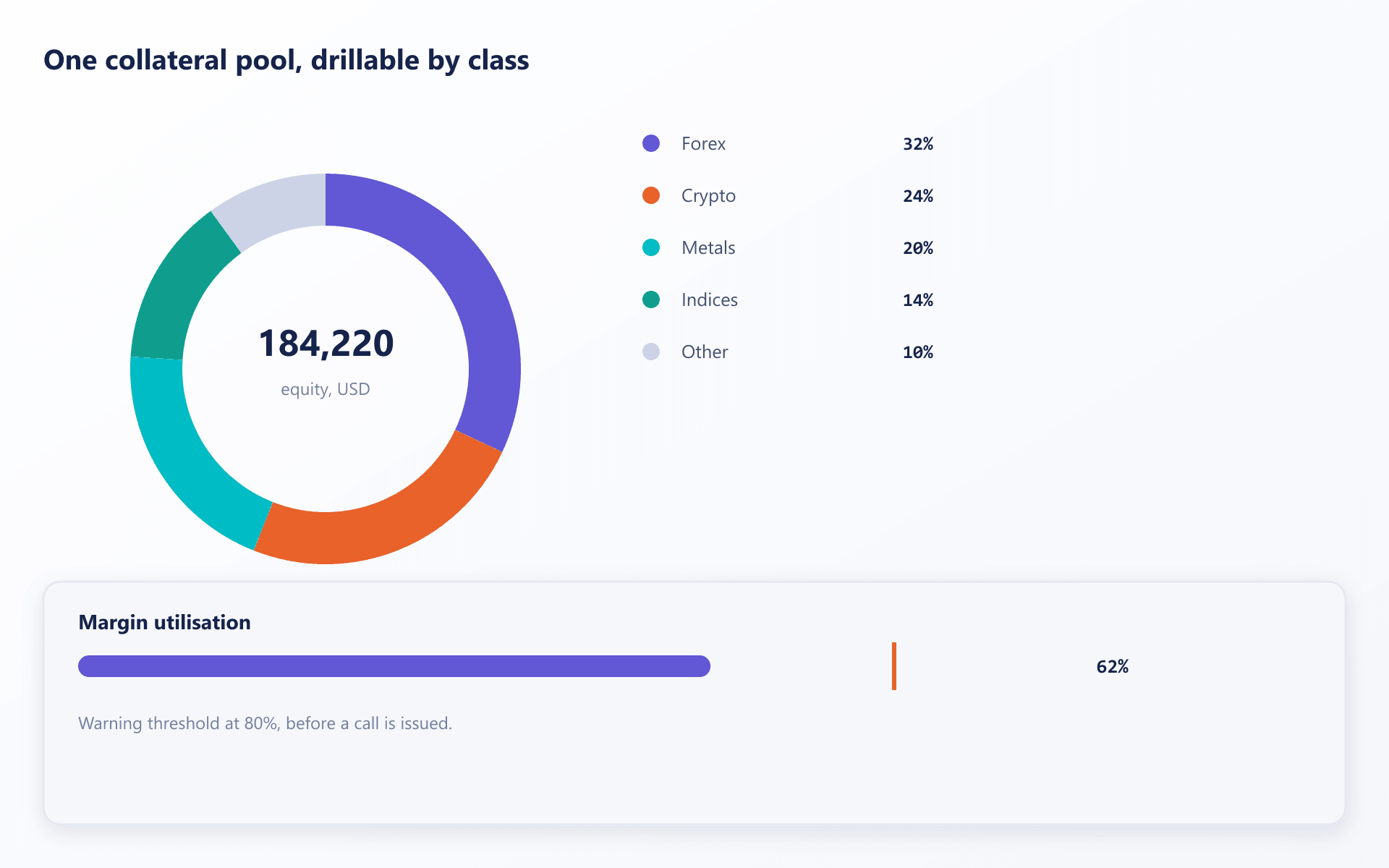
The consolidated requirement is a single figure you can open to see what each class contributes. A total nobody can decompose is a total nobody acts on.
Warnings before the call
Utilisation is visible with thresholds ahead of the requirement being breached, because the options available at eighty per cent are considerably better than the ones at a hundred.
See it live
One utilisation figure, drillable by asset class
Gauges and per-group limits drawn from a single collateral pool, with warnings surfaced ahead of a margin call rather than after it.
Funding and settlement
What the account can actually be settled in
Settle in fiat or digital assets
The account can be funded and settled in traditional currency or in digital assets, which matters for a desk whose treasury already holds both and would otherwise convert twice to do one trade.
Collateral is marked, not assumed
Digital assets posted as collateral carry a haircut and are revalued continuously. Accepting them at face value is what turns a volatile week into a margin call nobody modelled.
Conversion is explicit
Where a settlement currency differs from the account currency, the rate and the moment it was struck are recorded, so a difference months later has a documented cause.
What counts as collateral
Posted value and credited value are not the same number
Indicative bands. The schedule that applies to your account is agreed in writing and reviewed as markets change.
Full credit, no conversion exposure
Converted at a rate refreshed through the session
Marked continuously, not once a day
Thin books make the mark optimistic under stress
Margin rises with size
The requirement is tiered rather than flat: the first band of a position is margined at the headline rate and later bands at higher ones, because the cost of exiting a position is not linear in how big it is.
A ceiling on open exposure
Your account carries an agreed limit on total net open position across all asset classes. It is set with you during onboarding and reviewed as your book grows, rather than discovered when an order is refused.
Utilisation is visible before it binds
How much of the limit is consumed shows continuously alongside margin, so approaching the ceiling is something your desk sees rather than something a rejection tells you.
Per-currency collateral ceilings
How much margin credit any single collateral currency may provide can be capped, so a book is never quietly resting on one volatile asset.
FAQ
Single margin account: common questions
6 short answers to what teams ask before a demo.
Idle collateral. Capital posted against one provider and unused while another relationship is short is a real funding cost, and for most desks it is larger than the spread difference that led them to split providers in the first place.
No, and they should not. Each class carries a margin requirement appropriate to its own volatility. Netting them at a blended rate would understate the risk in the volatile ones and overstate it in the stable ones.
Yes. The consolidated figure opens to show what each of the 11 classes contributes. A total nobody can decompose is a total nobody makes decisions from.
One call against the consolidated position rather than several arriving independently. Utilisation warnings are surfaced ahead of it, since the options at eighty per cent utilisation are better than the ones at a hundred.
Yes, with conversion applied for the requirement calculation. The point is that collateral is not stranded in a denomination that happens to be the wrong one today.
This is your firm's account with us. How you segregate your own clients' funds is governed by your licence and handled in your own systems, and nothing here changes that obligation.
Still have a question?
A specialist will answer it directly, with your set-up in mind.
Ask a specialistHow much of your collateral is idle right now?
Add up what is posted against each provider and unused. That figure is usually larger than the spread saving that justified splitting them.