Documentation
Integration surfaces, product by product
These pages describe what each integration surface does and how it behaves. The full endpoint reference is issued against your own environment, because a large part of it depends on how that environment is configured.
API reference
Documented the way it is called
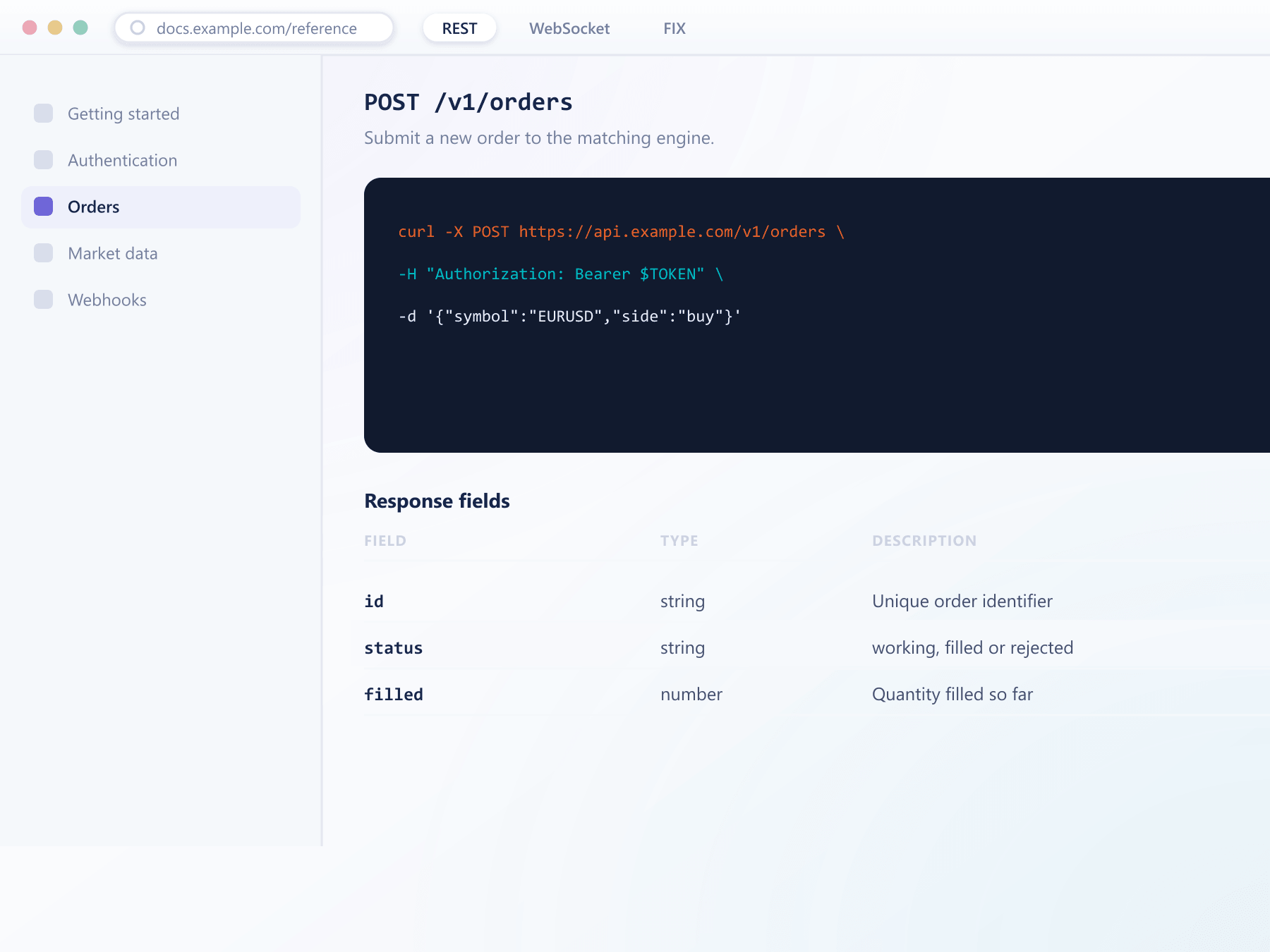
Every endpoint ships with a request, a response and the fields that actually matter — not just a schema.
By product
Where each surface is described
Getting access
Three things worth knowing before you integrate
Full reference is issued per deployment
Endpoint reference, schemas and credentials are provisioned against your environment rather than published openly, because half of what they describe is specific to your configuration.
Sandbox before commercials
A sandbox with test data can be issued before any agreement is signed, so integration work can start rather than wait on a contract.
An engineer, not a ticket queue
Integration questions go to someone who has connected this before. It is a smaller support surface than a public forum and a considerably faster one.
FAQ
Documentation: common questions
6 short answers to what teams ask before a demo.
Because much of it is specific to a deployment — available endpoints, instrument identifiers and permissions differ by configuration. A generic public reference would be wrong in the details that matter most.
Ask for a sandbox. It is issued with test data and the full API surface so your team can evaluate the integration properly rather than reading about it.
FIX for pricing and execution where latency matters, REST for account, client and payment operations, and webhooks for anything you would otherwise poll for.
The interfaces are standard FIX and REST, so existing tooling works. Where we provide helpers they are issued with the sandbox rather than published as a package.
The API surface is held stable deliberately. When something must change, it is announced ahead of time and named as breaking rather than described as an improvement.
Yes, and you should. The sandbox can produce rejections, timeouts and provider failures on demand, because those paths are where integrations actually break.
Still have a question?
A specialist will answer it directly, with your set-up in mind.
Ask a specialistStart integrating before you sign anything
A sandbox with test data and the full API surface is issued on request. It is the fastest way to find out whether this fits your architecture.