Connectivity
The protocol both sides of your market already speak
BridgeX runs FIX in both directions: sessions to the venues that price you, and sessions for the counterparties you price. Each is configured, certified and logged independently.
Initiating
BridgeX connects outAccepting
They connect inWhat a serious FIX layer has to get right
Connectivity is judged on the unglamorous details
Sessions in both directions
Upstream sessions consume pricing and send orders to venues. Downstream sessions accept order flow from your counterparties. Both use the same engine.
Per-session configuration
Heartbeat interval, sequence handling, supported message types, symbol scope and credentials are set per session rather than globally.
Sequence recovery
Gap fills and resend requests are handled automatically, so a brief disconnection does not require manual intervention to resume.
Drop copy
A read-only session can receive execution reports for risk or back-office consumption without the ability to submit orders.
Several margin accounts per connector
One connector can carry more than one margin account, so books that must stay separate for margin and reporting do not each need their own session, credentials and certification.
Complete message logs
Inbound and outbound messages are retained with timestamps, which is what turns a connectivity dispute into a comparison of records.
See it live
The terminal your FIX flow ultimately reaches
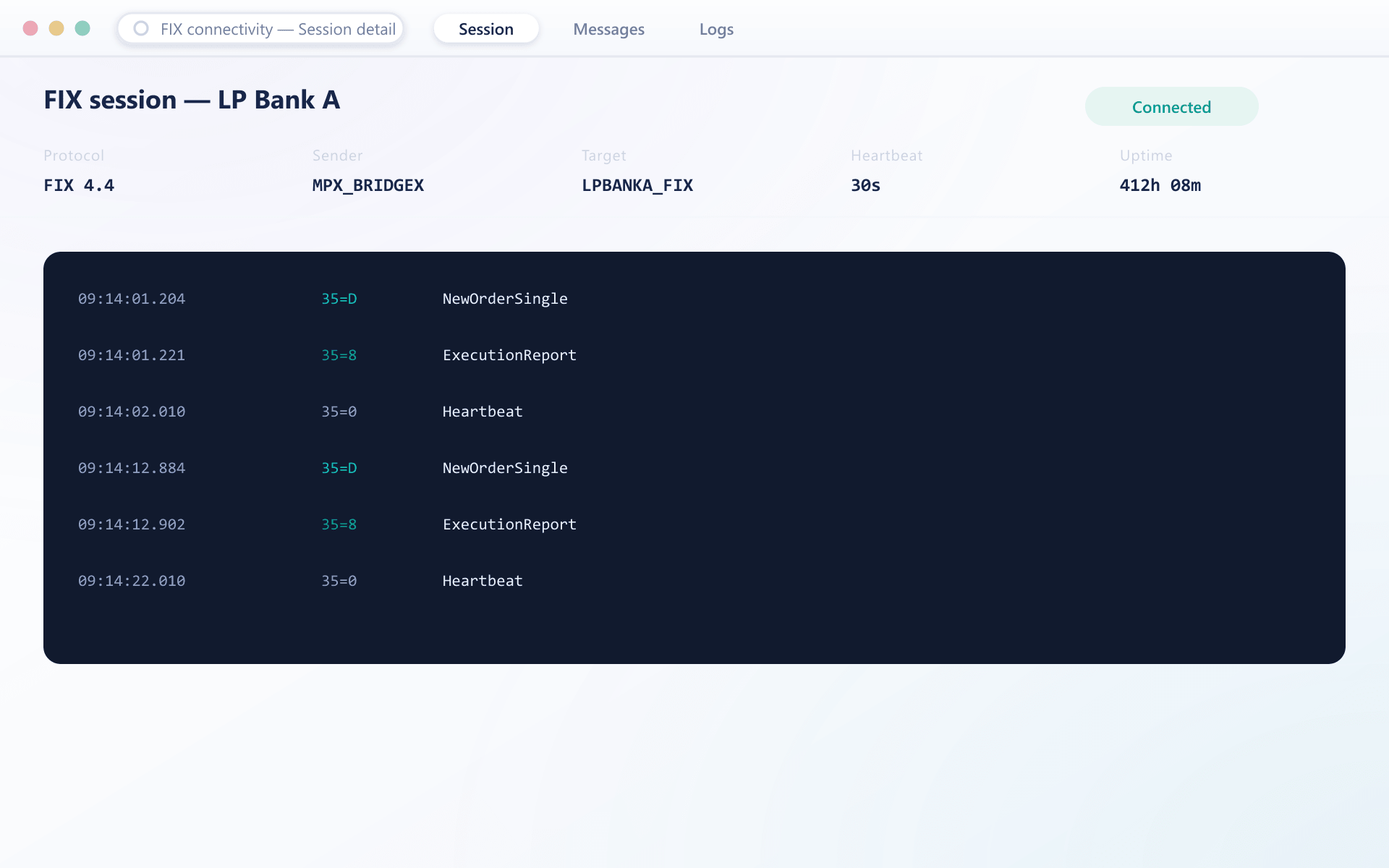
Whether an order arrives from a venue session or a counterparty session, it lands in the same platform view — nothing about the protocol changes what your team sees.
Standing up a session end to end
What happens between agreeing to connect and passing production flow
Before production
The session is defined first
Identifiers, credentials, heartbeat, message types and instrument scope are entered in the console before any connection is attempted.
Tested before it carries flow
The counterparty or venue connects to a test session and works through every message flow they intend to use, including rejections and cancellations.
In production
Production flow, same rules
Orders arriving over FIX pass through the same validation, routing and execution model as anything else. Nothing about the protocol grants a shortcut.
Health visible continuously
Connection state, sequence numbers, message rates and rejection counts appear in the console, so degradation is noticed before anyone reports it.
What FIX support actually unlocks
It is the difference between serving retail flow and serving institutions.
Institutional counterparties
Funds, market makers and brokers connect the way they connect everywhere else.
Venue flexibility
Because upstream connections share the protocol, adding a venue is a session rather than a project.
Clean reconciliation
Drop copy feeds risk and back-office systems without granting them trading rights.
Evidence on demand
Retained message logs settle disagreements about what was sent and when.
FAQ
FIX sessions: common questions
7 short answers to what teams ask before a demo.
Yes. It initiates sessions to upstream venues and providers, and accepts sessions from your downstream counterparties. Both directions are configured and monitored through the same console.
The standard set for order flow — new order, amend, cancel, execution report and reject — plus market data and drop copy. The exact message types enabled are per session.
Sequence recovery runs automatically: gap fills and resend requests are handled by the engine, so a brief drop resumes without manual intervention. Persistent failures raise an alert.
Yes. Counterparties and venues connect to a test session first and exercise the flows they intend to use, including rejection and cancellation paths, before production traffic is enabled.
No. A single connector can carry several margin accounts, which keeps the number of sessions and credential sets down. The accounts themselves stay isolated for margin, exposure and reporting.
Yes. Instrument scope is part of the session configuration, so a counterparty can be given access to a specific subset without seeing anything else you distribute.
If you choose. Attribution fields can be passed upstream with each order, so a provider that prices by client segment or needs origin details for its own compliance receives them, while counterparties you prefer to keep anonymous stay that way.
Still have a question?
A specialist will answer it directly, with your set-up in mind.
Ask a specialistBring your connectivity requirements
Tell us which venues and counterparties you need to reach and we will walk through the session model in detail.