Aggregation
Two venues quoting the same thing, differently
One quotes to five decimals, another to four. One prices per unit, another per contract. Before quotes can be merged they have to mean the same thing, and that is what normalisation does.
Both mapped into one canonical definition before anything merges
What gets reconciled
Each of these will silently corrupt an aggregate if it is not handled deliberately
Decimal precision
Sources quoting at different precision are brought to a common one, with the rounding direction chosen explicitly rather than left to chance.
Tick size
Where venues use different minimum increments, prices are aligned to your canonical tick before they are compared.
Size units
Per-unit, per-lot and per-contract quantities are converted to a single unit, so depth from two venues is genuinely additive.
Quote conventions
Inverted pairs and non-standard quote directions are flipped at the edge, so everything downstream reads the same way round.
Taker and maker naming
The name a taker subscribes to is configured independently of the one the venue publishes, so instruments can carry your naming convention without anything being renamed upstream.
Explicit rounding
Rounding is recorded rather than implicit, which is what makes a fractional discrepancy explainable months later.
See it live
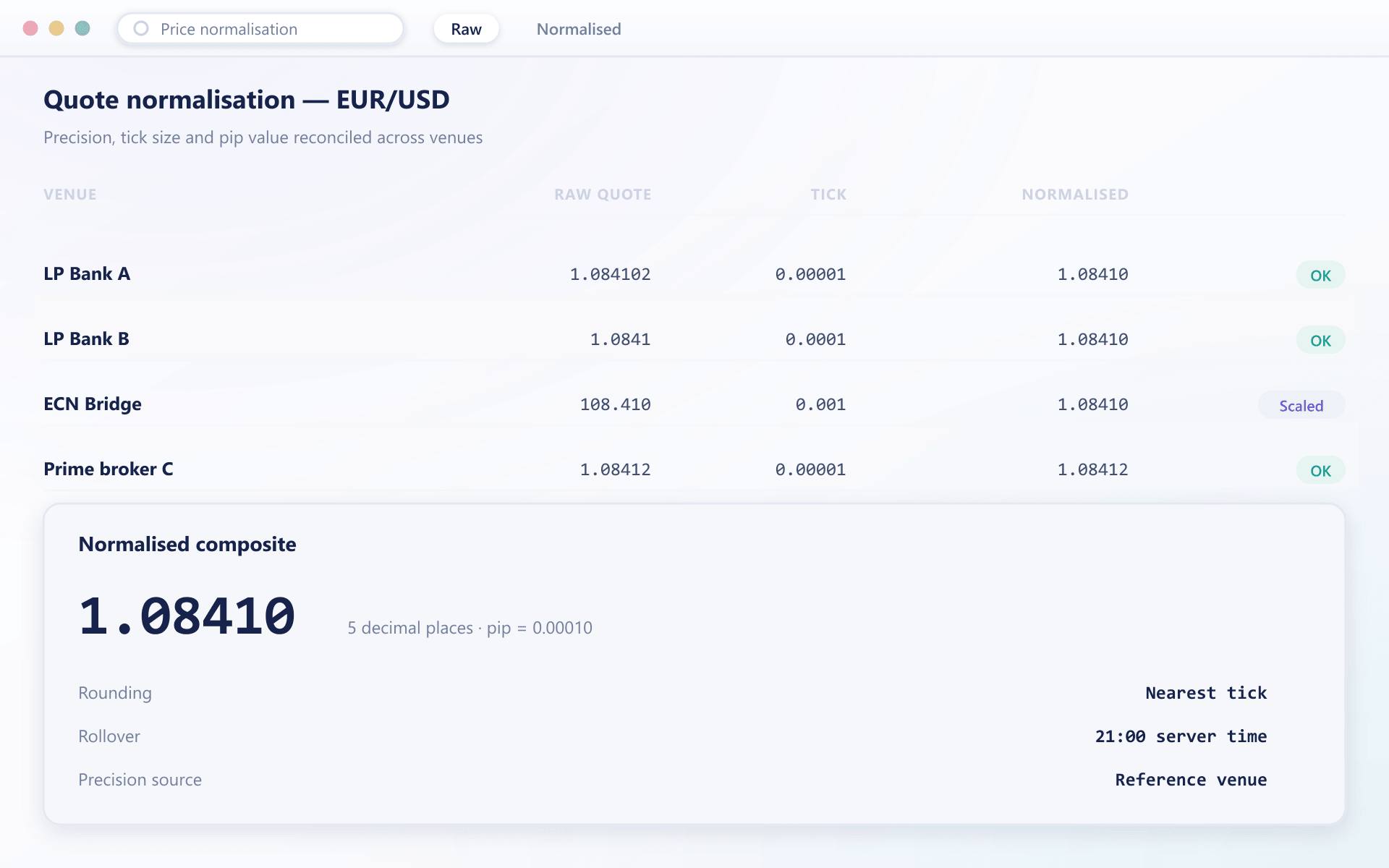
Every field reconciled before anything merges
Precision, tick size, size units and swap conventions are set once per instrument, so two venues quoting the same pair are finally comparable.
Where normalisation sits
Always before aggregation, never after
Your canonical instrument
Each instrument has one authoritative definition: precision, tick, size unit and quote direction. Every venue maps into it rather than the other way round.
Per-venue translation rules
A venue's own conventions are recorded alongside its symbol mapping, so translation happens automatically on every quote and order.
Translated on the way in and out
Incoming quotes are normalised before filtering, and outgoing orders are converted back into the venue's expectations before being sent.
Divergence surfaces a mapping error
A source that consistently diverges from the consensus is usually a mapping mistake, not a market view. That divergence is monitored and reported.
Merging first and reconciling afterwards produces a book that is wrong in ways nobody notices. The order matters.
The failure this prevents
Normalisation errors do not announce themselves. They just quietly make you money or lose it.
Aggregates that mean something
Depth is only additive when the units genuinely match.
No silent mispricing
A precision mismatch that flatters one source is caught by divergence monitoring.
Explainable differences
Explicit rounding means a fractional discrepancy has a documented cause.
Safe venue addition
A new venue's conventions are declared up front rather than discovered in production.
FAQ
Normalisation: common questions
6 short answers to what teams ask before a demo.
Because they often are not comparable. Different precision, tick size, size unit or quote direction means two numbers that look similar can represent quite different things. Merging them without reconciliation produces a book that is wrong in ways nobody notices.
Its prices are aligned to your canonical precision with an explicitly configured rounding direction. Because the rounding is recorded, any resulting fraction can be explained later rather than being a mystery.
They are flipped at the edge as part of the venue's mapping, so everything downstream — aggregation, routing, reporting — reads the instrument in one consistent direction.
Yes. Taker-side and maker-side names are set independently, so an instrument can be published under your own convention while the mapping to each venue's symbol stays behind the scenes. Nothing downstream has to know what a given venue calls it.
Yes. Orders are converted back into each venue's expected precision, tick and size unit before being sent, which prevents rejections caused purely by formatting.
Divergence monitoring. A source that consistently prices away from the consensus is far more likely to be mismapped than to be right, and that pattern is surfaced as a report rather than left to be discovered by a trader.
Still have a question?
A specialist will answer it directly, with your set-up in mind.
Ask a specialistReview your instrument definitions with us
Bring two venues that quote the same instrument differently and we will map both during the call.