Risk & Accounts
One event log, every report derived from it
Quotes, orders, fills, hedges and rejections are each written once. Exposure, execution quality and revenue reporting are queries over that record, so there is no second system that can disagree.
Saved reports
ScheduledAll four read the same event log
See it live
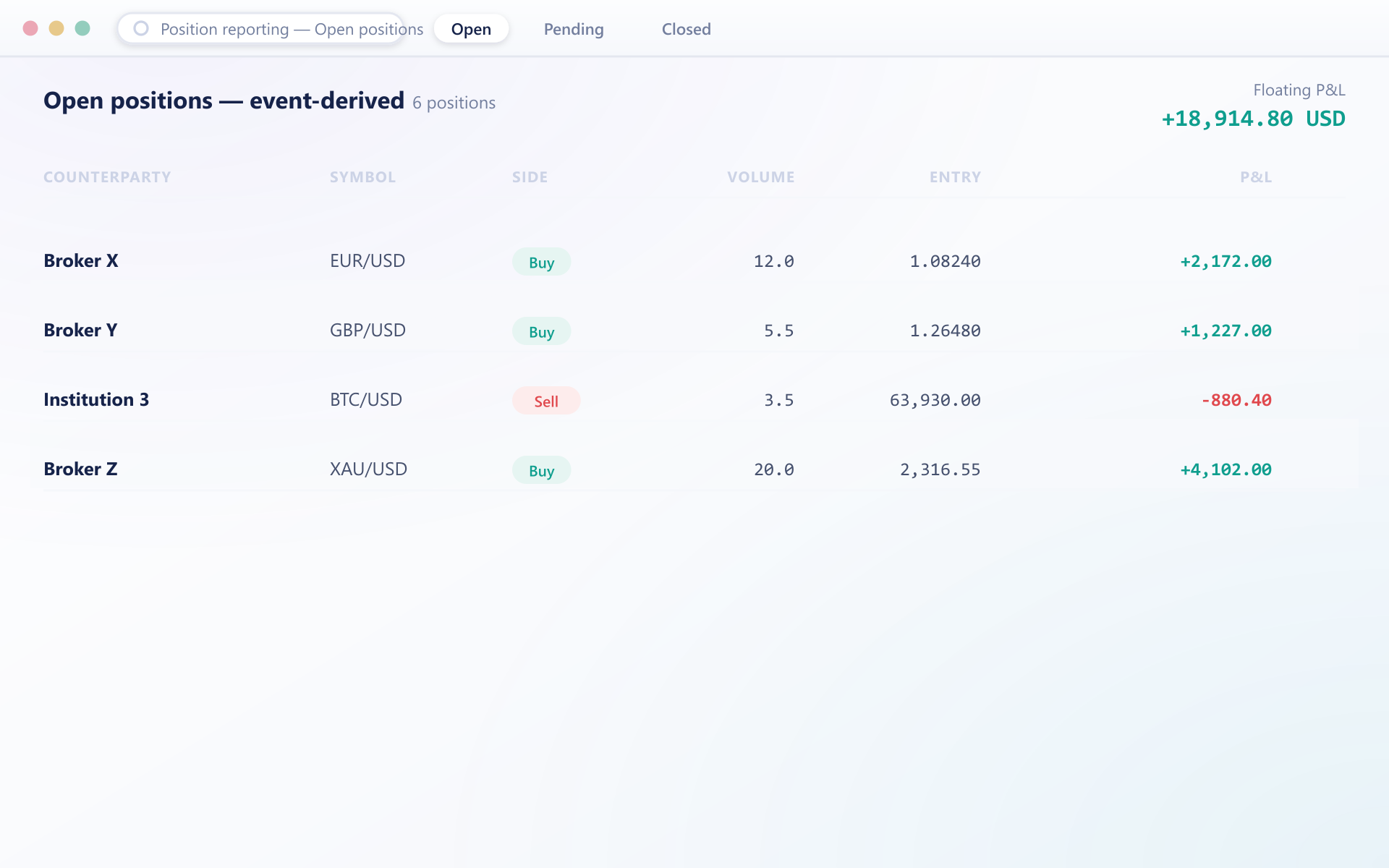
Every open position, with live P&L
The same event log that drives the scheduled reports also powers a live positions table, so the board pack and the desk view never disagree.
The reports a connectivity desk actually runs
The questions risk, finance and management ask every week
Exposure
Net and gross exposure by instrument, asset class and counterparty, with limit utilisation shown alongside.
Execution quality
Fill rate, rejection rate, latency and realised slippage per venue and per instrument, which is the basis of any serious renewal discussion.
Revenue attribution
Markup, commission and warehousing result reported separately, so it is clear which part of the profit came from taking risk.
Counterparty activity
Volume, revenue, rejection rate and limit utilisation per counterparty, on a schedule or on demand.
Hedge attribution
Each hedge linked to the exposure that triggered it, which makes the true cost of serving a counterparty measurable.
From event to board pack
There is no build step, which is why there is no window when the numbers disagree
- Record
Written once, at the moment
Every quote, order, fill, hedge and rejection is written as an event when it happens, with the venue, counterparty and rule that produced it attached.
- Query
Reports read the source
Each report is a query over those events rather than over an extract, so there is no step at which a record can be lost or duplicated.
- Scope
Cut the way the question needs
Period, instrument, venue, counterparty and asset class combine freely, and the result can be saved as a named report.
- Deliver
Arrives without being requested
A saved report runs on a schedule to a named recipient list, in the same format as an on-demand export.
What one source of truth prevents
Most reporting arguments are really two systems disagreeing about the same event.
One set of numbers
Risk, finance and management argue about the decision, not whose figures are right.
No reconciliation window
Live queries mean the platform and the reports are never out of step.
Factual venue reviews
Execution statistics turn a renewal into a conversation about measured performance.
Honest profitability
Hedge attribution shows what a counterparty actually costs to serve.
FAQ
Position reporting: common questions
5 short answers to what teams ask before a demo.
No. Reports query the same event log that drives exposure and account state. That removes the extract step where records are usually lost, duplicated or delayed.
They reflect events as they are written, so a report run mid-session includes activity from moments earlier. There is no nightly build.
Yes. Fill rate, rejection rate, latency and realised slippage are recorded per venue and per instrument, which gives a factual basis for commercial discussions.
Yes. Each hedge references the exposure movement that triggered it, which is what makes it possible to calculate the real cost of serving a given counterparty or instrument.
Yes. The underlying events are available over the API, so your own business intelligence tooling reads the same source the built-in reports use.
Still have a question?
A specialist will answer it directly, with your set-up in mind.
Ask a specialistBuild the report your risk committee asks for
Tell us the breakdown you need each month and we will construct it in the console during the call.