For Liquidity Providers
If you make prices, this is how they reach the market
BridgeX handles the unglamorous half of being a liquidity provider: onboarding takers, publishing your stream on their terms, enforcing entitlements and showing you what each of them actually did with it.
Stays with you
Handled by the platform
See it live
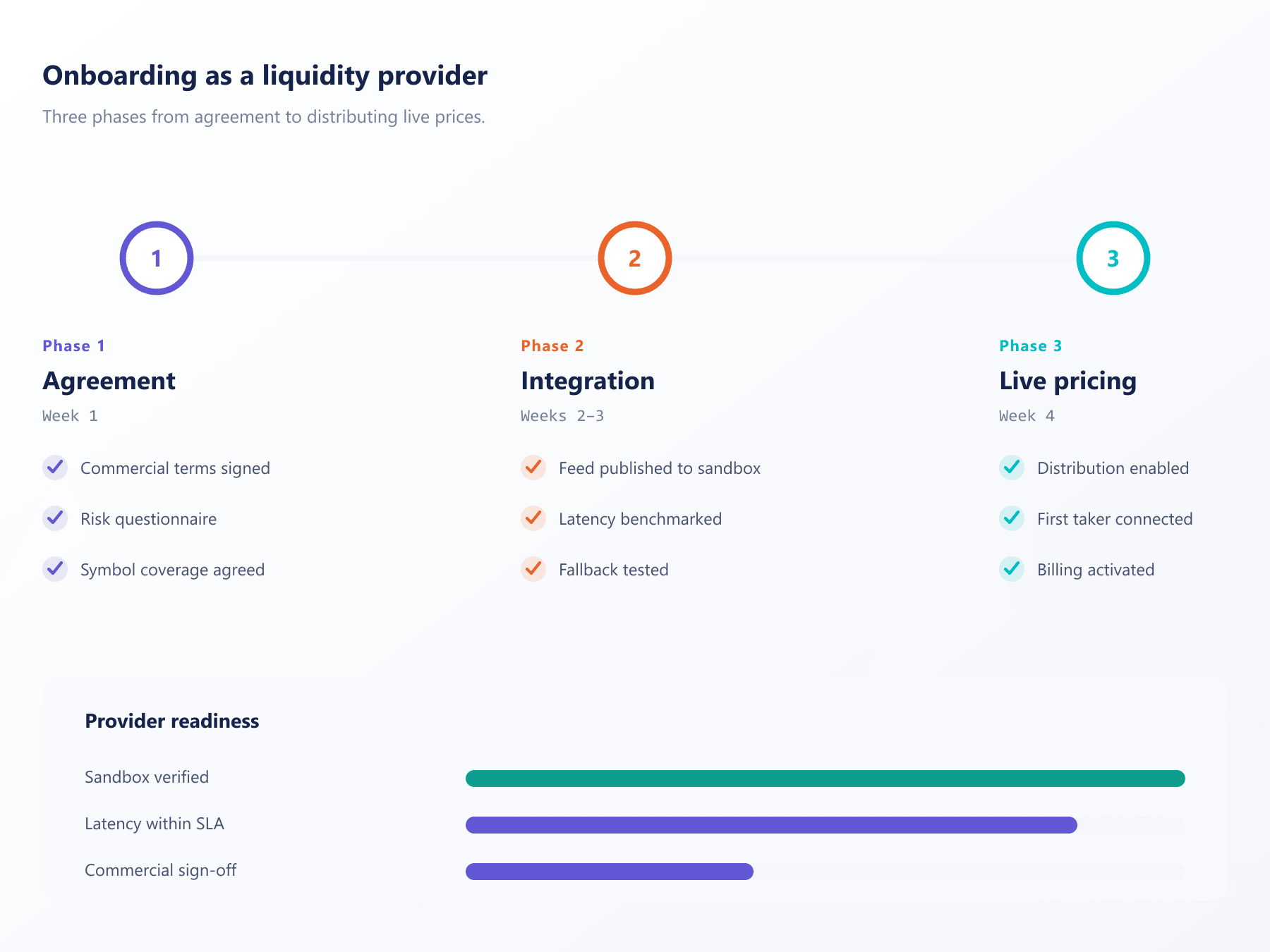
Onboarding, staged rather than all at once
A three-phase timeline tracks a taker from agreement through certification to a live stream, so nothing about going live is a surprise.
What distribution actually requires
Making a good price is your job. Everything after that is infrastructure.
Taker onboarding
Each recipient is created with credit, entitlements and pricing from the agreement, then given a scoped session and certified before going live.
Per-recipient pricing
Markup and spread floor attach to the relationship, so two takers receive genuinely different prices from the same book.
Entitlement control
Which instruments a taker sees is explicit. An instrument outside their set is never published to them in any form.
Credit enforcement
Exposure per taker is capped and enforced at the point of decision, with staged warning and restriction before a breach.
Activity analytics
Volume, fill rate, rejection rate and revenue per taker, which is what tells you which relationships are worth the credit you extend.
From agreement to live distribution
The same sequence for every taker, which is what makes onboarding repeatable
- 1Agree
Terms become configuration
Credit limit, instrument entitlements, markup and settlement terms from the signed agreement are entered as the taker's account.
- 2Connect
A scoped session
The taker receives FIX or API credentials scoped to exactly their entitled instruments, with nothing else visible.
- 3Certify
Proven before production
They exercise their intended flows against a test session, including rejection handling, before live pricing is enabled.
- 4Measure
Watch what they do with it
Volume, hit rate and revenue per taker are reported continuously, so a relationship that is not working is visible early.
What a distribution layer is worth
Providers usually lose more to operational friction than to bad pricing.
Repeatable onboarding
A new taker is configuration plus certification, not a bespoke project each time.
Terms that hold
Entitlements and credit are enforced by the engine rather than remembered by a person.
Relationship visibility
Per-taker analytics show which counterparties justify the credit you extend.
One stream, many terms
Preferential pricing for one taker costs nothing to maintain.
FAQ
Distributing pricing: common questions
5 short answers to what teams ask before a demo.
Yes. Markup and spread floor attach to the relationship, so the same underlying book produces genuinely different streams for different takers with no additional maintenance.
Instrument scope is part of the taker's account. Anything outside it is never published to them and never accepted from them, regardless of what else you distribute.
Exposure per counterparty is capped and checked before an order is accepted, with staged warning and restriction beforehand, so the limit prevents rather than reports.
Configuration is quick; certification is the variable part and depends on the taker's own readiness. The sequence is identical for every taker, which is what makes it predictable.
Yes. Volume, fill rate, rejection rate and revenue are reported per taker, which turns a subjective view of a relationship into a measurable one.
Still have a question?
A specialist will answer it directly, with your set-up in mind.
Ask a specialistPlan your distribution with us
Tell us who you want to price and on what terms, and we will map the onboarding and entitlement model.