Risk & Accounts
Margin accounts in the unit your counterparty reports in
A fund in Frankfurt closes its books in euros. A digital-asset desk measures itself in bitcoin. When every statement arrives in dollars, both of them convert it by hand and both of them eventually disagree with you. In BridgeX each margin account can carry its own base asset.
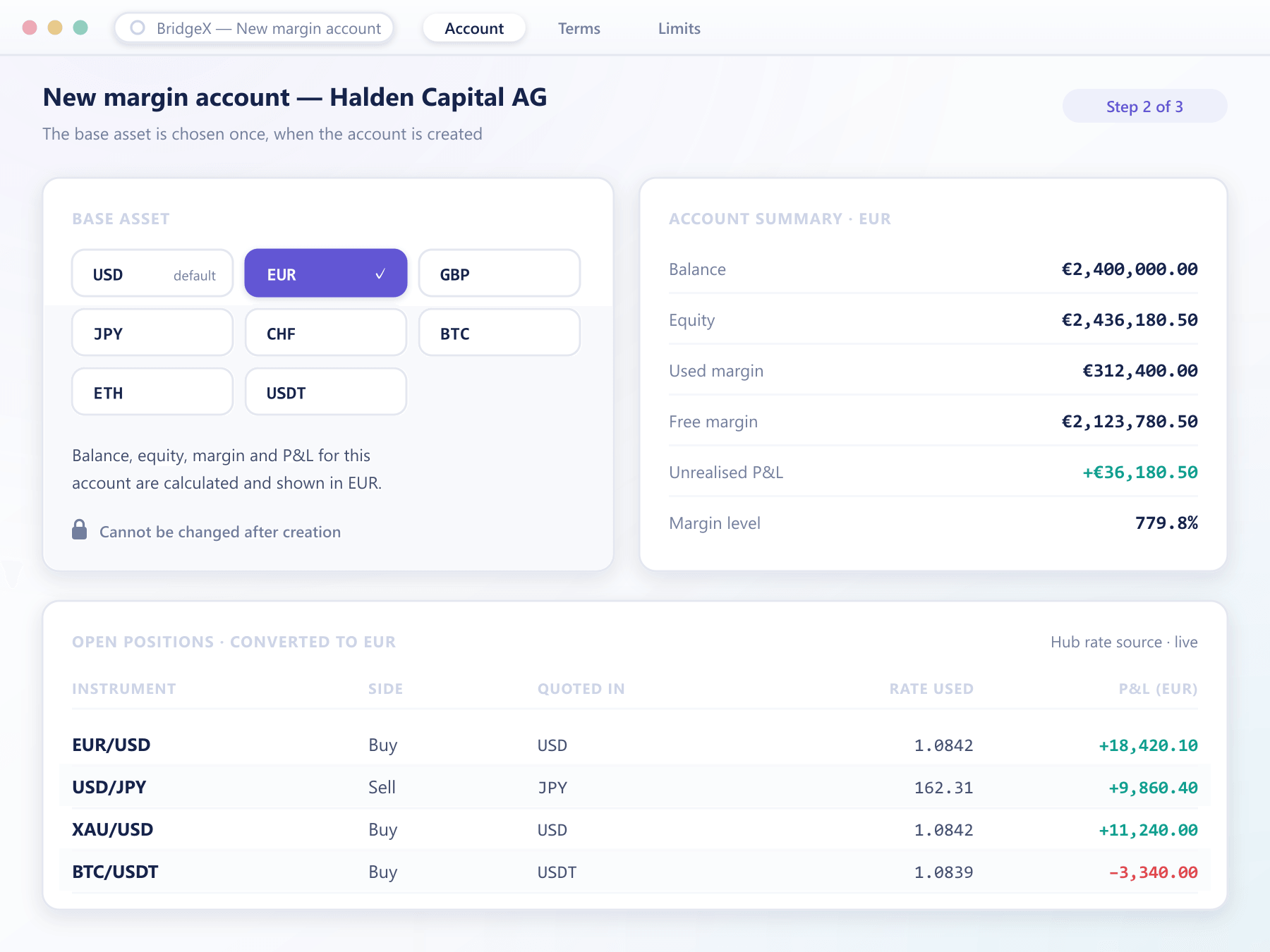
What the base asset changes
One account, one unit, every figure
The asset is chosen when the account is opened, and from then on the account is calculated and displayed in it rather than translated after the fact.
Fiat or digital, from your hub
Pick from whatever assets the hub already carries: euro, sterling, yen and other major currencies, or bitcoin, ether and dollar stablecoins.
Every number in the same unit
Balance, equity, used and free margin, and open and closed P&L are all computed in the account's base asset, not converted for display only.
Instrument prices converted for you
A yen account can hold EUR/USD. Quotes in other currencies are converted into the base asset with the hub's own rate source as part of each calculation.
Fixed from the first day
The base asset is set once, when the account is created, so an account's history never mixes units and margin readings stay comparable over time.
Dollar accounts stay as they are
USD is still the default for new accounts, and accounts opened before this option existed carry on without any migration.
Where it appears
The base asset runs through the whole account
Chosen at onboarding
The admin picks the base asset in the same form that sets credit, instrument entitlements and execution model for the counterparty.
Margin policy reads it
Warning, restriction and stop-out levels are evaluated in the account's own asset, so a threshold means the same thing on the console and on the statement.
Reports and the API carry it
Statements, exports and API responses return values in the base asset, so a counterparty's own systems can ingest them without a conversion step.
One rate source for everything
Conversions use the rate source configured for the hub, which keeps the console, the statement and the API in agreement on every figure.
Base asset questions
Before you open a non-dollar account
4 short answers to what teams ask before a demo.
No, and that is deliberate. A history in one unit is what keeps margin and P&L comparable. If a counterparty wants a different unit, open a second account in that asset and transfer between the two.
Any asset enabled on your hub. Desks usually offer EUR, GBP and JPY for fiat counterparties and BTC, ETH or USDT for digital-asset ones, but the list is yours to set.
Nothing. USD remains the default when an account is created, and accounts that already exist keep the unit and history they have.
Automatically, at the moment each figure is calculated, using the hub's configured rate source. Margin and P&L therefore move with the market in the account's own asset rather than lagging a daily conversion.
Still have a question?
A specialist will answer it directly, with your set-up in mind.
Ask a specialistOpen a test account in euros, yen or bitcoin
We will create one on a staging hub so your operations team can read a margin statement in the unit your counterparties actually report in.