Risk & Accounts
Each counterparty gets exactly the terms you agreed
Credit limit, instrument entitlements, markup, commission and execution model are all properties of the counterparty. Changing what you agreed is an edit, not a negotiation with your own systems.
Counterparty — Institutional client
ActiveCredit utilisation
41%Credit limit
- Utilisation 41%
Entitlements
- FX majors, metals
Pricing
- Preferential markup
Execution model
- Partial hedge
See it live
A counterparty’s whole position, in one place
Balance, holdings and currency exposure for the account sit together, so the terms you set are always read against the position they actually govern.
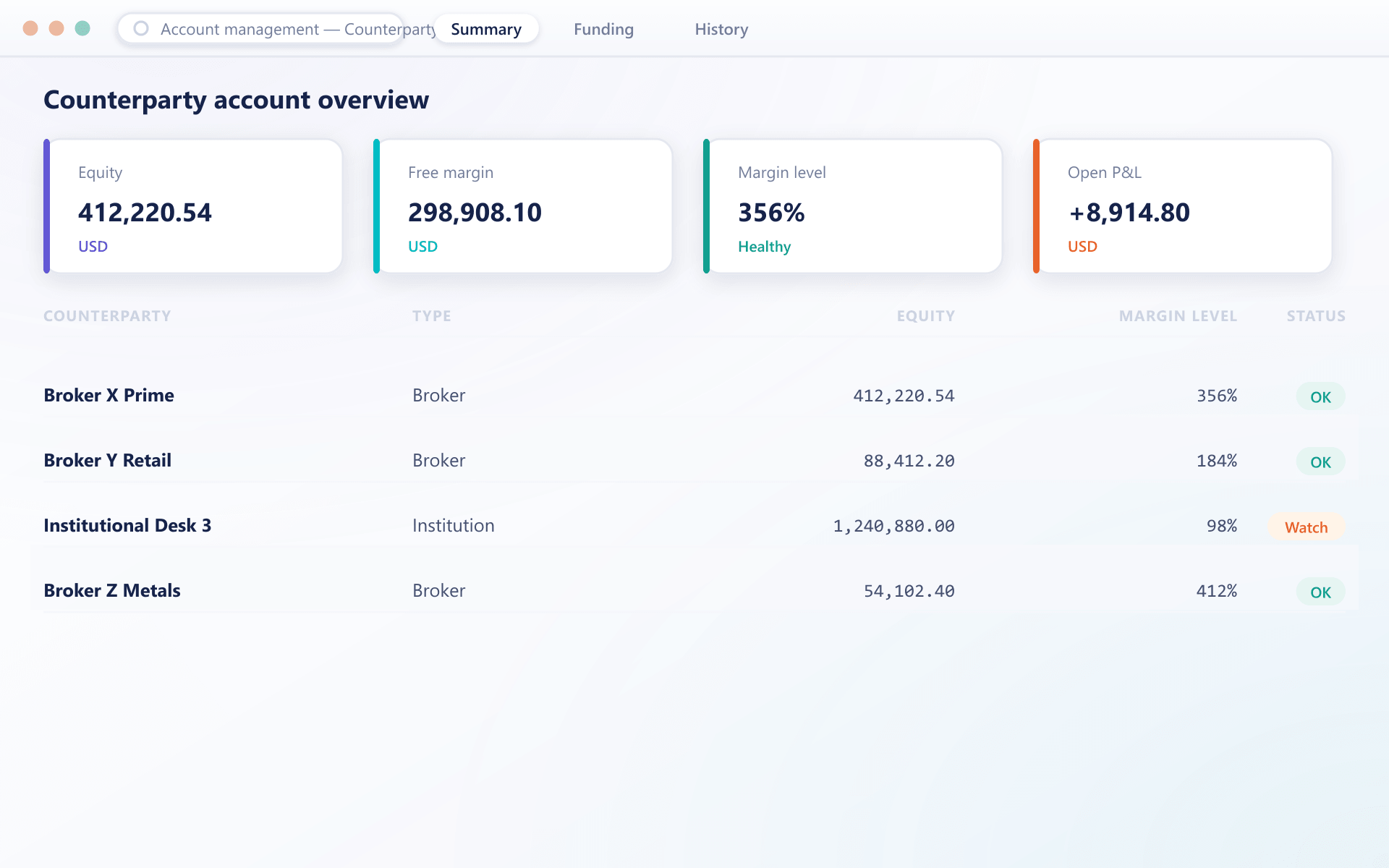
What an account carries
One object holds the whole relationship
Which is why nothing ends up configured in two places.
Credit limit
A ceiling on outstanding exposure per counterparty, with live utilisation and automatic restriction as they approach it.
Instrument entitlements
Which instruments this counterparty may see and trade. Anything outside the set is neither quoted to them nor accepted from them.
Pricing terms
Markup, spread floor and commission attach to the account, so preferential terms for one relationship affect nobody else.
Execution model
Whether their flow is passed through, retained or partially hedged is set here, and can differ per instrument within the account.
Swap profile
Overnight financing is charged from a swap profile that covers every asset class, including instruments that share a base or quote asset, rather than a rate typed per symbol.
Interest on idle balances
Cash that sits in the account without backing a position can earn interest at a rate you set, credited on a schedule and shown on the statement.
Attributed changes
Every amendment records the previous and new value with the operator identity, so a disputed term has a documented history.
Onboarding a counterparty
From signed agreement to first order, without a deployment anywhere
- Create
The account and its terms
The counterparty is created with credit limit, entitlements, pricing and execution model entered from the commercial agreement.
- Connect
Their session, their scope
A FIX session or API credentials are issued, scoped to exactly the instruments the account is entitled to.
- Certify
Proven before it is live
The counterparty exercises their intended flows against a test session, including rejections, before production trading is enabled.
- Operate
Terms applied on every order
Pricing, entitlements and limits are resolved from the account at the moment they act, so an amendment takes effect immediately.
What account-level control removes
Most connectivity pain is really commercial terms encoded in the wrong place.
Faster onboarding
A new counterparty is configuration plus certification, not a project.
No term drift
Because terms live on the account, two counterparties cannot silently end up on the same pricing.
Contained credit risk
Live utilisation and automatic restriction mean a limit is enforced rather than reported.
Defensible history
Attributed changes settle disputes about what was agreed and when.
FAQ
Counterparty accounts: common questions
7 short answers to what teams ask before a demo.
Yes. Markup, spread floor and commission are properties of the account, so preferential terms for one relationship have no effect on what anyone else is quoted.
Utilisation is visible live, an alert is raised at a configured warning level, and new exposure-increasing orders are restricted before the limit is actually breached.
Yes. Instrument entitlements are per account. An instrument outside a counterparty's set is neither quoted to them nor accepted from them, regardless of what else you publish.
On their next order. Terms are resolved from the account at the moment of the action rather than copied at onboarding, so an amendment applies immediately without a migration step.
Yes. Every amendment writes the previous value, the new value, the operator identity and the timestamp to the audit log.
Through a swap profile attached to the account. One profile can hold rates for every asset class, and instruments that share a base or quote asset can draw on the same rate instead of being configured one symbol at a time.
Yes, if you enable it. Idle balances accrue interest at the rate you configure for the account or its group, and each credit appears on the statement as its own line.
Still have a question?
A specialist will answer it directly, with your set-up in mind.
Ask a specialistOnboard a counterparty on the call
Bring a real agreement and we will configure the account, session and entitlements live.