For Brokers
Connectivity projects have a reputation. This one is scoped.
Most of the work is configuration and certification, and most of the elapsed time is waiting on venue credentials. Here is the sequence, what we do, and the specific things we need from your side.
Environment and sessions
Mapping and rules
Certification
Instrument by instrument
See it live
The rollout, staged and visible
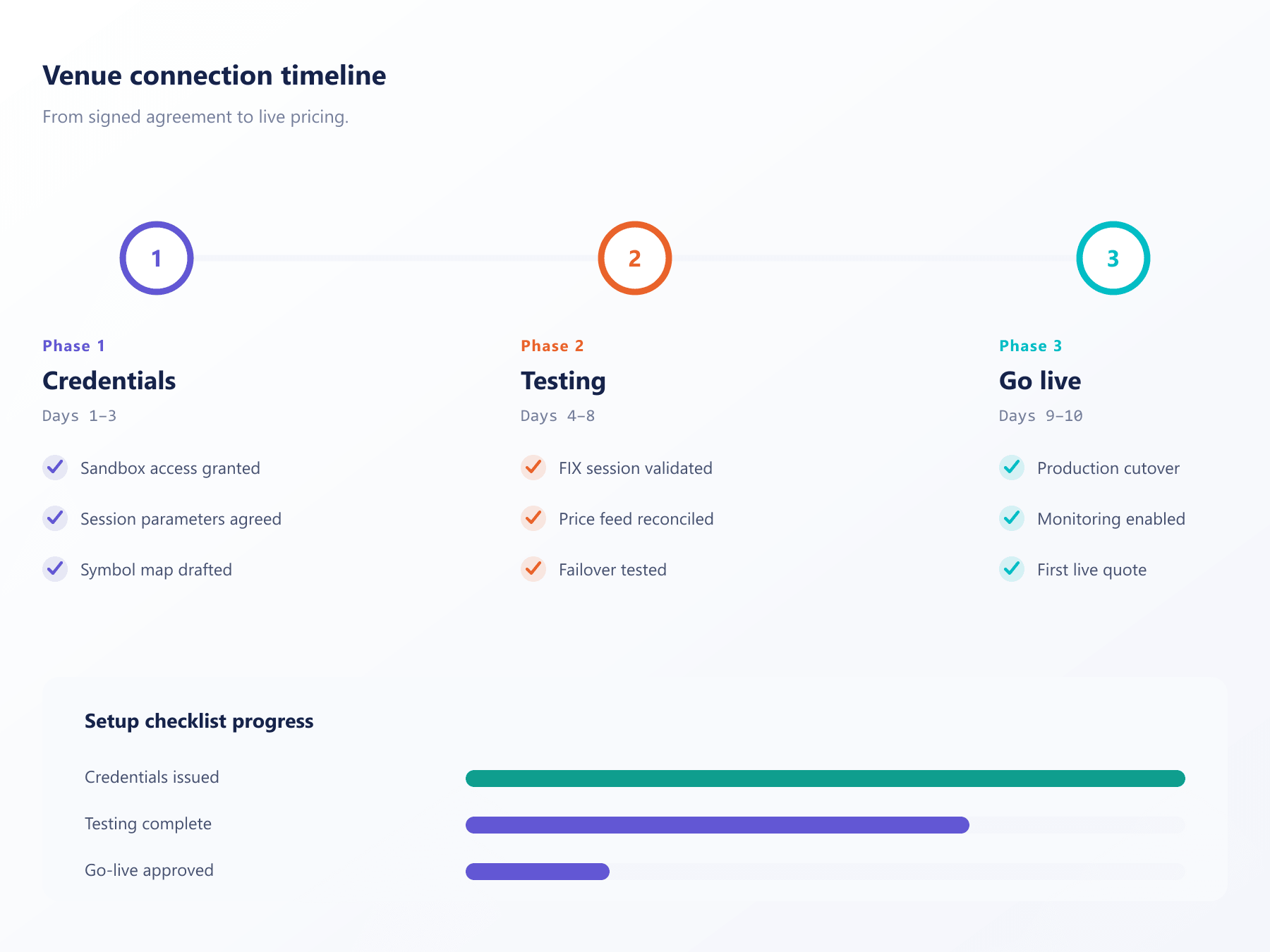
A three-phase deployment timeline shows where a connection stands, from provisioning through certification to go-live.
What you are actually asked for
Being specific about this up front is the difference between two weeks and two months
Request credentials on day oneVenue credentials
The single biggest source of delay. Requesting them from your venues on day one usually determines the whole timeline.
Instrument list
Which instruments you intend to price and trade, so mapping and validation can be prepared before sessions are live.
Routing intent
How you want flow handled per instrument. It does not need to be final — it needs to be a starting position we can configure.
A technical contact
One person who can answer questions about your platform's expectations, available during certification.
A test window
Time from your team to exercise the flows they care about, including the failure paths, before production.
The rollout, phase by phase
Elapsed time depends mostly on venue responsiveness, which is why credentials come first
- Days 1–3
Environment and first sessions
Your instance is provisioned and the first venue sessions configured. Credentials are exchanged and connectivity is proven in a test environment.
- Days 4–7
Mapping and rules
Symbol mapping, aggregation settings, markup and routing rules are entered, and incoming pricing is validated against expectation.
- Days 8–10
Certification
Your platform and any counterparties exercise their flows against test sessions, including rejections and cancellations.
- Go-live
Enabled instrument by instrument
Execution models are switched on per instrument rather than all at once, so the first live day is deliberately uneventful.
Why a staged go-live matters
The goal for the first production day is that nothing interesting happens.
Contained risk
Enabling instrument by instrument means a surprise affects one symbol, not the book.
Predictable timeline
Naming the dependencies up front stops the schedule slipping quietly.
Your team ready
Certification doubles as training, so operations know the console before they need it.
Reversible
Any instrument can be switched back to its previous handling in a single console change.
FAQ
Connecting: common questions
6 short answers to what teams ask before a demo.
The configuration and certification work is typically around two weeks. Elapsed time is usually determined by how quickly your venues issue credentials, which is why we ask you to request them on day one.
One integration against our API or a FIX session, and a technical contact available during certification. Everything behind that — venues, mapping, routing — is configuration on our side.
No, and we would advise against it. Execution models are enabled instrument by instrument, so you can start with a small set and expand as confidence builds.
Any instrument can be switched back to its previous handling with a single console change that takes effect on the next order. Nothing about a rollback requires a deployment.
Certification doubles as it. Your operations team works through the console during the test window, so by go-live they have already used the tools they will need.
Yes. The two are connected, so business clients can be onboarded, funded and have their hub balances managed from the BrokerOS back office instead of being set up twice. Margin accounts on the hub are created from the client record you already hold.
Still have a question?
A specialist will answer it directly, with your set-up in mind.
Ask a specialistGet a rollout plan for your venues
Tell us which venues and instruments you need and we will come back with a dated plan and the dependencies.