For Brokers
The volume numbers, delivered before anyone asks
Someone always needs to know what traded. Rather than making your team export it, the hub produces turnover reports on a schedule and sends them to where your desk already works.
What arrives
Reports that land rather than reports you fetch
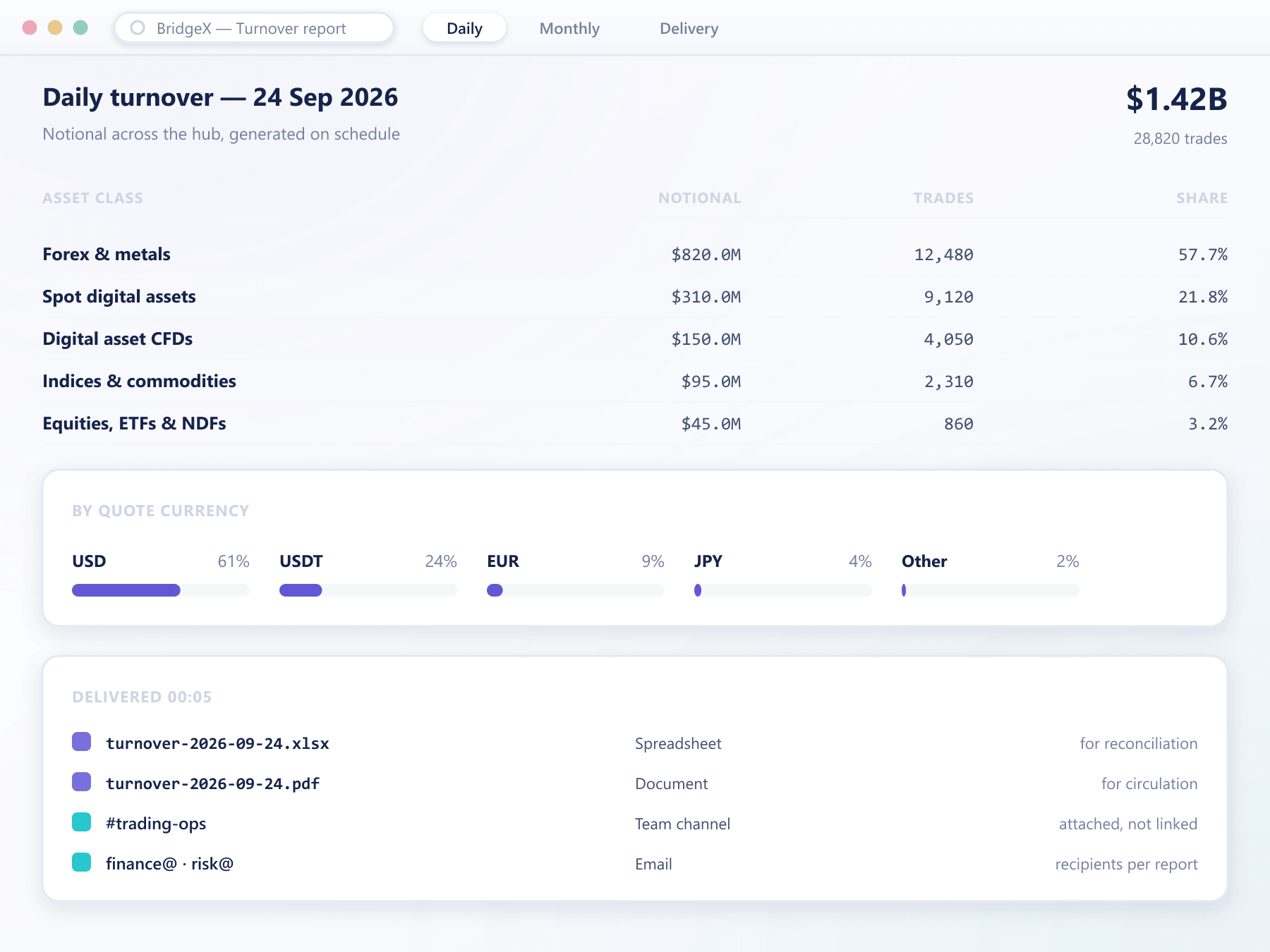
Daily and monthly notional turnover, broken down the way finance and risk actually ask for it.
Daily and monthly runs
A daily report for the trading day and a monthly one covering the full calendar month, both generated without anyone starting them.
Broken down three ways
Notional volume split by instrument, by asset class and by quote currency, because those are the three cuts that get asked for.
Machine and human formats
The same run produces a spreadsheet for reconciliation and a document for circulation, so nobody reformats anything.
Delivered to your channels
Reports arrive in the team channel and by email to the recipients you configure, rather than sitting in a portal waiting to be found.
Built for busy hubs
Execution and balance data is collected in batches, so reports stay current during peak activity instead of falling behind the flow.
Reconcilable against platforms
Order identifiers are consistent between the hub and connected platforms, so a line in the report can be matched rather than argued about.
How it runs
From trading day to delivered report
The period closes
A trading day or calendar month ends and the run starts on its own schedule.
Data is assembled
Executions, balances and orders are gathered in batches so the run does not compete with live trading for resources.
Both formats produced
A spreadsheet and a document are generated from the same figures, so the two can never disagree.
Sent where people are
The report lands in your configured channel and inboxes, attached rather than linked.
Reporting questions
What is in the numbers
4 short answers to what teams ask before a demo.
No. Provider analytics is about execution quality per counterparty. This is notional turnover across the hub, which is what finance and management ask for rather than what a trading desk watches.
Yes, per report. Recipients and channels are configured independently, so a daily report can go to the desk while the monthly one goes to management.
It should not. Data collection is batched specifically so that a busy session does not delay the run or the trading.
Yes. Order identifiers are unified across the hub and connected platforms, which is the part that usually makes reconciliation painful.
Still have a question?
A specialist will answer it directly, with your set-up in mind.
Ask a specialistTell us what your desk exports by hand today
Bring the report someone rebuilds every morning and we will show it arriving on a schedule instead.