Execution
Most flow offsets itself if you give it a moment
Hedging every fill individually pays away the spread on flow that would have netted out anyway. Partial hedging holds exposure inside a threshold and sends out only what genuinely accumulates.
One aggregation window
Illustrative. With a threshold of 2.0, five fills produce one small hedge instead of five.
See it live
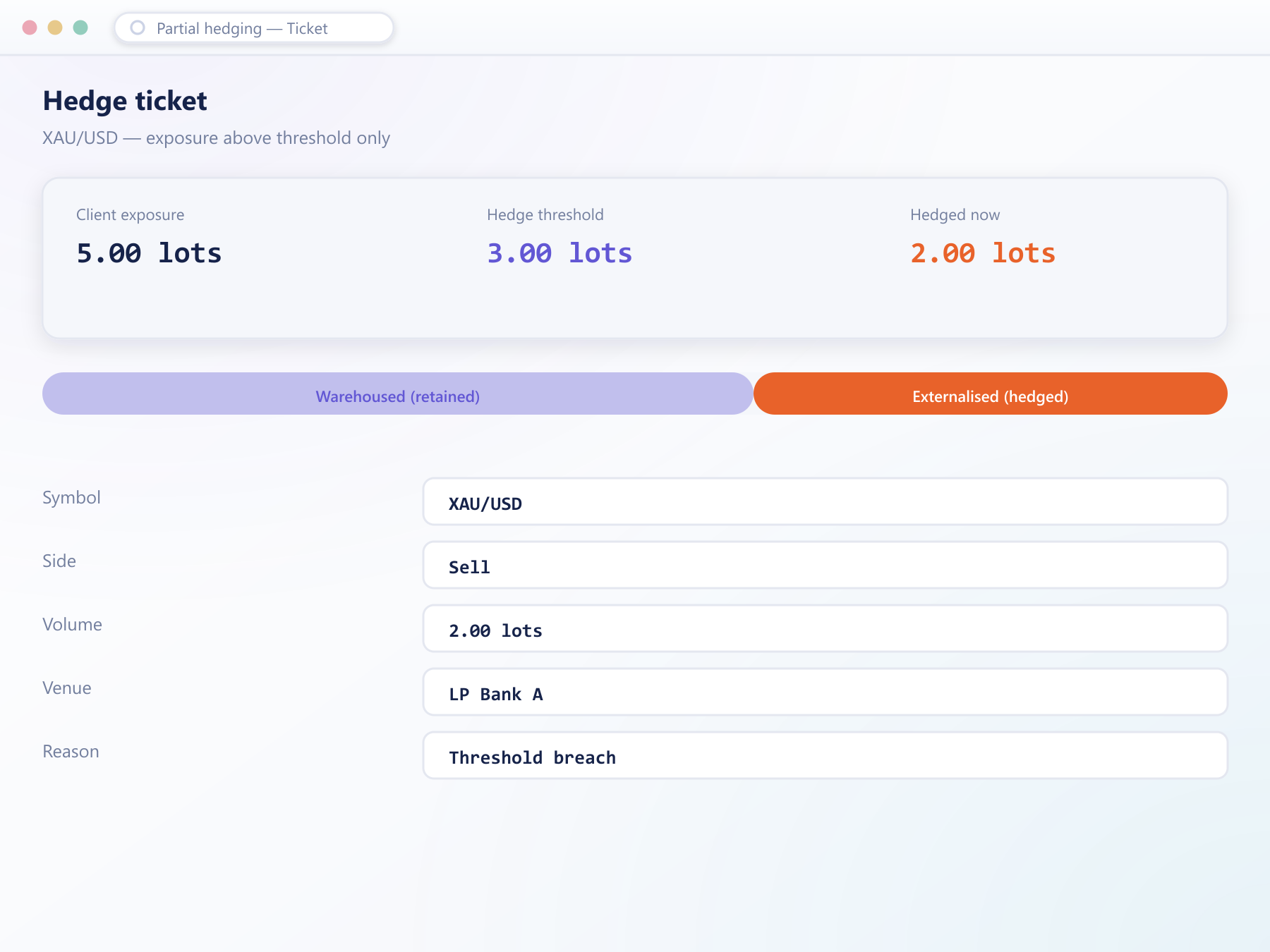
The hedge order, when one is actually placed
Once net exposure clears the threshold, the excess becomes a single order ticket linked back to the fills that produced it.
How the excess is decided
The mechanism is simple. The parameters are where the money is.
01Per-instrument thresholds
Each instrument carries its own retained exposure threshold, because what is comfortable in a major pair is reckless in a thin one.
02Aggregation window
Fills within a short window are netted before any hedge is placed, which is what lets naturally offsetting flow cancel itself out.
03Excess only
Only the amount above the threshold is sent to the market, so the hedge is as small as the position genuinely requires.
04Linked attribution
Every hedge references the exposure movement that triggered it, which is what makes the true cost of serving a counterparty measurable.
05Measured against the alternative
Reporting compares what partial hedging actually cost against what hedging every fill would have cost.
From several fills to one hedge
The netting step is what distinguishes this from hedging with extra steps
- Accumulate
Fills join the net position
Each client fill adjusts net exposure for that instrument. Offsetting fills reduce it without any external order being placed.
- Net
The window does the work
Within the aggregation window, opposing flow cancels. Only what remains at the end of the window is considered for hedging.
- Compare
Measured against the threshold
If net exposure is inside the threshold, nothing is sent. If it is outside, the excess becomes a hedge order.
- Hedge
Routed like any other order
The hedge goes through the normal routing rules, so it benefits from aggregation and best-price selection like client flow does.
Where the saving actually comes from
It is not from taking more risk. It is from not paying to hedge risk that never existed.
Fewer external orders
Netted flow never reaches a venue, so it never pays a spread.
Risk still bounded
The threshold is a hard limit, so the retained exposure is a number you chose.
Better hedge pricing
One larger hedge often executes better than many small ones.
Provable saving
Reporting compares actual cost against the full-hedge alternative rather than asserting a benefit.
FAQ
Partial hedging: common questions
5 short answers to what teams ask before a demo.
It is configured per instrument, and it should reflect how much exposure you are genuinely comfortable holding in that instrument. A liquid major and a thin token warrant very different figures.
It lets naturally offsetting fills cancel before any hedge is placed. Without it, two opposing client trades seconds apart would each be hedged separately, paying spread twice for no net exposure.
No, only the amount above it. The intent is to keep retained exposure at the threshold rather than to flatten the book entirely.
Through the same routing rules as client orders, so a hedge benefits from aggregation and best-price selection rather than defaulting to one venue.
Yes. Reporting compares the cost actually incurred against what hedging every fill would have cost over the same period, so the saving is measured rather than assumed.
Still have a question?
A specialist will answer it directly, with your set-up in mind.
Ask a specialistModel your thresholds against real flow
Send us a period of your trade history and we will show what partial hedging would have cost against what you paid.