Aggregation
Offer crosses that no venue quotes directly
Where a pair has no natural market, BridgeX derives it from the legs that do. The synthetic recalculates whenever either leg moves, and a fill on it can be hedged by executing those legs.
What makes a synthetic tradeable
It is easy to display a derived price. It is harder to make one you can safely fill.
Derived from live legs
The synthetic price is computed from the current aggregated price of each leg and recalculated whenever either of them moves.
Spread composed, not invented
The resulting spread reflects the spread of both legs plus your markup, which is what keeps the quote hedgeable at the price you showed.
Leg availability respected
If either leg becomes stale or loses depth, the synthetic widens or withdraws rather than continuing to quote a price you cannot cover.
Automatic leg hedging
A fill on the synthetic can trigger execution of the underlying legs immediately, so the exposure is closed rather than merely recorded.
Configured, not coded
A new synthetic is defined by naming its legs and the relationship between them. No development work is involved.
See it live
Pick the legs, get the cross
A synthetic instrument starts with choosing which quoted legs derive it — the console shows exactly which instruments make up each synthetic price.
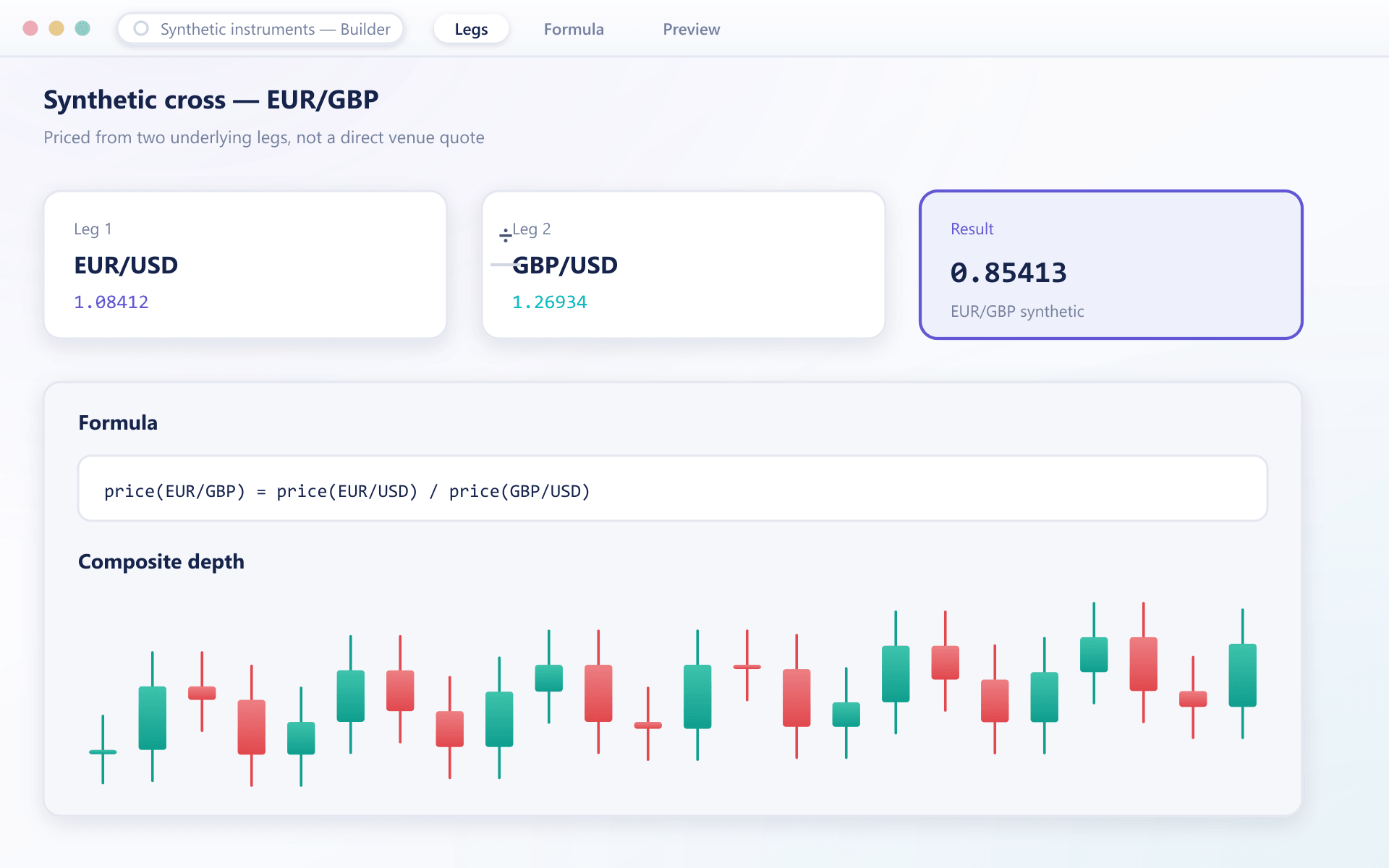
From two legs to one tradeable price
The construction and, more importantly, what happens after a fill
- Define
Name the legs and the relationship
A synthetic is declared as a combination of two or more instruments already priced in the platform, along with how they combine.
- Price
Computed on every leg update
Bid and offer are derived from the corresponding sides of each leg, so the composed spread accounts for the cost of crossing both.
- Guard
Withdrawn when the legs cannot support it
Staleness or insufficient depth on any leg widens the synthetic or removes it, which prevents quoting a price you would have to fill at a loss.
- Hedge
Filled once, hedged in parts
A fill triggers orders on each leg according to the relationship, and the resulting executions are linked back to the synthetic trade.
Why synthetics are worth offering
They expand what you can quote without expanding what you have to source.
A wider instrument list
Offer crosses your clients ask for without finding a venue that makes them.
No extra liquidity cost
The legs are already sourced, so the synthetic adds coverage without adding providers.
Risk that closes
Automatic leg hedging means the exposure is genuinely covered, not just measured.
Differentiation
Clients notice when a broker quotes the pair everyone else refuses.
FAQ
Synthetic instruments: common questions
5 short answers to what teams ask before a demo.
From the current aggregated price of each leg, combined according to the relationship you declared. Bid and offer are derived from the corresponding sides of each leg, so the spread reflects the true cost of crossing both.
The synthetic widens or is withdrawn, depending on how you configure it. It is never left quoting a price that the underlying legs could not actually support.
Yes. A fill triggers orders on each leg according to the declared relationship, and those executions are linked back to the original synthetic trade for reporting and reconciliation.
No. It is configuration: name the legs, declare how they combine, set the markup. There is no code change and no deployment involved.
Yes, though each additional leg widens the composed spread and adds another dependency that can withdraw the quote. Most practical synthetics use two.
Still have a question?
A specialist will answer it directly, with your set-up in mind.
Ask a specialistBuild a synthetic on the call
Name a cross your clients keep asking for and we will construct and price it live.