Execution
Decide what happens to the risk, per instrument
Some flow you want off your book immediately. Some you are happy to keep. Most desks want both, decided instrument by instrument and counterparty by counterparty — and changed without a release.
Straight-through
- Risk
- None retained
- Cost
- External execution on every fill
- Suits
- Size you would rather not hold
Warehousing
- Risk
- Fully retained
- Cost
- No external execution
- Suits
- Flow you are comfortable holding
Partial hedge
- Risk
- Capped at your threshold
- Cost
- Only on the excess
- Suits
- Most books, most of the time
See it live
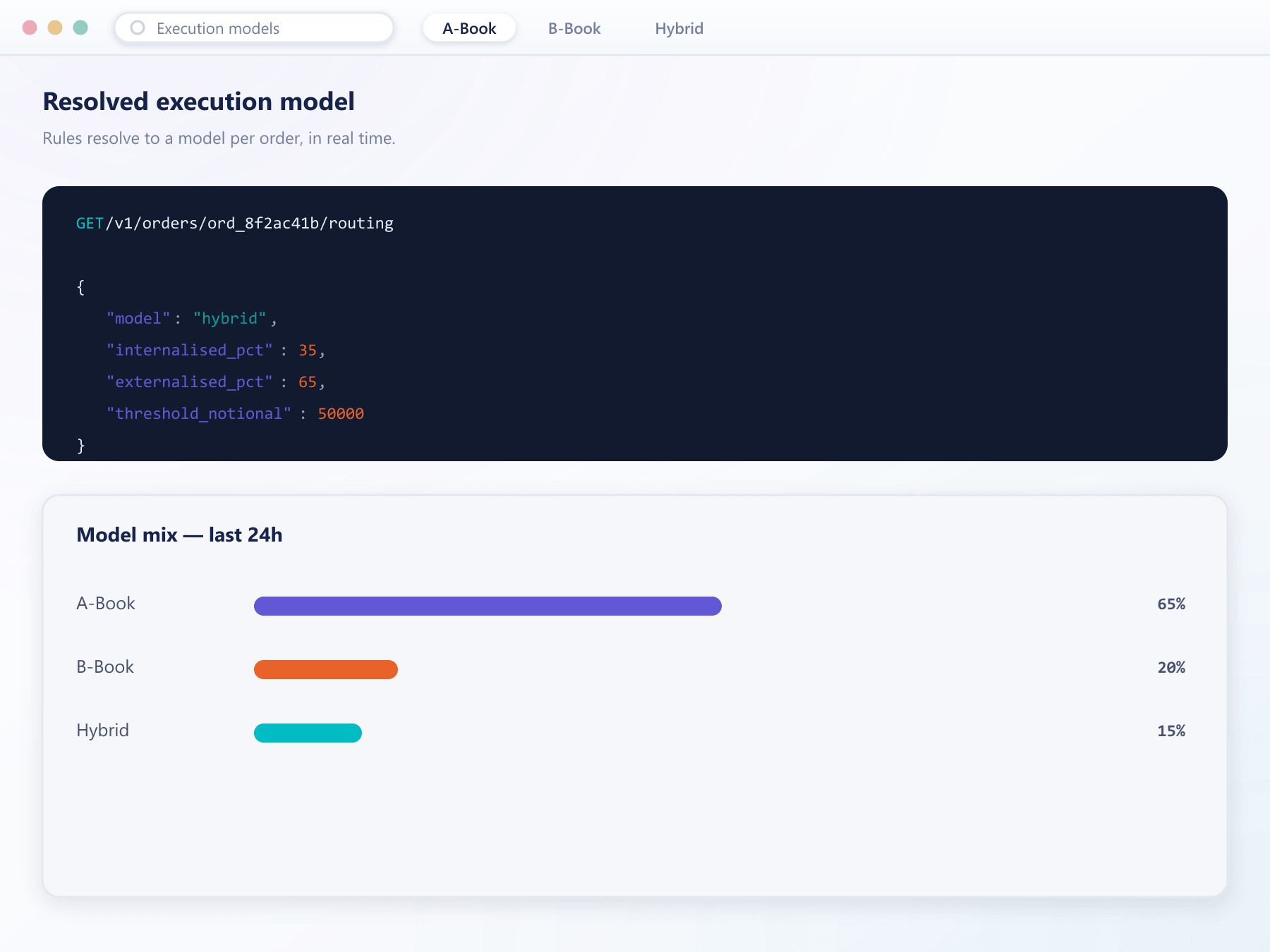
The model, resolved per request
A call against the routing API returns the resolved execution model and threshold for an instrument and counterparty, exactly as the engine applies it.
The three models, and when each earns its place
There is no universally correct answer, which is exactly why it needs to be configurable
Straight-through
The client order is mirrored to the venue immediately. You keep the markup and carry no market risk, which suits size you would rather not hold.
Risk warehousing
The order is filled from your own book and the exposure is retained deliberately, removing external execution cost on flow you are comfortable holding.
Partial hedging
Exposure below a threshold stays with you and anything above it is hedged automatically, so small flow is not sent out at unnecessary cost.
Resolved per relationship
The model is a property of the instrument and the counterparty, so the same symbol can be handled differently for two clients.
Changed without a release
Switching model is a console change that takes effect on the next order, which matters when conditions turn quickly.
What happens after a client fill
The client is filled first in every model. What differs is what happens next.
- Fill
The client is served immediately
The client's order is matched and confirmed from your book. Nothing about the execution model delays their confirmation.
- Resolve
The model is looked up
The applicable model is read from the instrument and the counterparty, together with any threshold that applies to partial hedging.
- Act
Pass on, retain, or hedge the excess
Straight-through places a matching order at the venue. Warehousing does nothing further. Partial hedging places an order only for the amount above the threshold.
Pass onRetainHedge excess - Attribute
Result split by source
Markup, spread and warehousing result are reported separately, so it is clear which part of the profit came from taking risk and which did not.
Why a mixed book usually wins
Hedging everything is safe and expensive. Hedging nothing is cheap and eventually catastrophic.
Lower execution cost
Flow you retain costs nothing to execute, and most desks retain more than they expect.
Bounded risk
Thresholds mean retained exposure never exceeds a figure you agreed in advance.
Responsive to conditions
Switching to straight-through before a known event takes seconds.
Honest attribution
Separating warehousing result from markup shows what risk-taking actually earned.
FAQ
Execution models: common questions
5 short answers to what teams ask before a demo.
Yes, and most desks do exactly that. The model is a property of the instrument and the counterparty, so a liquid major and a thin token can be handled quite differently.
No. The client is matched and confirmed from your book first. Whatever happens to the risk afterwards runs behind that confirmation.
Against a net exposure threshold per instrument. Exposure below it is retained; the amount above it is hedged automatically, and the hedge is linked to the fill that triggered it.
It is a console change that applies from the next order. Positions already open keep the treatment they were established under.
Yes. Markup, spread and warehousing result are reported as separate lines, so the return from holding risk is visible rather than blended into a single profit figure.
Still have a question?
A specialist will answer it directly, with your set-up in mind.
Ask a specialistReview your book strategy with us
Bring your current approach and we will configure it as models and thresholds during the call.