Aggregation
One book, built from sources that rarely agree
Real feeds arrive at different rates, with different precision and the occasional bad tick. Aggregation is mostly the discipline of deciding what to ignore, and doing it consistently.
Merged offer side
Depth from 3 sourcesIllustrative ladder. Dots show how many sources contribute size at each level.
What happens between the feeds and the price
Five steps, in this order, every time a quote arrives
Depth merged in full
Every price level from every source contributes to the aggregate, so available size is visible rather than inferred from the top of book.
Stale sources dropped
A feed that has not updated within its threshold is excluded from the merge, because a stale price that looks tradeable is worse than no price.
Outliers rejected
Quotes outside a sanity band relative to the consensus are discarded rather than averaged in, so one bad tick cannot move your book.
Source weighting
Sources can be weighted or prioritised per instrument, so a provider that is strong in one asset class carries more influence there.
Markup applied last
Your spread floor and markup are applied to the merged book, per instrument and per counterparty, after all filtering has taken place.
See it live
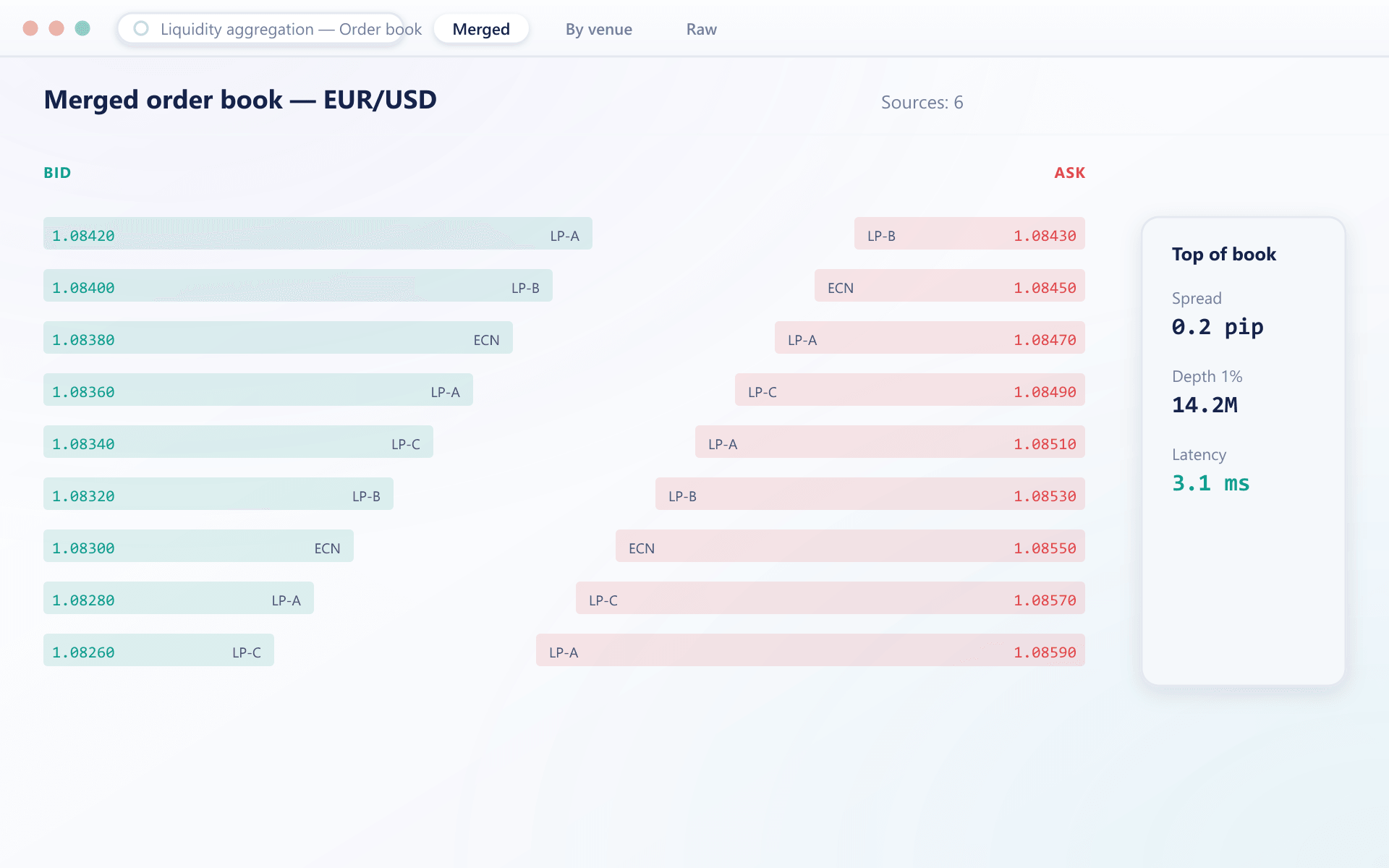
The merged book, not six separate ones
What reaches the terminal is already the aggregated ladder — depth summed across sources, staleness and outliers already filtered out.
A quote’s journey into the book
Four stages, each of which can drop the quote entirely
- 6sourcesArrive
Normalised at the edge
The quote is translated from the venue's symbols and precision into your canonical definitions before anything else looks at it.
- 5surviveFilter
Sanity checks before the merge
Staleness and outlier checks run against the source's own thresholds and against the current consensus across sources.
- 1ladderMerge
Levels combined by price
Surviving levels from every source are combined into a single ladder, with size at each price summed across contributors.
- 1quoteShape
Your commercial terms applied
Markup and spread floor are applied per counterparty, producing the price that is actually published and traded on.
Why aggregate at all
One source is simple. It is also a spread you cannot improve and an outage you cannot survive.
Tighter spreads
Combining sources improves the best bid and offer without changing your markup.
More available size
Merged depth means larger orders fill without walking a single venue's thin book.
Outage resilience
Losing one source narrows the book rather than stopping trading.
Leverage on price
When any provider is one of several, their commercial terms are negotiable.
FAQ
Aggregation: common questions
5 short answers to what teams ask before a demo.
Full depth. Every level from every surviving source contributes, with size summed at each price. That is what allows a larger order to be filled without walking one venue's thin ladder.
By time since its last update, measured against a threshold configured per source and per instrument. Once it is exceeded, the source stops contributing to the merge until it updates again.
Outlier rejection. A quote outside a sanity band relative to the consensus across sources is discarded rather than averaged in, so a single misbehaving feed cannot distort the aggregate.
Yes. Sources can be weighted or given priority per instrument, which is useful when a provider is genuinely strong in one asset class and mediocre in another.
After filtering and merging, per instrument and per counterparty. Applying it last means your commercial terms are never distorted by a source that was about to be filtered out anyway.
Still have a question?
A specialist will answer it directly, with your set-up in mind.
Ask a specialistCompare your current book against an aggregated one
Give us your sources and we will show you the merged book alongside what you are quoting today.