For Brokers
The tenth venue integration is the one that hurts
The first venue connection is a project. The tenth is a maintenance burden that never ends. BridgeX collapses all of them into one interface your platform talks to, and absorbs every upgrade behind it.
Without a bridge
Six integrations, six upgrade cycles, six ways to fail.
With one
New venues arrive as configuration. Your platform never notices.
See it live
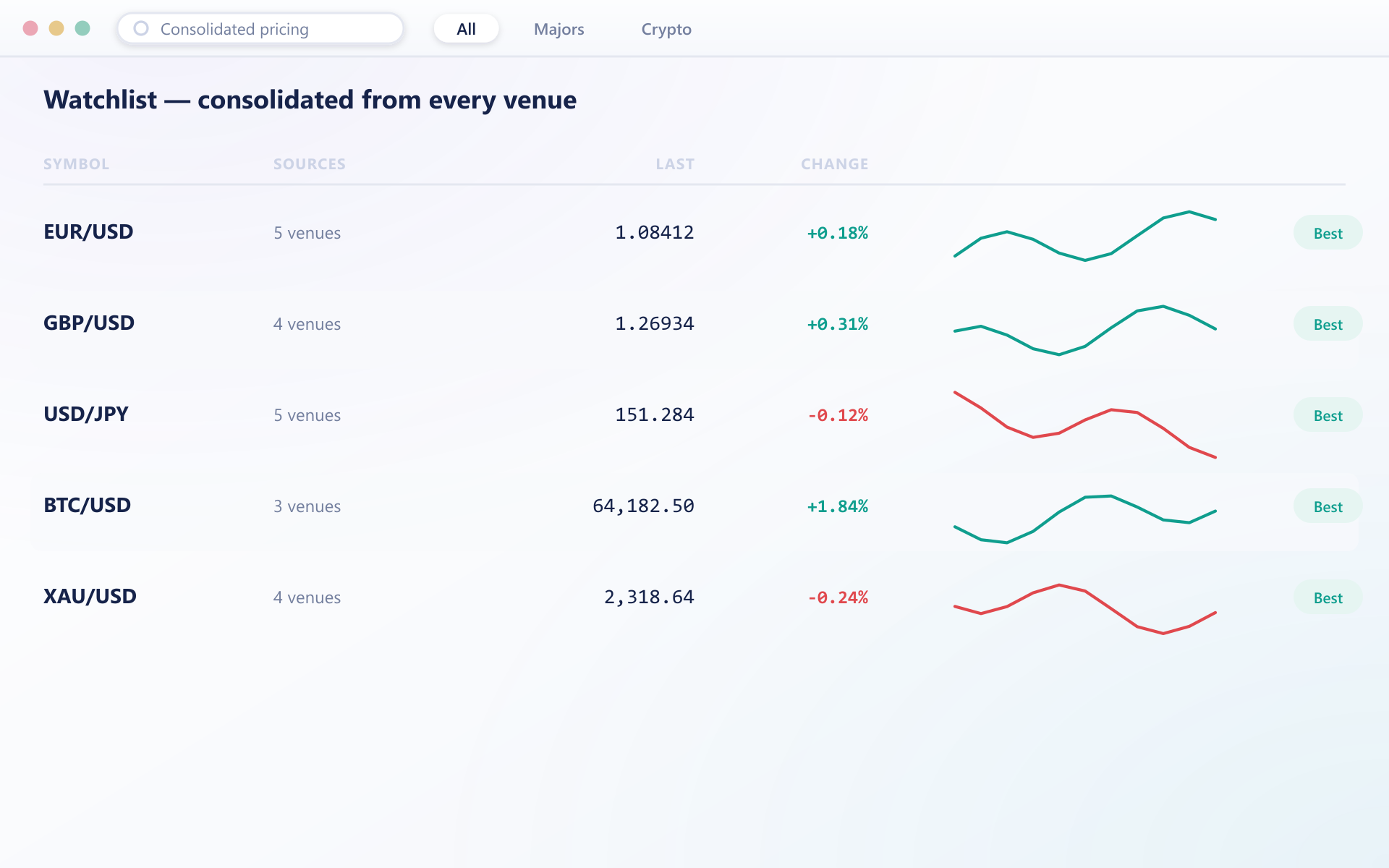
Every venue’s pricing, one list
Instruments from every connected venue sit in a single watchlist with live spreads, so the consolidation behind the scenes shows up as one clean screen.
What consolidating connectivity gives you
The value is not the first integration. It is every one after it.
Normalised everything
Symbols, precision, size units and rejection reasons arrive in one consistent vocabulary regardless of which venue produced them.
Upgrades absorbed
When a venue changes its protocol, the change is handled in the integration layer rather than in every system that talked to it.
One credential model
Venue credentials are held and rotated in one place instead of being scattered across systems and environments.
Aggregated by default
Once several venues are connected they can be aggregated into one book, so consolidation improves pricing rather than merely tidying it.
Adding a venue after you are live
The sequence that used to be a quarter of engineering time
- 01Configure
The venue is set up in the console
Session settings, credentials, symbol mapping and conventions are entered. Nothing is deployed and your platform is untouched.
- 02Validate
Pricing checked before it counts
Incoming quotes are compared against the existing sources, which catches a mapping error before any client sees it.
- 03Enable
Joins aggregation and routing
The venue is added to the instruments it can price, with its weighting in the routing rules set explicitly.
- 04Observe
Its performance is measured
Fill rate, latency and slippage are attributed to it from the first order, so its value is evident rather than assumed.
What it frees up
Mostly engineering time, which is the resource that decides how fast everything else moves.
Roadmap back
Connectivity maintenance stops consuming the team that should be building product.
Commercial freedom
Adding or dropping a venue becomes a business decision, not an engineering estimate.
Better pricing
Consolidation makes aggregation possible, which tightens what you can quote.
Fewer failure modes
One integration to monitor rather than ten each failing in their own way.
FAQ
Multi-venue access: common questions
5 short answers to what teams ask before a demo.
No. Your platform integrates with BridgeX once. Venues behind it are configuration, so adding one requires no code change, no deployment and no downtime on your side.
The change is absorbed in the integration layer. Your platform continues to see the same normalised interface and generally needs no change at all.
Entirely. Routing rules are yours to configure — best price, preferred venue, weighted distribution or exposure-based. Consolidating connectivity does not mean giving up routing decisions.
Yes. Some desks keep a direct line to a primary venue and route everything else through BridgeX. That is a normal arrangement and nothing prevents it.
Fill rate, rejection rate, latency and realised slippage are recorded per venue from the first order, which gives a factual basis for deciding where flow should go.
Still have a question?
A specialist will answer it directly, with your set-up in mind.
Ask a specialistTell us which venues you need to reach
We will tell you which are supported today, what each would involve, and what a realistic rollout looks like.