Execution
Hedging that runs as a programme, not a reflex
When thousands of small fills arrive from hundreds of accounts, hedging each one is expensive and hedging none of them is reckless. Systematic hedging pools the exposure into one hedge book and works it down on rules your desk sets, in the instrument and at the venue you choose.
What the programme does
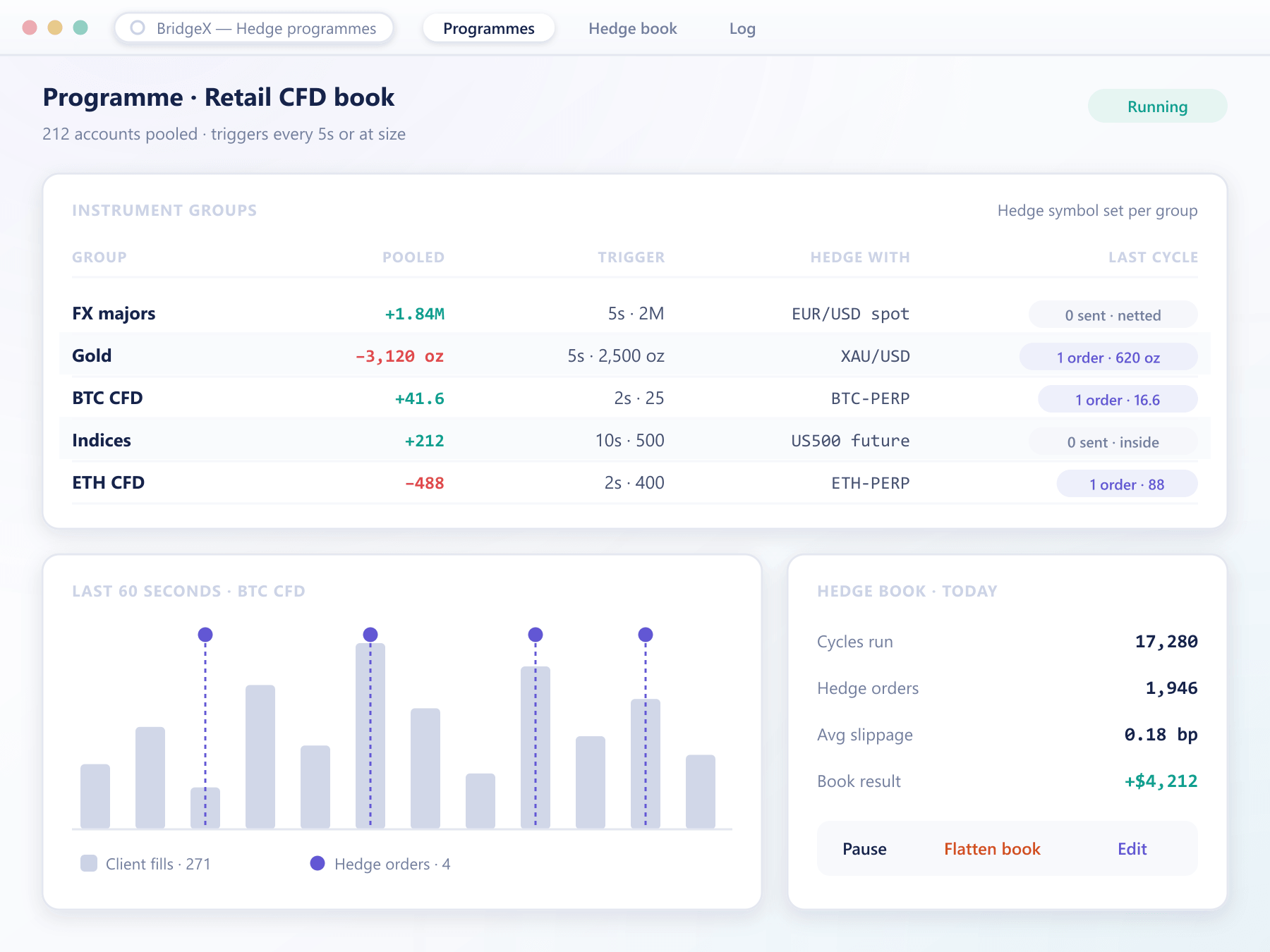
One hedge book instead of a thousand tickets
Partial hedging decides how much exposure to keep. Systematic hedging decides when the rest is hedged, where it goes and what it is hedged with.
Exposure pooled across accounts
Accounts you assign to a programme feed one hedge book per instrument group, so offsetting flow from different counterparties cancels before anything is sent out.
Time and size triggers
Hedge on a fixed interval, when the pooled position moves past a size you set, or on whichever comes first. Each instrument group carries its own trigger.
Hedge in a different instrument
The symbol clients trade and the symbol used to hedge are set independently, so a CFD book can be covered in spot or perpetuals where the liquidity is deeper.
Built for bursty flow
Copy-trading surges and algorithmic bursts are absorbed into the book and leave as a handful of hedge orders, without queueing behind live client traffic.
A hedge book with its own result
Hedge fills, slippage against the trigger price and the running result of the book are recorded apart from client trading, so the cost of covering risk is visible.
The desk stays in charge
Pause a programme, suspend one instrument, change a trigger or flatten the book by hand. Every intervention is logged against the operator who made it.
One cycle
From scattered fills to a covered position
Fills join the pool
Every fill on an assigned account adjusts the pooled position for its instrument group. Opposing fills reduce it without any external order.
A trigger fires
The interval elapses or the pooled position crosses its size threshold. Inside a partial-hedging threshold, the retained amount is left alone.
The hedge is mapped and routed
The residual is translated into the hedge instrument and sent through the normal routing rules to the providers the programme allows.
The book is reconciled
Fills update the hedge book, slippage is measured against the trigger price, and the cycle waits for the next trigger.
Hedging questions
Before you switch a programme on
5 short answers to what teams ask before a demo.
Partial hedging sets how much exposure you are willing to keep. Systematic hedging decides when the remainder is covered, with which instrument and through which providers. Most desks run the two together: the threshold says how much, the programme says when and where.
Yes. The client-facing symbol and the hedge symbol are configured separately for each instrument group, so exposure from a CFD can be covered with a spot or perpetual contract where depth and fees suit the size better.
Size triggers keep working between intervals, so a sharp move in the pooled position is hedged without waiting for the clock. The desk can also tighten a trigger or flatten the book manually at any time.
Only the ones you assign. A programme can cover a whole book, a single counterparty, or a group such as all copy-trading accounts, and an account can be removed without stopping the rest.
The hedge book records every fill and the slippage against the price at which the trigger fired. Its result is reported apart from client trading, so the cost of carrying the programme is a figure rather than an estimate.
Still have a question?
A specialist will answer it directly, with your set-up in mind.
Ask a specialistReplay a busy day through a hedge programme
Share a day of fills and we will show how many hedge orders a pooled book would have sent, and what they would have cost.