Risk & Accounts
Rates that follow the size of the business
A flat margin rate undercharges the account that builds one enormous position and overcharges the one that trades small. A flat commission does the same to a counterparty whose volume has tripled. BridgeX tiers both, so the terms scale with the account instead of being renegotiated every quarter.
Two kinds of tier
Margin by position size, commission by volume
Both are profiles. You build them once and assign them to accounts or groups, and an account's terms change by moving it to another profile.
Margin charged per slice
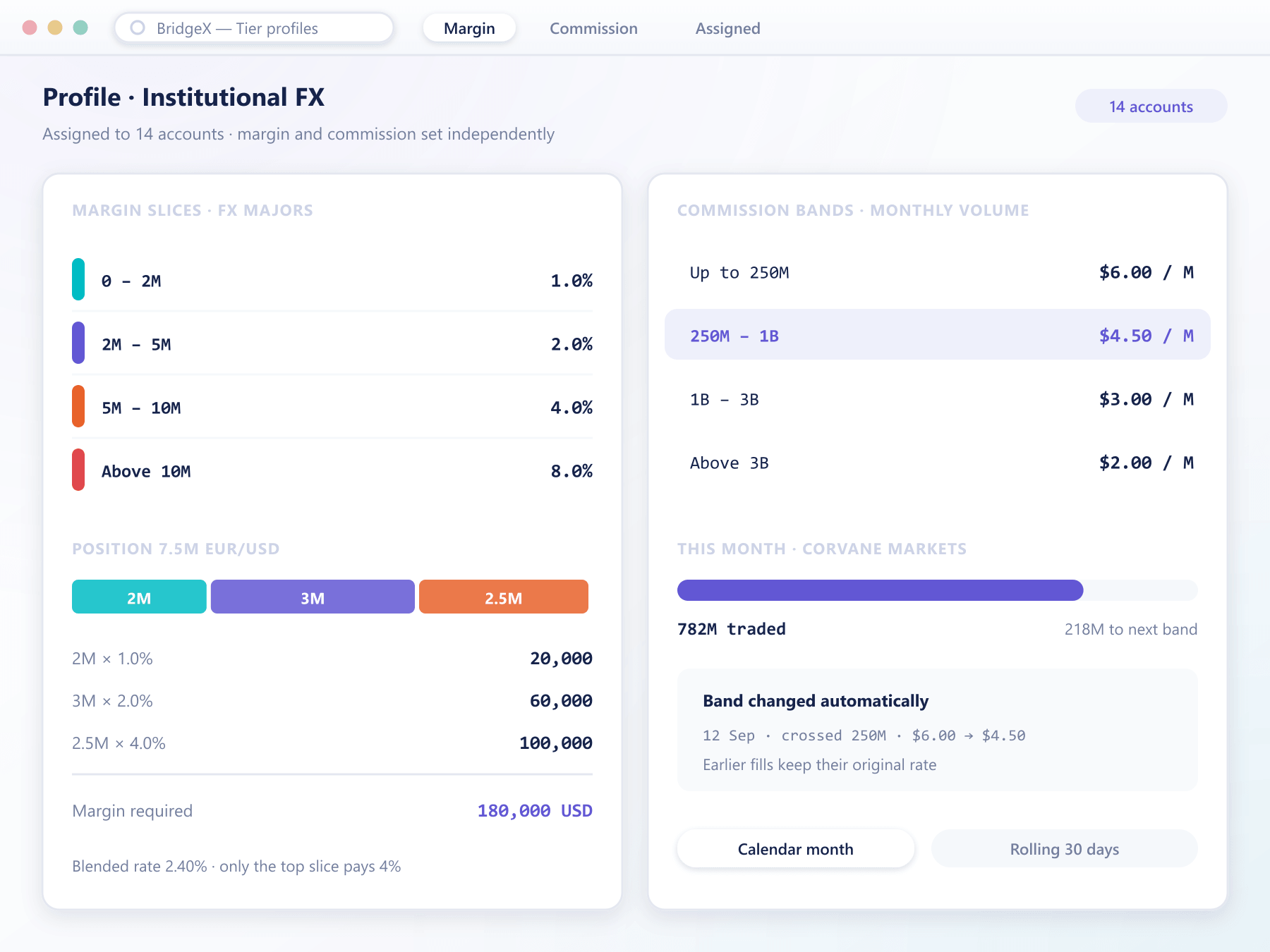
A position is divided into size slices and each slice carries its own rate, for example a lower rate on the first block and progressively higher rates above it.
Requirement that rises with size
Because larger slices cost more margin, concentration becomes expensive before it becomes dangerous, without a hard limit stopping normal trading.
Set per instrument or asset class
Majors, metals, indices and digital assets can each have their own slice boundaries and rates inside one profile.
Commission that steps down
Commission bands are defined by traded volume. When an account crosses a band, the lower rate applies automatically without anyone editing the account.
A volume period you define
Measure volume over a calendar month or a rolling window, so the tier reflects the relationship as it is now rather than as it was when it was signed.
Visible on every statement
Statements and the API show which margin slice and which commission band applied to each figure, so a counterparty can check the arithmetic.
How a profile is used
Built once, applied everywhere
Build the profile
Define margin slices per instrument group and commission bands per volume level in the console.
Assign it
Attach the profile to an account or a group. Accounts without one keep the flat rates they already have.
Let it move
Margin is recalculated as positions grow or shrink, and the commission band updates as volume accumulates during the period.
Report it
Each fill and margin reading carries its tier, so reporting and reconciliation show exactly which rate applied.
Tier questions
How the arithmetic works
4 short answers to what teams ask before a demo.
Each slice of the position is charged at its own rate and the results are added together. Only the part of the position that falls into a higher slice pays the higher rate, so growing a position never re-prices the part already open.
From the first fill after the account crosses the band's volume level. Fills before that point keep the rate they were charged, which keeps statements stable.
Yes. Margin and commission profiles are assigned independently, so you can tier one and keep the other flat.
With a calendar-month period, the account starts the month in the band set as its floor. With a rolling window, the band follows the volume inside the window, so there is no cliff on the first day of the month.
Still have a question?
A specialist will answer it directly, with your set-up in mind.
Ask a specialistModel your largest counterparty on tiers
Send us a month of their positions and volume and we will show what tiered margin and commission would have charged against your flat rates.