Aggregation
The book you built, delivered to everyone who needs it
Your trading platform, your counterparties and your internal systems all need the aggregated price. Each gets it with its own entitlements, its own update rate and a snapshot that is internally consistent.
One aggregated book
Your trading platform
Institutional counterparty
Risk and reporting
What distribution has to handle
Publishing prices is easy. Publishing the right prices at a rate the recipient can absorb is the work.
Per-recipient entitlements
Each consumer receives only the instruments it is entitled to, which keeps you inside both your data licensing and your commercial agreements.
Throttling per consumer
Update rate is matched to what each recipient can actually process, so a slow consumer does not fall progressively further behind.
Consistent snapshots
A newly connected consumer receives a coherent snapshot of the book before incremental updates begin, rather than assembling it from fragments.
Multiple transports
The same book is published over FIX market data sessions and over the streaming API, so each consumer uses what suits it.
Per-recipient shaping
Markup and spread floor are applied per recipient, so two counterparties can receive genuinely different prices from one book.
See it live
One book, published on each recipient’s terms
The same aggregated list reaches your platform, your counterparties and your internal systems — each with its own entitlements and update rate.
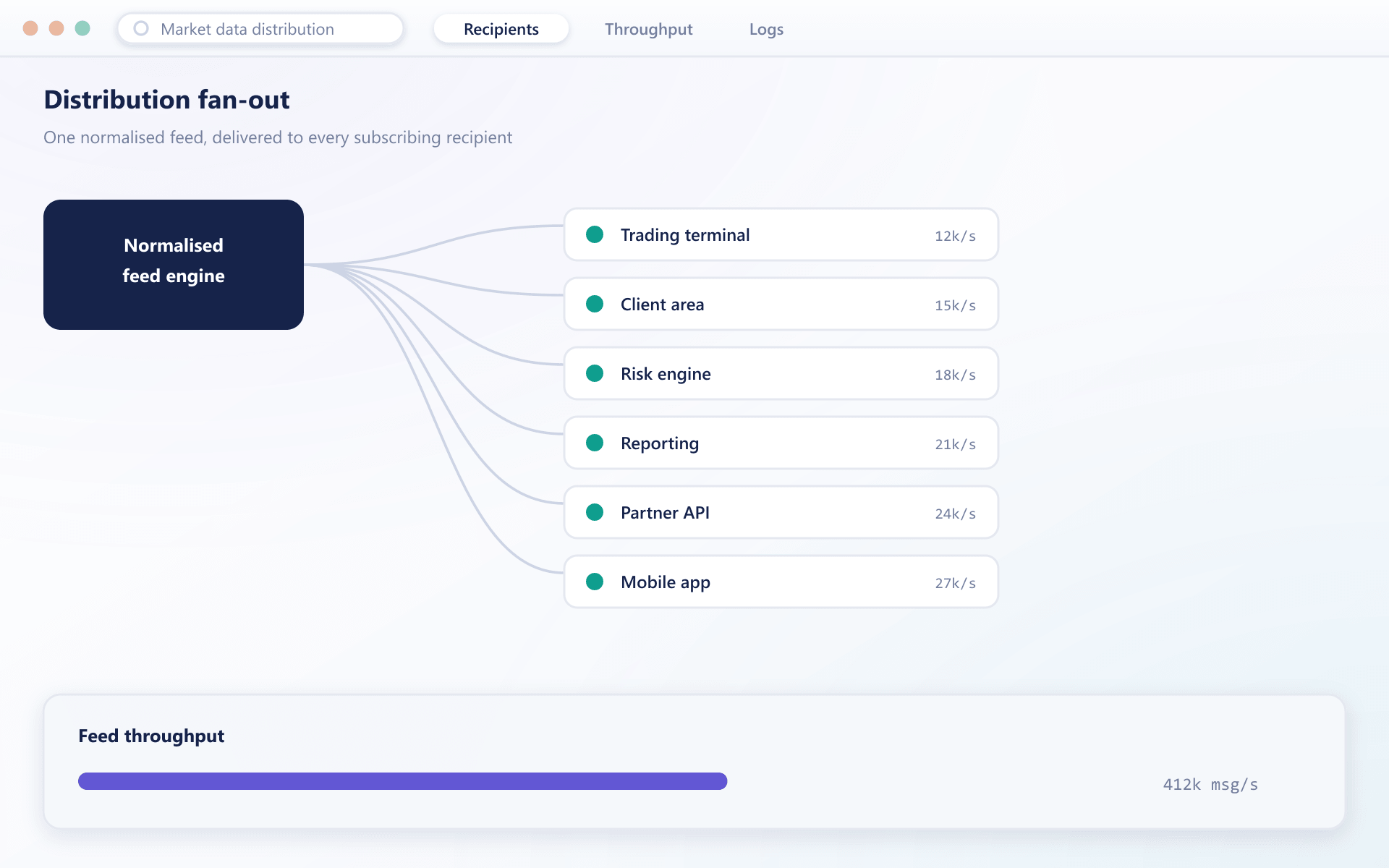
From aggregate to consumer
The same underlying book, shaped differently for each recipient
Decide what each consumer may see
Instrument scope is attached to the recipient, so an unentitled instrument is never published to them in any form.
Apply their commercial terms
The recipient's markup and spread floor are applied to the merged book, producing the price they specifically receive.
A coherent starting point
On connection the consumer receives a full, internally consistent snapshot, after which only incremental changes are sent.
Updates at a rate they can take
Incremental updates are throttled per consumer, coalescing intermediate states rather than queueing an ever-growing backlog.
What controlled distribution gives you
The book is an asset. Distribution decides who gets to use it and on what terms.
Differentiated pricing
Two counterparties can receive different prices from the same underlying book.
Licence compliance
Entitlements keep you inside the terms your data providers set.
Stable consumers
Throttling stops a slow client from drifting hopelessly behind the market.
One source of price
Platform, risk and reporting all read the same book, so they cannot disagree.
FAQ
Distribution: common questions
5 short answers to what teams ask before a demo.
Yes. Markup and spread floor are applied per recipient to the same merged book, so preferential terms for one counterparty do not affect what anyone else sees.
Instrument scope is attached to the recipient. An instrument outside that scope is never published to them, which keeps you compliant with both data licensing and commercial agreements.
Updates are throttled to a rate that consumer can absorb, coalescing intermediate states rather than building an unbounded queue. They see the current book, not a growing backlog of stale changes.
With a full, internally consistent snapshot on connection, after which only incremental updates are sent. It never has to assemble a starting book from partial messages.
FIX market data sessions and the streaming API. Both carry the same book, so a counterparty on FIX and an internal system on the streaming API see identical prices.
Still have a question?
A specialist will answer it directly, with your set-up in mind.
Ask a specialistPlan your distribution model
Tell us who needs the book and on what terms, and we will map entitlements and shaping during the call.