Connectivity
Modern interfaces for everything FIX was never meant to carry
FIX carries orders. Configuration, account state, monitoring and reporting belong on interfaces built for them — documented REST endpoints and a streaming channel for anything that changes continuously.
One streaming connection
v1Subscribe to what you use. Everything else stays off the wire.
What the API surface covers
If it appears on a screen in the console, there is an endpoint behind it
Configuration endpoints
Instruments, symbol mappings, routing rules, markup and counterparty terms can all be read and written programmatically.
configStreaming prices and fills
Aggregated book updates, order state changes and executions arrive over a persistent connection rather than being polled.
streamgRPC interface
The same operations are exposed over gRPC for teams that prefer a typed contract to JSON, with client stubs generated from the published schema so drift between your code and ours cannot go unnoticed.
grpcReporting access
The same records the built-in reports query are available directly, so your own analytics read the source rather than an export.
reportsWebhooks
Session state changes, limit breaches and rejection spikes can be pushed to an endpoint you control for your own alerting.
webhooksSandbox
A separate environment mirrors the production surface, including error responses, so integration work happens before anything is live.
sandboxSee it live
Documented endpoints, not a private interface
Every request and response shape shown here is exactly what the console itself calls — nothing is held back for internal use only.
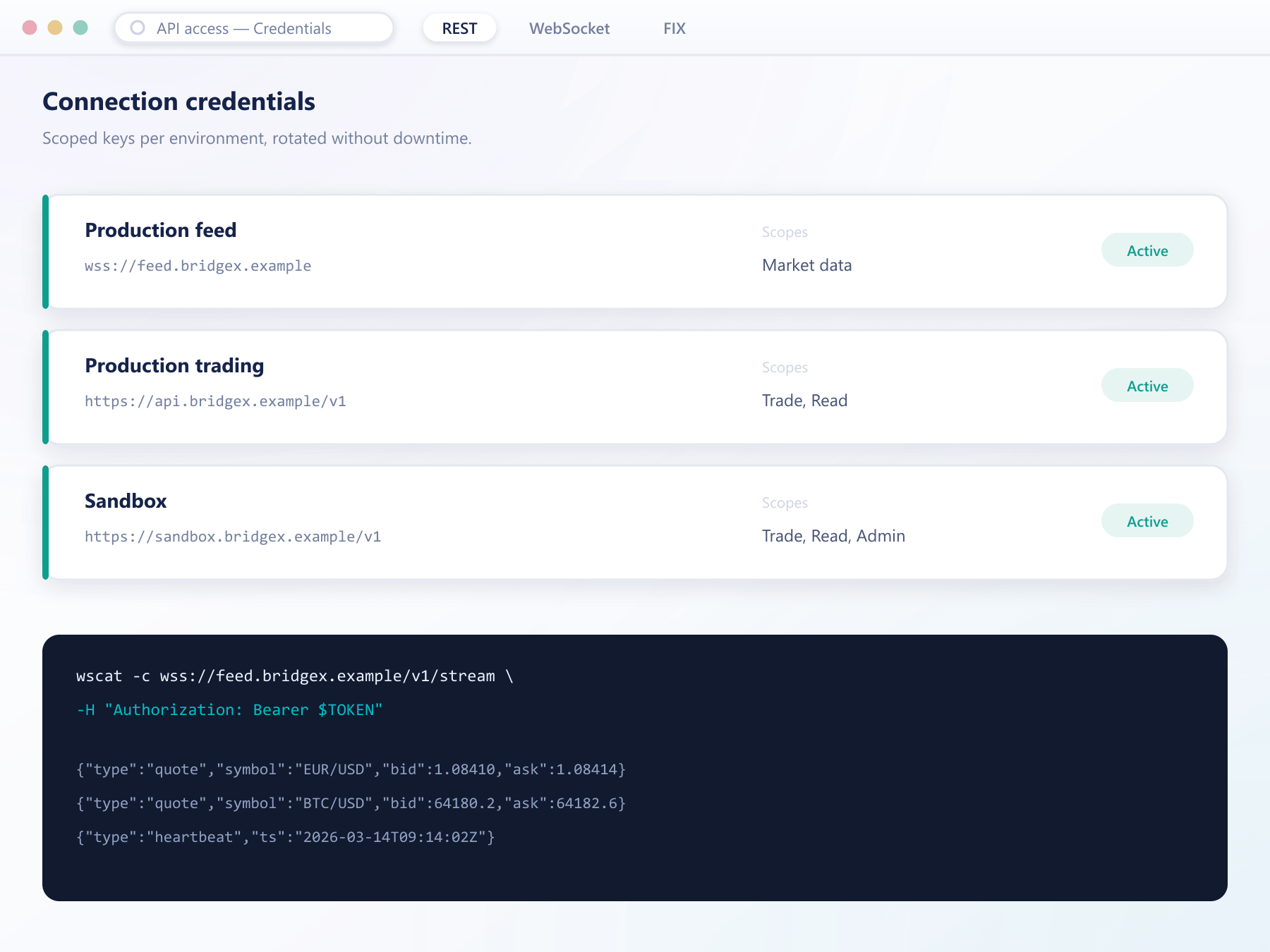
Integrating against BridgeX
The path from a first request to production traffic
- 1Credentials
Scoped keys, issued and revoked by you
API keys are created in the console with an explicit scope — read-only, configuration or trading — and every issuance and revocation is written to the audit log.
- 2Sandbox
Exercise the failure paths first
The sandbox returns the same shapes and the same errors as production, so an integration meets its edge cases before it meets real money.
- 3Subscribe
One stream, many topics
A single streaming connection carries book updates, order events and session state. Topics are subscribed individually so you only receive what you use.
- 4Promote
Same shapes, real credentials
Moving to production changes the endpoint and the key. Request and response shapes, validation and error semantics are unchanged.
Why the API matters operationally
Most of the work of running connectivity is configuration, and configuration wants to be automated.
Automated onboarding
Adding a counterparty and its terms becomes a script rather than a console session.
Your own dashboards
Streaming state feeds the monitoring tools your team already watches.
Config as code
Routing rules and mappings can live in your own version control and be applied through the API.
Fewer surprises
A sandbox with real error responses removes most of what delays a go-live.
FAQ
APIs: common questions
6 short answers to what teams ask before a demo.
Yes. The console is a client of the public API rather than of a privileged internal interface, which is what keeps the published documentation accurate.
Each key carries an explicit scope — read-only, configuration or trading — granted separately. Issuance and revocation are recorded in the audit log with the operator identity.
No. One streaming connection carries book updates, order events and session state, with topics subscribed individually so you receive only what you actually consume.
No. The same operations are also available over gRPC, with client stubs generated from the published schema. Teams that already build against typed contracts tend to prefer it; nothing is withheld from REST for those that do not.
The surface is versioned with published schemas and a changelog per release. When a version is superseded, the previous one remains available for a stated window so you can migrate deliberately.
Yes, applied per credential rather than per account, so one misbehaving integration cannot degrade the others you run.
Still have a question?
A specialist will answer it directly, with your set-up in mind.
Ask a specialistWalk the API with your engineers
We will go through the API surface, the streaming model and the sandbox with your technical team.