Risk & Accounts
Margin that is enforced, not reported the next morning
Collateral eligibility, haircuts and requirement levels are set per counterparty, and the engine acts on them continuously — warning, then restricting, before anything has to be closed.
Illustrative schedule. Eligibility and haircuts are set per counterparty.
See it live
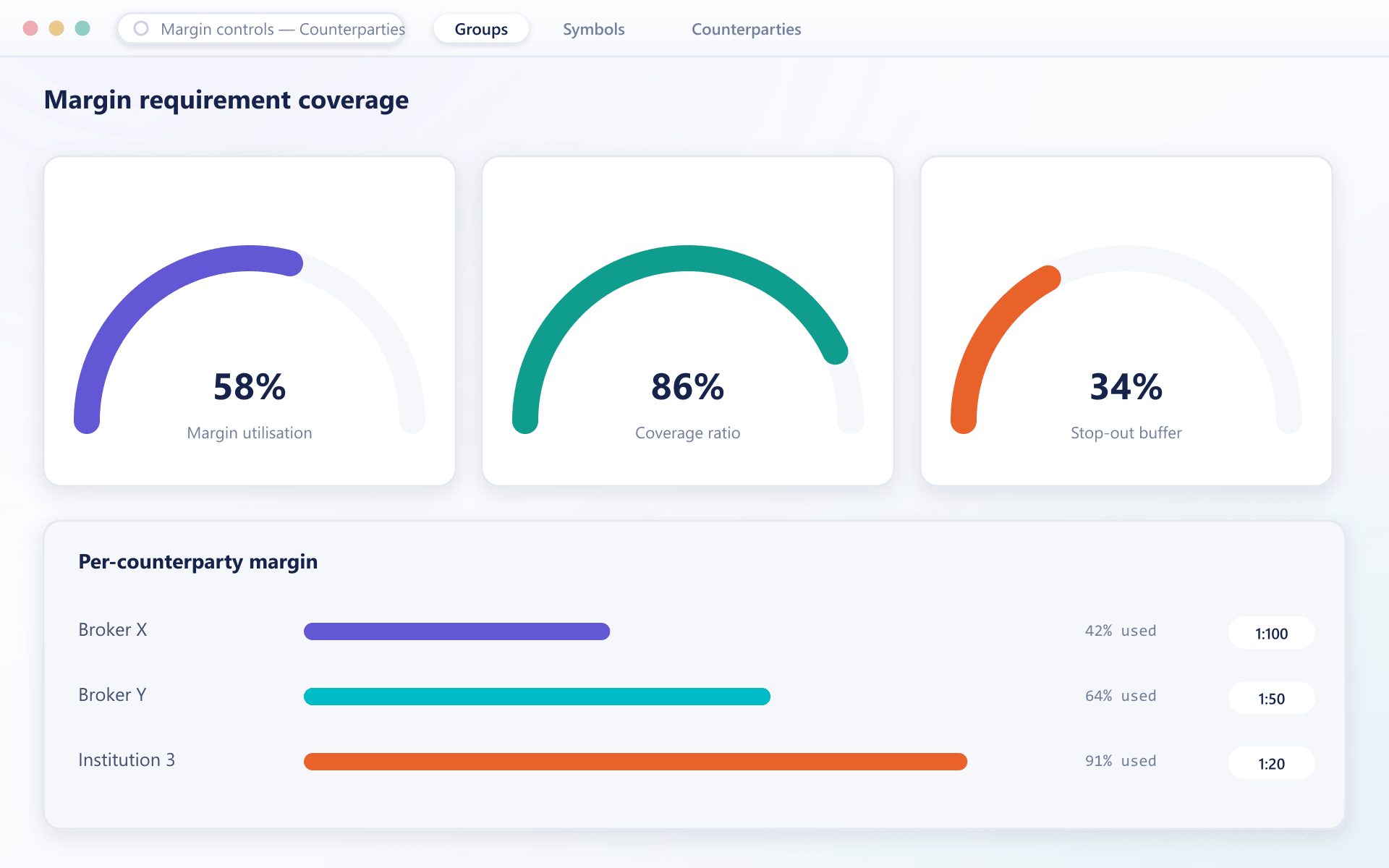
Margin health, read in one glance
Gauges for requirement coverage sit above per-group limit bars, so a desk sees exactly which counterparty is approaching which threshold.
What the margin policy defines
Five levers, and each of them differs by counterparty in practice
Evaluated continuouslyEligible collateral
Which assets count toward margin for this counterparty, and at what haircut, set per asset rather than as a single blanket rule.
Initial and maintenance
The requirement to open exposure and the lower level at which it must be maintained are configured separately.
Staged thresholds
Warning, restriction and action levels are distinct, so a counterparty is told and then limited before anything is forced.
Continuous evaluation
Margin health recalculates on every fill and every price update rather than on a scheduled sweep.
Restriction, not just alerts
At the restriction level, exposure-increasing orders are refused while reducing orders remain available, so the counterparty can still act.
A counterparty moving through the levels
Four stages, and most relationships never reach the last one
- Level 1
Healthy
Requirement covered comfortably
Posted collateral after haircuts exceeds the maintenance requirement. Utilisation is visible to both your desk and the counterparty.
- Level 2
Warning
Told while there is time
Crossing the warning level raises an alert to your desk and to the counterparty, stating the shortfall and what would clear it.
- Level 3
Restricted
Exposure frozen, not closed
New exposure-increasing orders are refused. Reducing orders and additional collateral remain available, which is usually enough to recover.
- Level 4
Action
Reduced only as a last resort
Where restriction does not restore health, positions are reduced according to a configured ordering, and every step is recorded.
Why staged margin beats a single limit
A binary limit produces surprises. Staged levels produce phone calls, which is much better.
Fewer forced closures
Warning and restriction usually resolve the situation before action is needed.
Credit risk contained
Continuous evaluation means a fast move does not outrun your controls.
Relationships preserved
A counterparty told early is a counterparty who stays.
Defensible decisions
Every threshold crossing and notification is recorded, so nothing is contested afterwards.
FAQ
Margin controls: common questions
5 short answers to what teams ask before a demo.
Yes. Which assets are eligible and at what haircut is set per counterparty, because the collateral you will accept from a bank and from a small broker are rarely the same.
On every fill and every relevant price update. There is no overnight batch, which is what prevents a fast move from breaching a limit before anything reacts.
A warning notifies without changing what the counterparty can do. Restriction refuses orders that would increase exposure while still permitting reducing orders and additional collateral.
Only as a last resort, and only where restriction has failed to restore health. Reduction follows a configured ordering and each step is written to the event log.
Yes. Utilisation, requirement and distance to the next threshold are available to them, which removes most of the enquiries your desk would otherwise field.
Still have a question?
A specialist will answer it directly, with your set-up in mind.
Ask a specialistConfigure your margin policy with us
Bring your collateral schedule and thresholds and we will set them up on a live environment.