Execution
Where an order goes should be a decision, not a default
Routing rules are evaluated per order against the live book, your venue preferences and your current exposure. An order can go to one venue, be split across several, or never leave your book at all.
Rule set — EUR/USD
First match wins- 1size > 5MSplit across A, B
- 2reduces exposureInternalise
- 3instrument in FX majorsBest price
- 4otherwisePreferred venue A
Illustrative rules. Ordering is explicit, so the outcome is predictable under pressure.
See it live
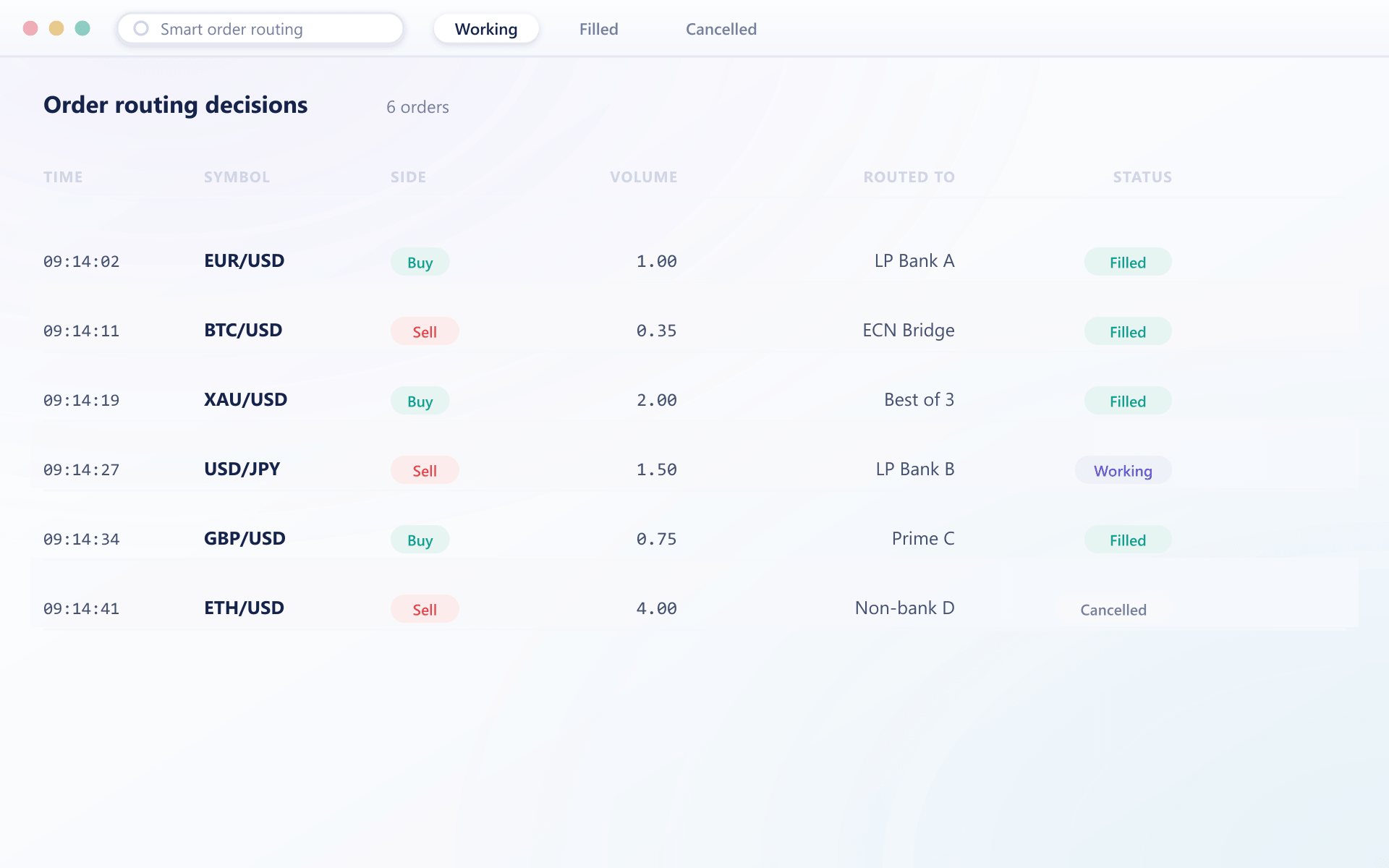
Every order, tracked to its destination
Working, filled and cancelled orders in one table, each carrying the venue it was routed to and the rule that sent it there.
The rules you can actually express
Rules are ordered and the first match wins, which keeps behaviour predictable
Best price
The order goes to whichever source is showing the best executable price for the required size, taking depth into account rather than top of book alone.
Preferred venue
A named venue takes the flow while it is healthy and within its limits, with a fallback order defined for when it is not.
Weighted distribution
Flow is spread across several venues in proportions you set, which is how volume commitments are honoured without manual intervention.
Exposure-based
The rule consults your current net exposure, so an order that would reduce risk can be internalised while one that increases it is routed out.
Order splitting
Where no single source can fill the size at an acceptable price, the order is split across sources and the fills are reported as one execution.
One order through the router
Four steps, all of which happen before the client notices any delay
- Evaluate
Rules in order, first match wins
The rule set for that instrument is evaluated against the order, the current book and your live exposure. Ordering is explicit so the outcome is predictable.
- Select
One destination, or several
The rule resolves to a venue, a set of venues with sizes, or internalisation. Unhealthy sources are excluded before selection rather than after.
- Execute
Sent, and watched
Orders are placed with the venue's own precision and size conventions. A rejection or timeout triggers the configured fallback immediately.
- Record
Outcome attributed to the venue
Fill or rejection, latency and realised slippage are written against the venue, which is what feeds the statistics behind future routing decisions.
What routing control is worth
Execution cost is a rounding error per trade and a serious number per year.
Lower execution cost
Best-price routing across sources beats a single relationship, consistently.
Commitments honoured
Weighted distribution meets volume agreements without anyone tracking it manually.
Continuity
Failover means one venue's rejection storm does not become your outage.
Evidence for renewals
Per-venue statistics turn a commercial discussion into a factual one.
FAQ
Routing: common questions
5 short answers to what teams ask before a demo.
Rules are configured per instrument and evaluated in order. The first rule whose conditions match determines the destination, which keeps the outcome predictable rather than emergent.
No. It considers depth, so the source chosen is the one that can fill the required size at the best effective price rather than the one showing the best price for a token amount.
Yes. Where no single source can fill the size acceptably, the order is split and the resulting fills are reported back as a single execution with the venue breakdown retained.
The configured fallback is triggered immediately. Persistent rejection above a threshold removes that venue from routing until it recovers, so one misbehaving source cannot absorb repeated attempts.
Yes. An exposure-based rule consults live net position, which allows risk-reducing orders to be internalised while risk-increasing ones are routed out.
Still have a question?
A specialist will answer it directly, with your set-up in mind.
Ask a specialistWrite your routing rules with us
Describe how you want flow handled today and we will express it as rules in a live environment.