MultiPrimeX Product
One connection to every venue you trade on
BridgeX sits between your platform and the market. It aggregates pricing from many sources into a single book, routes each order by rules you write, and gives you control over whether the risk is passed on or kept.
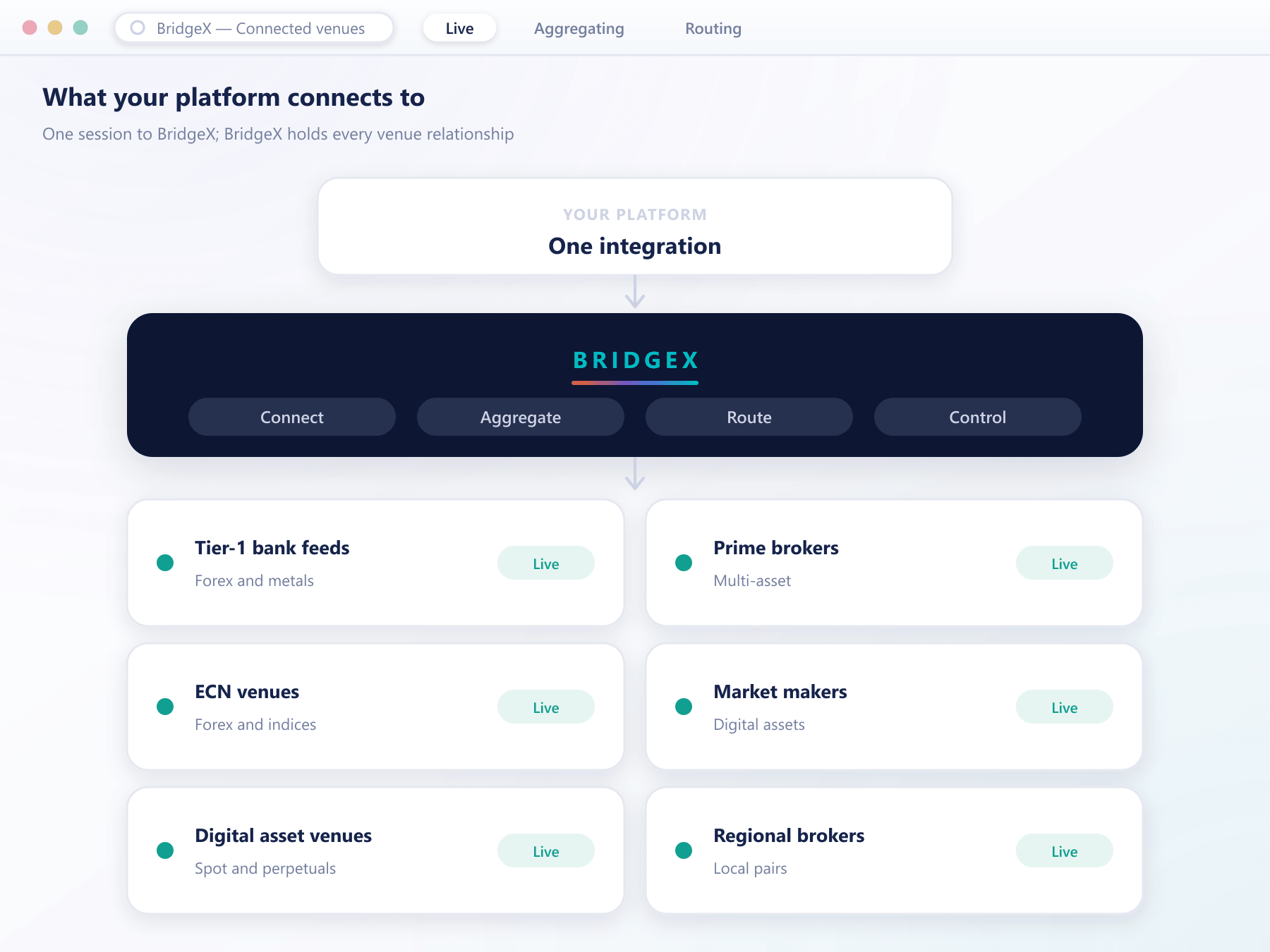
Venues and providers connectable
Instruments distributable
Median routing decision
Figures are indicative of platform capability and are confirmed against your own venue list during scoping.
See it live
One aggregated book, not six separate feeds
Every connected venue folds into a single priced instrument list. What a trader sees on the terminal is already the aggregated, filtered book BridgeX built underneath it.
The four layers
What sits between your platform and the market
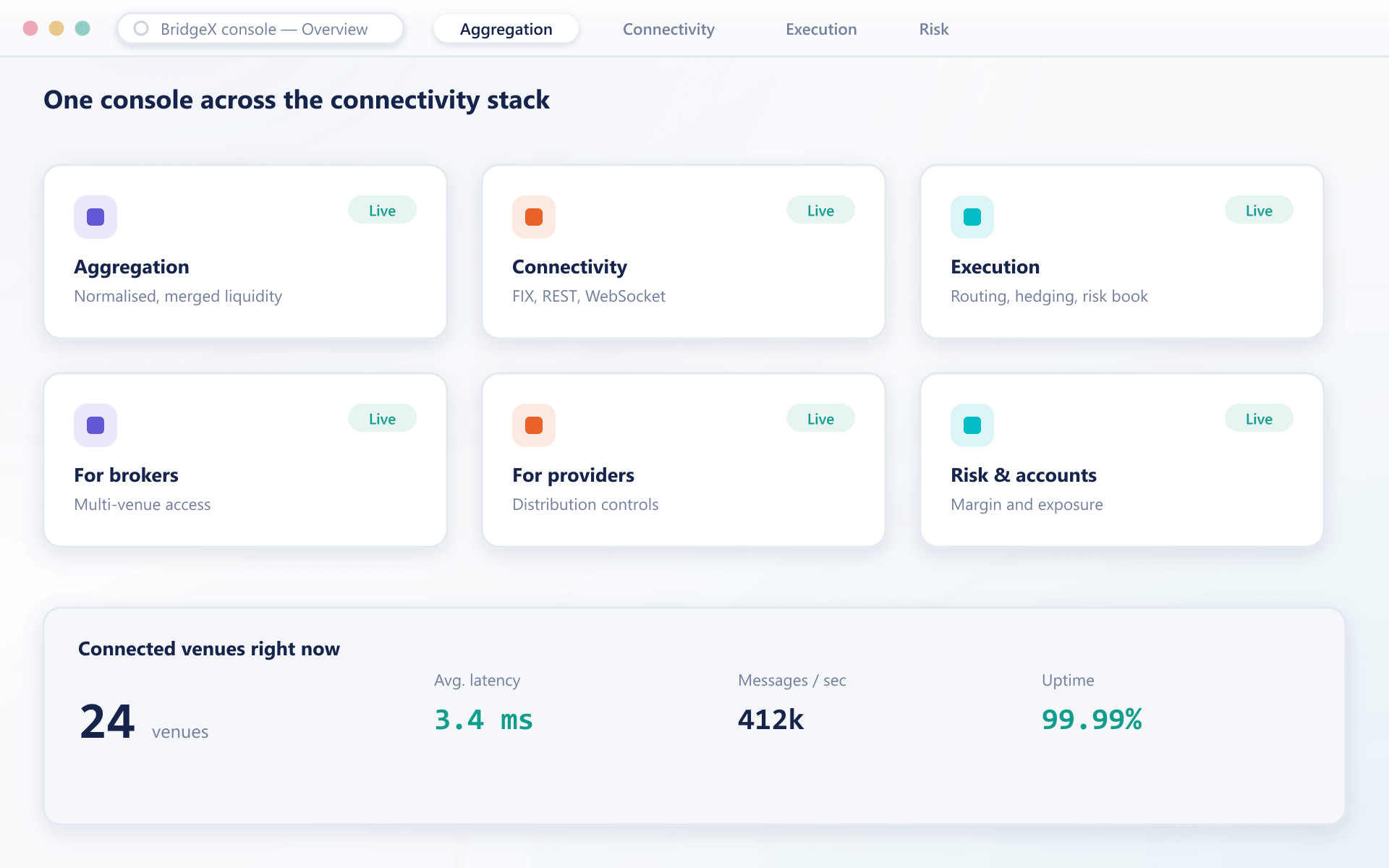
BridgeX is not one component. It is four, and each is configured independently so you can change routing without touching connectivity.
- 01Connect
One interface, many dialects
Each venue is integrated once, with its own session settings, symbol mapping and quirks absorbed at the edge. Your platform only ever speaks to BridgeX.
Per-venue session configuration
Symbol mapping handled at the edge
- 02Aggregate
Many books, one price
Quotes from every connected source are combined into a single book with full depth, after stale and outlying prices have been filtered out.
Depth from every source
Stale and outlier filtering
- 03Route
Rules decide the destination
Best price, preferred venue, weighted distribution or exposure-based routing — the rule is evaluated per order against the current state of the book.
Rules per instrument
Automatic failover on degradation
- 04Control
Decide what happens to the risk
Pass the order straight through, keep it on your book, or hedge only the portion above a threshold. The execution model is a setting, not a rebuild.
Straight-through, warehousing or partial
Exposure visible per instrument
Merged offer side
3 sourcesIllustrative ladder. Dots show how many sources contribute at each level.
Aggregation
A single book built from sources that disagree
Real feeds arrive at different rates, with different precision and occasional bad ticks. Aggregation is mostly about deciding what to ignore.
Depth merged, not just top of book
Every level from every source contributes, so size is visible rather than implied.
Stale quote filtering
A source that stops updating is dropped from the aggregate before it can mislead a routing decision.
Outlier rejection
Prices outside a sanity band relative to the consensus are excluded rather than averaged in.
Your markup on top
Spread floor and markup are applied per instrument and per counterparty after the book is built.
Synthetic instruments
Quote pairs nobody actually makes a market in
Where no venue quotes a cross directly, BridgeX derives it from the legs that are quoted, keeping the synthetic price consistent with its components.
Execution models
Three ways to handle the risk, chosen per instrument
Most desks want a mix. The model is resolved per instrument and per counterparty, and it can be changed without a deployment.
Straight-through
The client order is mirrored to the venue immediately. You earn the markup and carry no market risk.
- Risk
- None retained
- Cost
- External execution on every fill
Warehousing
The order is filled from your own book and the exposure is retained deliberately, removing external execution cost.
- Risk
- Fully retained
- Cost
- No external execution
Partial hedge
Exposure below a threshold stays with you and anything above it is hedged automatically.
- Risk
- Capped at your threshold
- Cost
- Only on the excess
Counterparty accounts
Every counterparty on terms you set
Each counterparty carries its own credit limit, margin policy, instrument set and pricing. Changing terms is an edit, not a renegotiation with your own systems.
Credit and margin
Limits per counterparty with utilisation visible live, and automatic restriction as they approach the ceiling.
Pricing per relationship
Markup, spread floor and commission are attached to the counterparty, so preferential terms do not require a separate deployment.
“We were maintaining six venue integrations and every upgrade was somebody’s month. Moving that behind one connection gave the team back their roadmap.”
Head of Trading Technology
Multi-asset brokerage, APAC
Reporting
Trade, risk and account reporting from one record
Every quote, order, fill, hedge and rejection is written once. Reporting is a query over that, which is why the numbers never need reconciling against a second system.
Execution quality
Fill rate, rejection rate, latency and realised slippage per venue and per instrument.
Exposure and result
Net and gross exposure by instrument, attributed to markup, spread and warehousing separately.
Counterparty activity
Volume, revenue and limit utilisation per counterparty, scheduled or on demand.
Session health
Problems visible before a counterparty calls
Connectivity fails quietly. BridgeX surfaces it loudly, on the channels your operations team already watches.
Live session state
Connection status, sequence numbers, message rates and staleness per venue.
Automatic failover
A degrading source is removed from aggregation and routing, then reinstated when it recovers.
Alerting
Threshold breaches and disconnections raise alerts into your existing operational channels.
Full message logs
Inbound and outbound messages retained, so a connectivity dispute is settled from records.
Getting connected
From contract to first routed order
Connectivity projects have a reputation for taking months. These are the three phases and what each actually requires from you.
Environment and sessions
Your instance is provisioned and the first venue sessions are configured. Credentials are exchanged and connectivity is proven in a test environment.
Mapping and rules
Symbol mapping, aggregation settings, markup and routing rules are entered. Pricing is validated against what you expect to see.
Certification and go-live
Counterparty sessions are certified, execution models are switched on per instrument and your team is walked through the console.
Interfaces
FIX where it is expected, modern APIs everywhere else
Institutional counterparties get standard FIX sessions. Everything else — configuration, reporting, monitoring — is available over documented REST and streaming interfaces.
Connectivity in detailFIX sessions
Order flow, market data and drop copy, configured and certified per counterparty.
REST and streaming
Configuration, account state and reporting over request-response; prices and fills over a persistent connection.
Versioned and documented
Published schemas and a changelog per release, with older versions supported through a stated window.
Fits your stack
Sits alongside what you already run
BridgeX is a layer, not a platform replacement. It feeds your trading platform, your risk system and your back office rather than asking you to move them.
Trading platforms
Risk systems
Back office
Business intelligence
Monitoring stacks
Settlement providers
Explore the platform
Every part of BridgeX, documented
The product is grouped by layer, then by who is using it. Pick a section to see what each part actually does.
FAQ
BridgeX: common questions
6 short answers to what teams ask before a demo.
BridgeX is the MultiPrimeX liquidity connectivity layer: one connection from your platform to many venues, with price aggregation, order routing, execution controls and the risk and reporting behind every fill.
Bank feeds, prime brokers, ECNs, market makers and digital-asset venues connect over FIX in both directions, with REST and streaming APIs for configuration and data. New venues are added through configuration rather than a software release.
Quotes from every source are normalised and merged into one book with stale and outlier filtering. Orders are then routed by best price, preferred venue, weighted split or current exposure, with automatic failover when a venue rejects or disconnects.
Yes. Partial hedging sends only the exposure above a threshold to providers, and risk warehousing lets you retain flow deliberately with per-instrument limits and automatic unwind triggers.
No. Liquidity providers use it to distribute their own pricing to takers, with per-taker rate limits, quote validity windows, last look and analytics on what each relationship trades.
Yes. Each margin account can carry its own base asset, such as EUR, GBP, JPY, BTC, ETH or USDT, with balance, margin and P&L calculated in that asset.
Still have a question?
A specialist will answer it directly, with your set-up in mind.
Ask a specialistMap your venues onto BridgeX
Bring the list of venues and counterparties you need to reach and we will lay out the connectivity, aggregation and routing plan on the call.