Brokerage Operations
Risk visibility that arrives after the loss is just a report
Firm-wide exposure across every platform you run, updated continuously, with the controls to act on it sitting on the same screen as the number that prompted it.
The end-of-day report
Accurate, complete, and about something that already happened. Useful for explaining a loss to a board, useless for preventing one.
The spreadsheet someone maintains
Assembled from three exports by one person who is occasionally on holiday. It is right until the day the format changes and nobody notices.
The desk
Aggregated across every platform, updated continuously, with the controls to act sitting on the same screen as the number that prompted it.
See it live
Exposure and stop-out buffer, always on screen
Margin utilisation, exposure limits and stop-out buffer are visible per group, recalculated on every tick rather than on a reporting cycle.
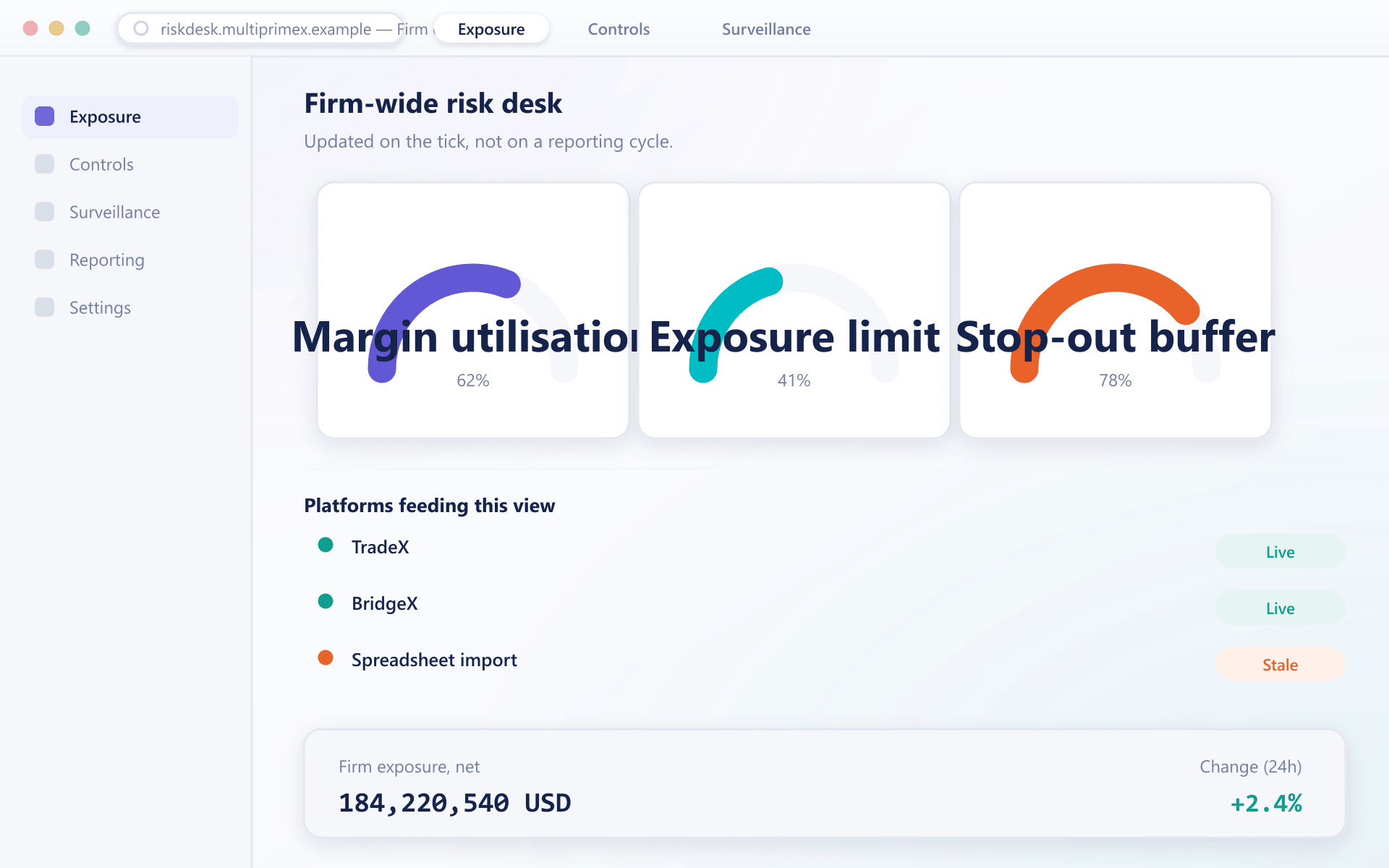
Where risk currently lives
Every platform knows its own risk. None of them knows yours.
This is the honest version of what RiskDesk adds, stated against our own products rather than around them.
TradeX
Per-client trading risk inside one platform
Leverage bands, margin calls and liquidation for the clients on that platform. Correct, complete, and blind to everything running alongside it.
BridgeX
Counterparty exposure on the connectivity layer
What you owe each venue and what each venue owes you. Essential, and a different question from what the firm is carrying overall.
RiskDesk
The firm, across all of it
Both of the above plus every other platform, aggregated into one position with one set of limits and one place to intervene.
What it actually does
Four things, and each one is the difference between a control and a report
Blocked before execution
Notional caps, leverage ceilings, concentration limits and fat-finger checks applied pre-trade rather than reported post-trade.
Automatic at any hour
Loss and exposure thresholds trigger a halt on a client, an instrument or the book without depending on somebody being awake.
Evidence, not instinct
Hold time, fill quality and post-trade drift separate a genuinely good trader from flow that is structurally costing you.
Reconstructable afterwards
Every limit change, override and automated action carries who, when, why and the state at the time.
A day on the desk
The same records, from the open to the board pack
- Pre-market
Overnight positions are checked against limits before the session opens, and the stress run from the previous evening is reviewed against where the market actually opened.
- Session
Exposure updates continuously. Pre-trade controls block what should not execute, and anything crossing a threshold reaches the desk before it reaches the book.
- Event
When something moves sharply, the automated actions you configured fire without waiting for someone to reach a terminal, and every one is recorded as it happens.
- Close
The report is generated from the same records the desk acted on, so what the board reads matches what the dealer saw rather than being reconstructed from it.
Explore
Four areas, and most desks start with the first
FAQ
RiskDesk: common questions
6 short answers to what teams ask before a demo.
RiskDesk is the MultiPrimeX risk console: firm-wide exposure across every platform and book in real time, pre-trade controls, automated stop-outs, flow surveillance and an audit trail behind every decision.
Positions from TradeX, BridgeX and the other platforms you connect are aggregated into one firm-wide view, split by book, instrument and client.
It shows A-book and B-book exposure separately and together, with routing decisions per client and instrument beside what each book earns, and P&L attribution that separates spread, commission, financing and retained risk.
Yes. Hard pre-trade limits block erroneous orders before execution, and kill-switch and stop-out rules halt a client, an instrument or the whole book at thresholds you define.
Surveillance profiles each client by instruments, sizing, hold times and post-trade price movement, and flags latency arbitrage with the timing evidence needed to justify a restriction.
Yes. Limit changes, overrides, automated actions and alerts are logged with who, when, why and the account state at the time, and risk reports are generated from the same records.
Still have a question?
A specialist will answer it directly, with your set-up in mind.
Ask a specialistBring one day of your trading data
We will show you the aggregated exposure view against your own book rather than against a prepared demo, and you will likely see something you did not expect.