Exposure
Find out on a quiet Tuesday, not during the event
The book you are comfortable with today is the book that has not been tested. A scenario run costs nothing; discovering the same thing live costs whatever the market decides.
See it live
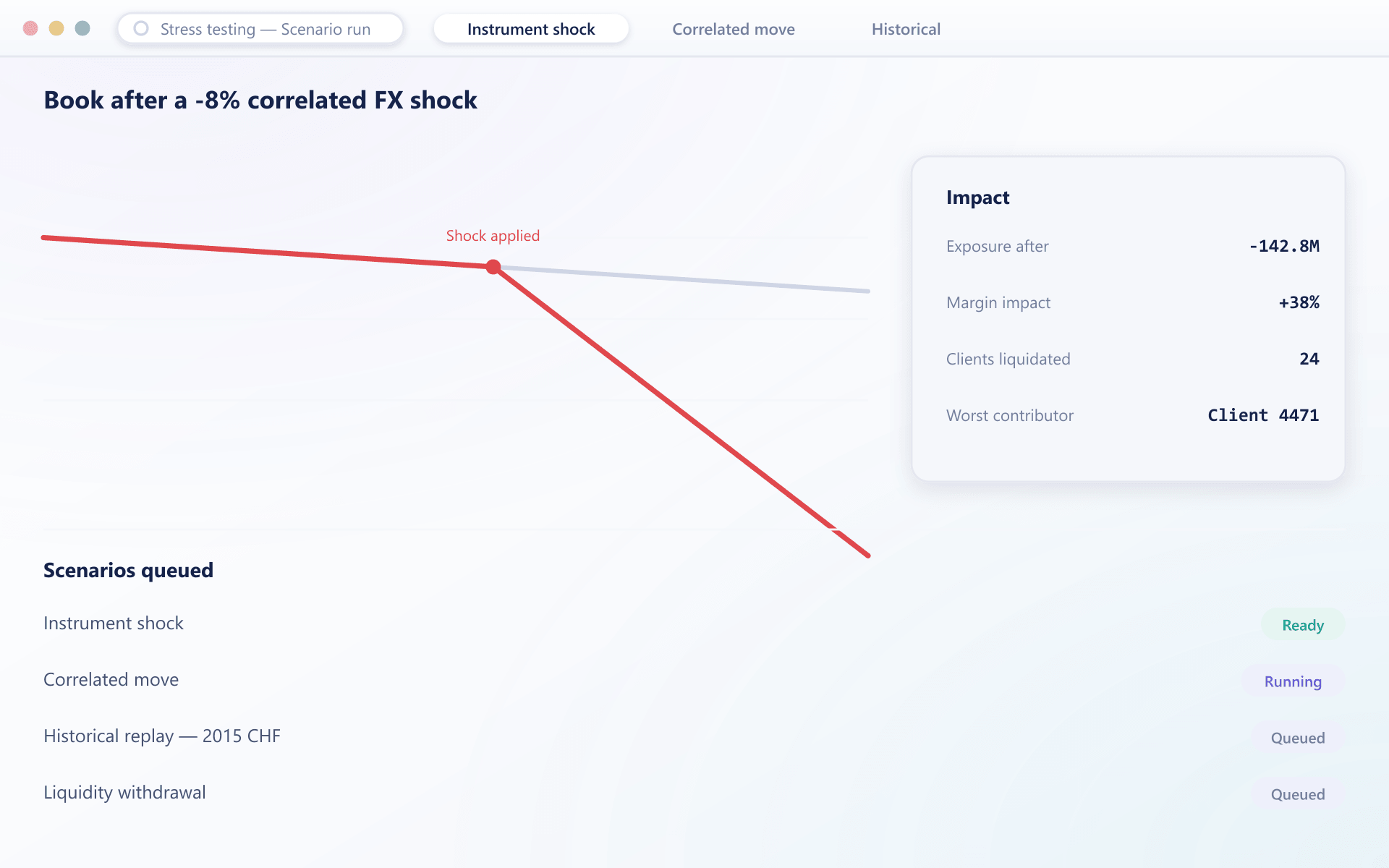
The book, after the shock is applied
A scenario run shows exposure, margin and liquidations the way a live dashboard would, so the outcome is legible rather than a row in a spreadsheet.
Four kinds of scenario
The first is easy to model and consistently too optimistic
Instrument shock
A defined move in one instrument or asset class. The simplest scenario and the one most likely to reveal a concentration nobody had noticed.
Correlated move
Several markets moving together, which is what actually happens in a risk event. Testing instruments independently understates the outcome substantially.
Historical replay
A past episode applied to today's book. Useful because the scale and speed are real rather than chosen by whoever designed the test.
Liquidity withdrawal
Spreads widening and depth thinning at the same time as the price moves, which is the part usually left out and the part that turns a manageable loss into a bad one.
What comes back
Five outputs, and the third one surprises people
Where the net position lands once the move is applied
Whether your own collateral requirements remain comfortable
How many accounts would stop out, and what that leaves behind
Which limits would be crossed, and in what order
The single position doing most of the damage
A scenario where most accounts stop out at once creates its own second problem: the flow that follows, and the support load behind it.
FAQ
Stress testing: common questions
6 short answers to what teams ask before a demo.
Yes, against the current book rather than an end-of-day snapshot. A scenario run against yesterday's positions answers a question about yesterday, which is rarely the one being asked.
Yes, and most desks run a standard set overnight so the morning starts with a current picture. Ad-hoc runs are available whenever something specific is worth checking.
Correlated moves and liquidity withdrawal. Single-instrument shocks are easy to model and consistently understate what happens, because in a real event several markets move together and the spreads widen at the same time.
Yes, and it is often the most useful output. A scenario where a large share of accounts stop out simultaneously creates its own problems — the resulting flow, the support load and the reputational consequence.
Fast enough to be useful during a session rather than only overnight. A stress test that takes an hour will not be run when a market is actually moving, which is when the answer matters most.
Yes, and you should. The scenarios that matter are specific to your instrument mix and your client base, and a generic set will systematically miss the exposure you actually carry.
Still have a question?
A specialist will answer it directly, with your set-up in mind.
Ask a specialistWhat would a bad Monday do to your book?
Bring your current positions and we will run it. It takes minutes, and the answer is usually not the one people expect.