Exposure
Collateral is a position too
Margin is only as good as what is backing it. If the collateral is marked once a day and the leverage was set at onboarding, the number on the screen describes a market that has already moved on.
See it live
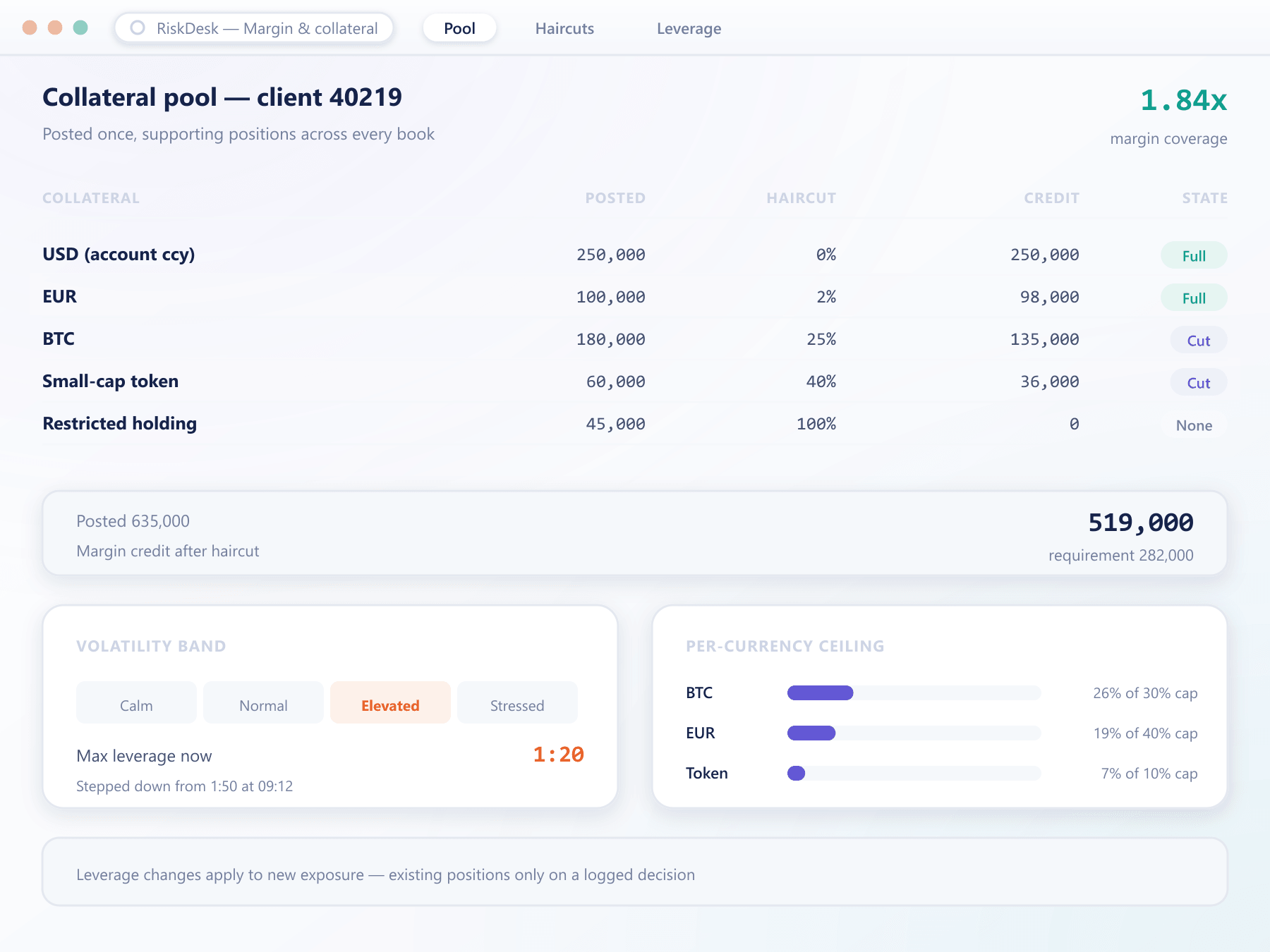
One pool, its haircuts, and the leverage band in force
Posted collateral, the credit it actually provides after haircut, and the volatility band currently setting maximum leverage.
Eligibility and haircuts
What counts as collateral, and for how much
Indicative bands. The schedule is yours to set per asset and per client group — these are the shapes desks usually start from.
Held in the currency the account is margined in
Full credit
Converted at a rate refreshed through the session
Full credit
Marked continuously, not once a day
Reduced credit
Thin books mean the mark is optimistic under stress
Reduced credit
Recognised on the balance sheet, not as margin
No credit
Cross-margin
One pool behind several books
One collateral pool, several books
Capital posted once supports positions across asset classes rather than being trapped per product. A client hedged between two books stops being margined as though each leg were standalone.
Offsets you define, not assumed
Which instruments genuinely offset is a policy decision with a number attached. Correlation that held for two years is not a reason to grant full relief on a third.
Per-currency ceilings
A limit on how much margin credit any single collateral currency may provide, so a book is never quietly backed by one volatile asset.
Margin ratio set per asset
The requirement is configured instrument by instrument rather than applied uniformly, so a volatile pair can carry a heavier ratio while a stable one is priced to be worth trading.
Revalued continuously
Collateral is marked on the same tick as the positions it supports. Margin computed against yesterday's collateral value is how a book looks solvent right up until it is not.
Leverage that moves
Four conditions that should change what the platform allows
Realised volatility rises
Leverage steps down on the affected instrumentsMaximum leverage is tied to a volatility band rather than fixed at onboarding, so the position size the platform permits contracts as conditions deteriorate.
A session is about to close
Weekend and holiday margin appliesRequirements step up ahead of a gap risk window on a schedule, rather than being raised manually by whoever remembers.
Exposure concentrates
Tiered margin by position sizeLarger positions attract a higher requirement, because the exit cost of a position is not linear in its size.
An event is scheduled
Pre-announced temporary requirementElections, rate decisions and listings can carry a raised requirement set in advance and communicated, so clients are not surprised into a liquidation.
Three things worth saying plainly
What margin efficiency costs
Cross-margin makes a default bigger
The efficiency is real, and so is the concentration. One pool backing several books means a single client failure reaches all of them at once. That is a trade to make deliberately, with per-currency ceilings underneath it.
A haircut is a guess about liquidity
Every haircut is an estimate of what the asset fetches in the market you will actually be selling into — which is the stressed one. Reviewing haircuts only after a stress event is reviewing them too late.
Changing leverage mid-position has consequences
Tightening leverage on an open book can push accounts toward liquidation on its own. Changes apply to new exposure by default, and applying them to existing positions is a deliberate, logged decision.
FAQ
Margin and collateral: common questions
6 short answers to what teams ask before a demo.
Capital posted once supports positions across books and asset classes instead of being held separately against each. For a client running offsetting positions it is the difference between two margin requirements and one net one.
You do, per asset and per client group, with a haircut attached to each. The platform enforces the policy and revalues against it; it does not decide for you what a token is worth as margin.
Tiered leverage varies with position size and is static. Dynamic leverage also responds to conditions — realised volatility, an approaching session gap, a scheduled event — so the limit reflects the market rather than the day the account was opened.
Not by default. New requirements apply to new exposure, because applying them retroactively can push an account into liquidation on the change alone. Applying them to open positions is possible and is recorded as a deliberate decision.
On the same tick as the positions it supports. Daily revaluation is what allows a book to appear adequately margined through a move that has already made it otherwise.
Yes, and it is worth doing. A per-currency ceiling on margin credit stops a firm-wide position from resting on a single volatile asset, which is the failure mode cross-margin makes easier to reach.
Still have a question?
A specialist will answer it directly, with your set-up in mind.
Ask a specialistSend us your current haircut schedule
We will run it against a stressed mark and show where the margin credit you are granting today would not survive the move.