Surveillance
Some patterns are about your feed, not the market
When a client only ever wins in the moments your price has not caught up, that is not a view on the market. It is a measurement of your infrastructure.
See it live
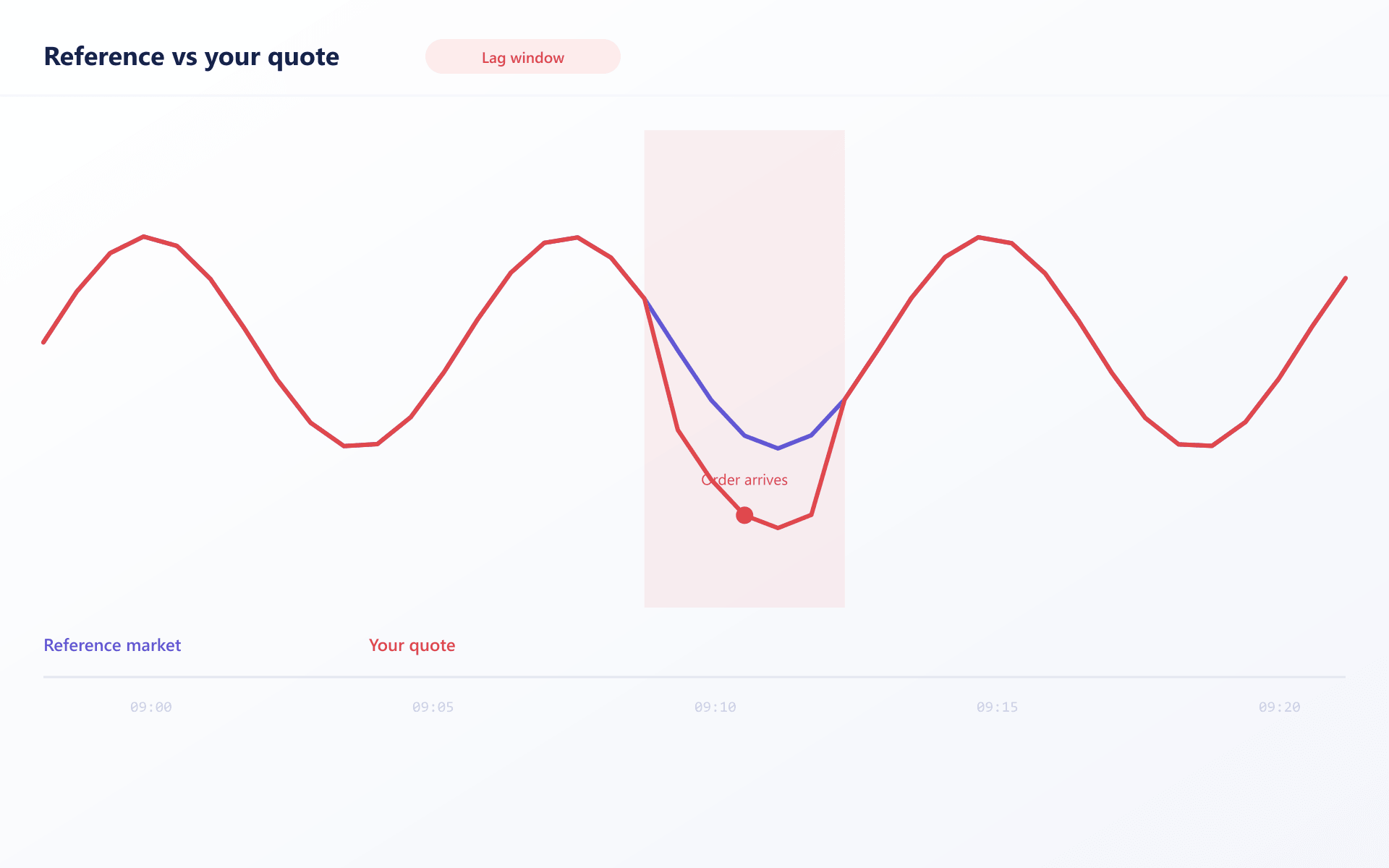
The window, visible on the same chart
Reference price movement and your own quote sit on one chart, so the lag between them is something you can see rather than infer from outcomes.
The sequence
Four steps, and the whole thing happens in a fraction of a second
- 1
Reference moves
The underlying market re-prices somewhere you are not looking yet.
- 2
Your quote lags
For a short window your price reflects a market that has already changed.
- 3
The order arrives
Precisely inside that window, and reliably on the profitable side.
- 4
Your feed catches up
The price corrects, and the position is closed almost immediately.
What to do about it
In this order, because the first step usually solves it
- 01
Fix the feed first
This is usually a symptom rather than an attack. If your pricing lags a reference market, the fix is the connectivity and the aggregation before it is anything to do with the client.
- 02
Then route the flow
Where the pattern persists, passing that client's flow on externally removes the structural cost while keeping the relationship. It is usually a better outcome than a restriction.
- 03
Restrict last, with evidence
A restriction should be the final option and should be defensible. Timing evidence per trade is what turns a difficult client conversation into a factual one.
FAQ
Latency arbitrage: common questions
6 short answers to what teams ask before a demo.
Toxic flow is the broader question of which clients cost you structurally. This is one specific mechanism within it — trading against a quote that had not yet updated — and it is identified by timing evidence rather than by outcome.
Frequently not, in any meaningful sense. If your price lags a reference market, an automated system will find that window whether or not anyone set out to exploit it. The first place to look is your own connectivity.
Per trade: the reference market movement, your quote at the time, the arrival timestamp and what happened immediately after. That sequence is what makes a restriction defensible if you decide to apply one.
Usually not as the first step. Fix the pricing lag, then route the flow externally through BridgeX if it persists. Restriction is the last option because it loses the client entirely and often addresses a symptom of your own infrastructure.
That is the whole point of using timing rather than profitability. Fast trading with mixed outcomes looks different from trading that only ever lands in the lag window, and the difference is measurable rather than a matter of opinion.
Faster than for general toxic flow, because the signature is specific. A handful of trades landing consistently inside the same window is already meaningful, where general profitability would need far more history.
Still have a question?
A specialist will answer it directly, with your set-up in mind.
Ask a specialistHow far behind is your quote?
Most desks have never measured it against a reference market. It is usually the cheapest thing on this page to fix.