Surveillance
One bad day is not a pattern
Almost every unnecessary restriction comes from acting on a snapshot. A behavioural baseline is what turns “this looks unusual” into a statement about a specific person rather than a general one.
See it live
Behaviour, watched across more than one day
Instrument mix, sizing and session pattern build up per client over time, the same way a watchlist tracks several instruments at once.
What a profile holds
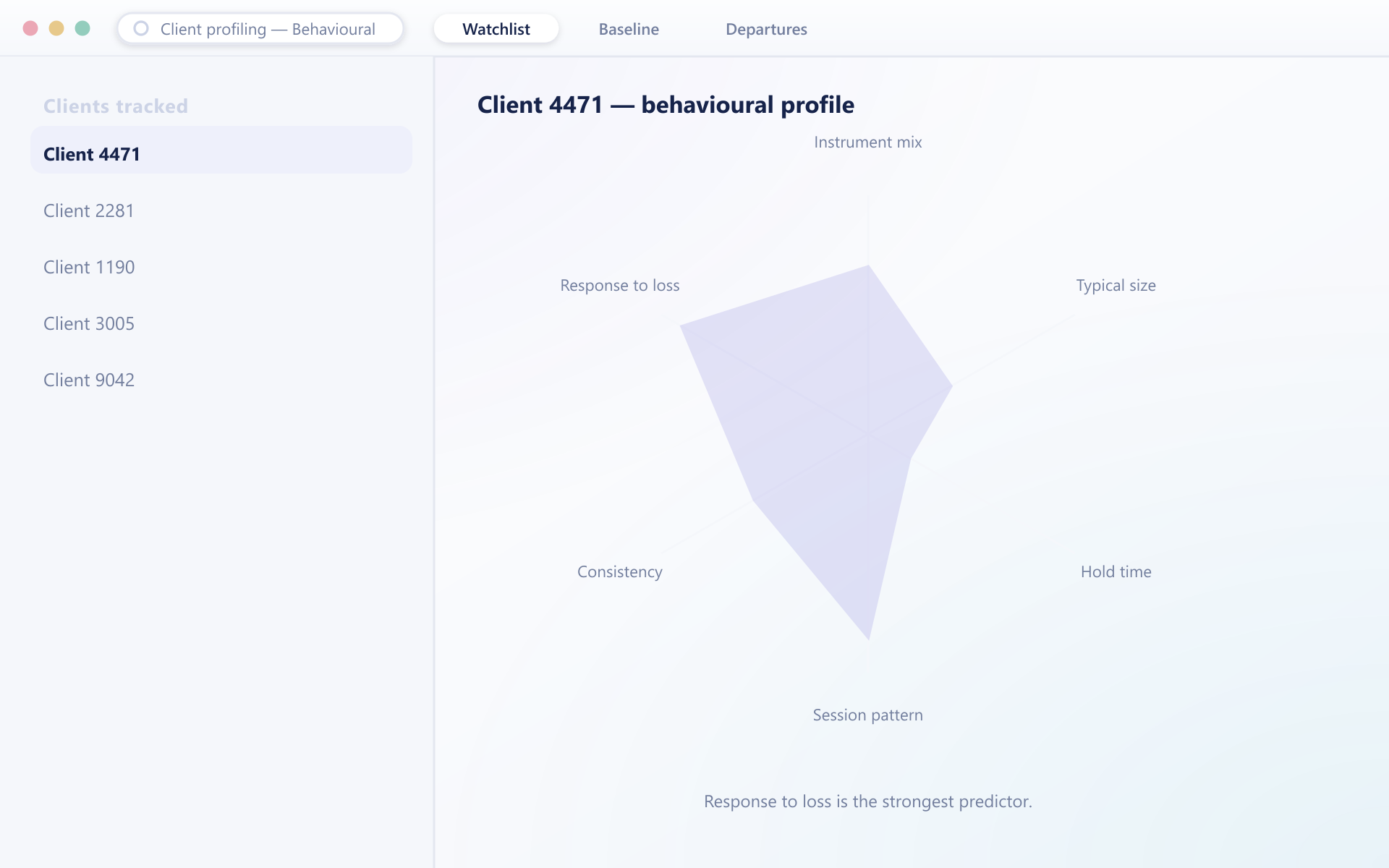
Six traits, and the last one predicts the most
A client who moves into unfamiliar markets is worth noticing
Establishes what counts as unusual for this person specifically
Separates position traders from those working the spread
Activity confined to particular hours is often a system, not a person
Steady results and volatile results carry very different risk
Whether size increases after a loss says a lot about what follows
What it is for
A profile that changes no decision is just a report
Routing decisions
Whether a client's flow is retained or passed on should follow their behaviour over time rather than the impression left by their most recent week.
Limits that fit the person
A limit calibrated to a client's own baseline is both safer and less irritating than a segment-wide number that is too tight for some and meaningless for others.
Departures from baseline
The useful alert is not that a client traded a large size. It is that this client traded a size they have never traded before, which is only detectable with history.
FAQ
Client profiling: common questions
6 short answers to what teams ask before a demo.
Enough activity for a baseline to separate from noise. Acting on a profile built from a few days is how a normal run of trades gets mistaken for a change in behaviour.
BrokerOS scores compliance risk — who the client is, their jurisdiction, their verification status. This profiles trading behaviour — what they trade, how large, how long they hold. Different questions, and a client can be low risk on one and notable on the other.
Response to loss. Whether a client increases size after losing is more predictive of an eventual problem than almost anything else on the list, and it is invisible without history.
Only where you configure it to. Profiles most often feed alerting and rules as context — a departure from a client's own baseline is a far better trigger than a fixed threshold applied to everybody.
No. This is internal risk information, and exposing it would tell a client precisely which behaviour is being watched — which changes the behaviour rather than the risk.
It is continuous, weighted towards recent activity. A client who traded one way two years ago and differently since should be assessed on the latter, without the earlier history disappearing entirely.
Still have a question?
A specialist will answer it directly, with your set-up in mind.
Ask a specialistWhich of your clients increase size after a loss?
Most desks cannot answer that, and it is more predictive of a future problem than almost anything else they do track.