White label
Your brand on the front, our infrastructure behind it
A white label puts one piece of the stack under your name and leaves the running of it with us. You keep the commercial decisions and the client relationship; we keep the servers, the patching and the pager.
Yours, everywhere
Never ours
Nothing to buy
Held by us
Yours, always
We configure to it
You set them
We apply them
You set them
We enforce them
You
Not us
Your commercial decision
We configure it
Entirely yours
No contact
Nothing to run
Ours
You are told
Ours to fix
You request
Ours
Your brand, not ours
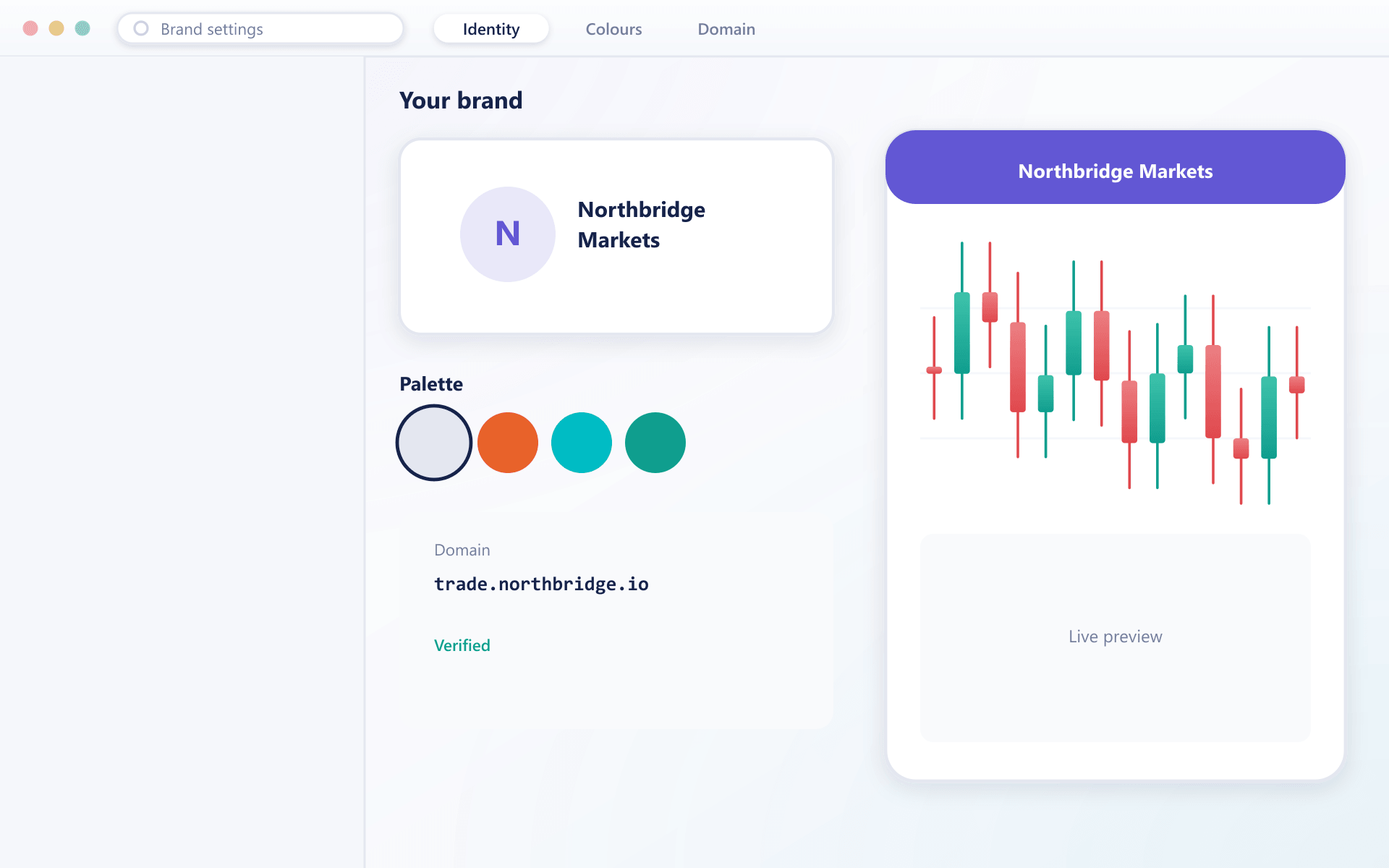
The workspace a client opens carries your name
Logo, colours and domain are applied before launch — nothing in the workspace points back to MultiPrimeX.
What can be white labelled
Four components, taken singly or together
Against turnkey
Which of the two you want depends on what is missing
Turnkey is a business, white label is a component
A turnkey package assembles everything a brokerage needs and hands the whole thing over. A white label puts one part of the stack under your brand and leaves the rest of your setup alone.
White label is usually faster to launch
There is less to scope, because you are not deciding the shape of a whole business. If a specific gap is what you are filling, that narrower scope is the reason it moves quicker.
They combine more often than people expect
A firm frequently takes one product white label and adds others later. Because the account model is shared, the second one is configuration rather than a second integration.
Where it sits in your product
A white label that sends clients elsewhere is not white label
The test is whether a client can complete the journey without leaving your domain or meeting a name that is not yours.
Widgets inside your own pages
Leaderboards, account statistics and subscription controls drop into your existing site or client area as components, so a client never leaves your domain to reach them.
Copying across platforms
A strategy running on one trading platform can be followed by an account on another. Clients are not asked to migrate to whichever platform a provider happens to be on.
Visibility controlled element by element
Any element of a surface can be shown or hidden per client group — fee lines, statistics, ranking columns — because what one segment should see is rarely what another should.
Notifications from you
Transactional email templates carry your sender address, your wording and your styling, which is where most white labels quietly leak the provider's name.
FAQ
White label: common questions
6 short answers to what teams ask before a demo.
No. The terminal, the client area, statements, emails and the domain all carry your brand. Our name appears in our contract with you and nowhere the trader can reach.
Scope. A turnkey package assembles a whole brokerage and hands it over; a white label puts one component under your brand and leaves the rest of your setup as it is. Firms often start with one white label and add more later.
We do. Hosting, patching, monitoring and incident response sit with us, which is most of what distinguishes a white label from a licence. You keep the commercial configuration — instruments, pricing, margin, fees.
You can request them and they are considered against the roadmap. What you cannot do is set the roadmap, which is the honest trade-off in exchange for not maintaining the platform yourself.
Not necessarily. Pricing can come from us, from a provider you already use, or from several through the connectivity layer. The platform does not care whose liquidity flows through it.
The account model, payments and reporting underneath are the same ones a full deployment uses, so moving to a broader arrangement is a change of contract and configuration rather than a migration.
Still have a question?
A specialist will answer it directly, with your set-up in mind.
Ask a specialistWhich piece are you actually missing?
If it is one component, a white label is the shorter route. If it is the whole business, a turnkey package is the honest answer.