Reporting
Knowing you made money is not knowing why
Four sources of revenue behave in four different ways. Added together they produce a number that looks informative and cannot support a single decision.
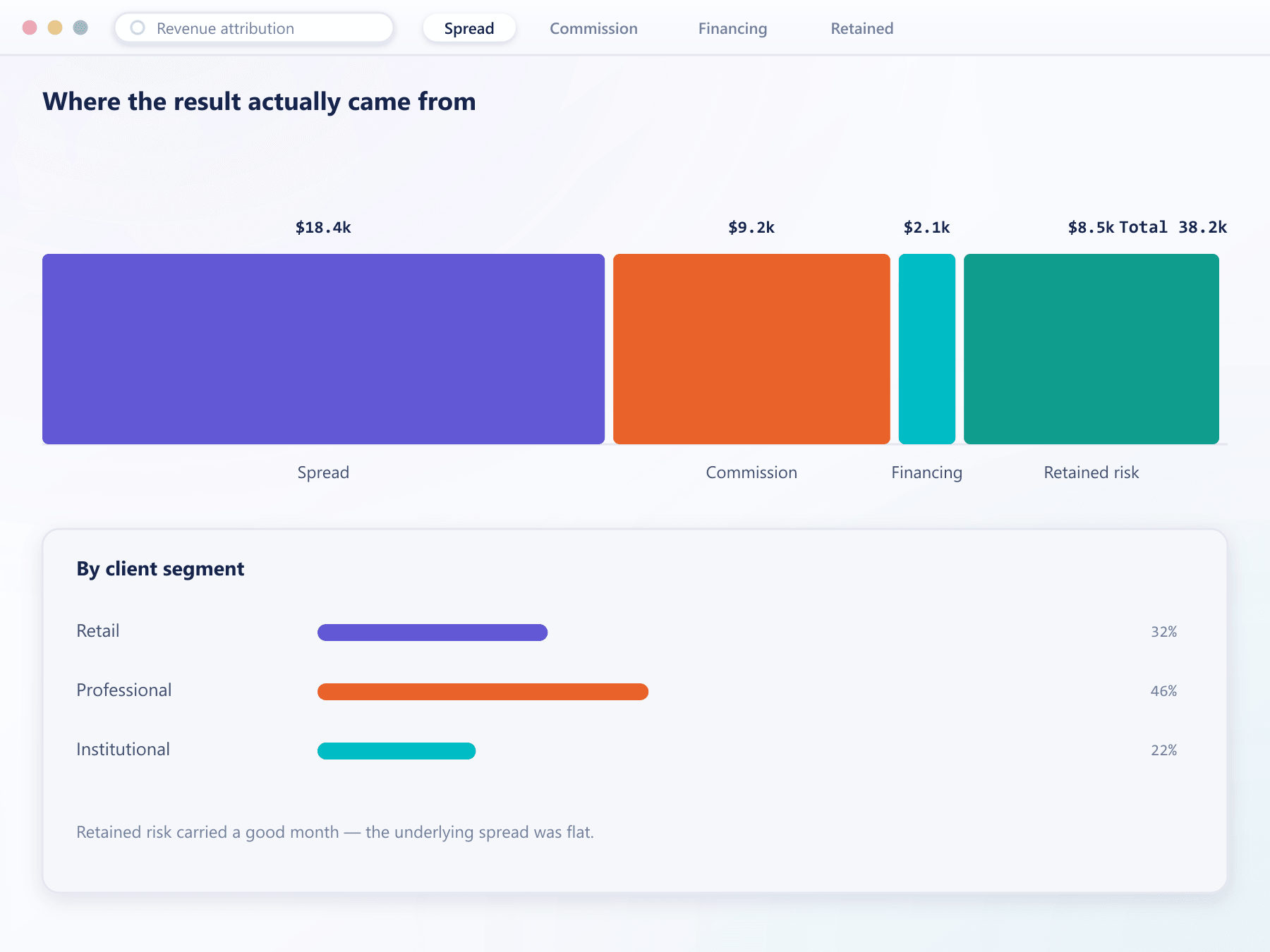
Spread
PredictableEarned on volume regardless of direction. The steadiest line and the one most sensitive to your pricing and routing quality.
Commission
PredictableAlso volume-driven and largely independent of outcomes. Together with spread this is the revenue you can plan against.
Financing
Slow-movingAccrues on held positions. Small daily, meaningful annually, and the line most often left unexamined for years at a time.
Retained risk
VolatileThe client result on flow you kept. Can dominate a good month and disappear in a bad one, which is exactly why it should never be read as part of the total.
What a blended total hides
Three expensive misreadings
A good month that was actually luck
Where retained risk carried the result, the underlying business may have been flat or worse. Reading the total as performance leads to expanding something that did not work.
A leak that never shows up
Financing set once and never reviewed can quietly cost more than it earns. It is too small to notice in a total and obvious the moment it is a line of its own.
A segment carried by another
One profitable client group can mask an unprofitable one indefinitely. Attribution by segment is what makes that visible before the good clients leave.
See it live
Revenue, split by where it actually came from
Spread, commission, financing and retained risk sit as separate lines against the same period, so a strong month can be explained rather than just reported.
FAQ
Revenue attribution: common questions
6 short answers to what teams ask before a demo.
Because the four sources behave completely differently. Spread and commission are predictable, financing is slow, and retained risk is volatile. A total blends them into a number that cannot support any decision.
That a strong month was carried by retained risk while the underlying business was flat. It is the single most consequential misreading in brokerage, because it leads to expanding an activity that was not actually working.
Yes, and it is where most of the value sits. One profitable segment can subsidise an unprofitable one for a long time, and nobody discovers it until the profitable clients leave.
As its own line rather than folded into spread. It is small enough daily to vanish inside a total and large enough annually to matter, which is precisely the profile of a cost nobody reviews.
No. This is management information for risk and commercial decisions. It reconciles against your accounting rather than substituting for it, and the two answer different questions.
Across your full retention period, and comparably. Because attribution derives from event records rather than stored summaries, a change in how you categorise something applies consistently to history as well.
Still have a question?
A specialist will answer it directly, with your set-up in mind.
Ask a specialistHow much of last month was retained risk?
If nobody can answer that quickly, the month has not really been understood — only counted.