Exposure
Which book is actually making the money?
Most desks have a strong view and weak evidence. Seeing both books separately, with revenue attributed to each, turns that into a number.
The flow you offset externally
Exposure leaves the firm and revenue comes from spread and commission. Predictable, thinner, and the right home for flow you would rather not hold.
Cost of hedging, fill quality, counterparty concentration
The flow you keep
Exposure stays with the firm and revenue includes the client result. Higher and more variable, and only sensible where you can see and cap what you are holding.
Net position, worst-case scenario, limit utilisation
How the split is decided
Three things that make routing a policy rather than a habit
Routing is a per-client decision
Whether a client's flow is passed on or retained is a property of that client, refined as their behaviour becomes clear rather than fixed at signup and forgotten.
And a per-instrument one
The same client can reasonably be retained on one instrument and passed on in another, because the risk you are willing to hold varies with the market as well as the person.
The result is measurable either way
Revenue is attributed per book, so the question of whether a routing decision was correct becomes a number rather than an argument between the risk desk and sales.
See it live
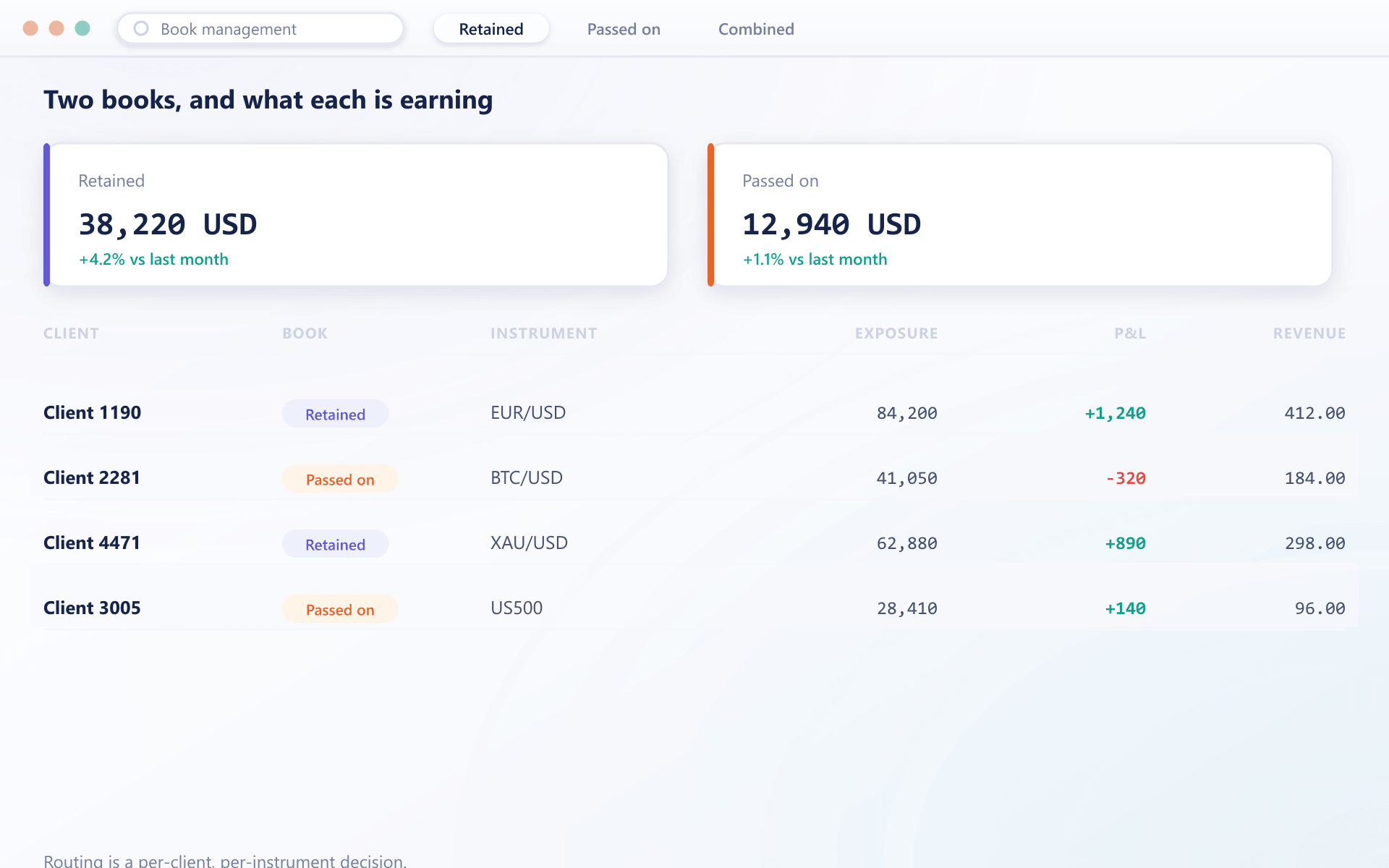
Both books, and what each one is earning
Positions from the retained book and the passed-on book sit in one table, with live P&L attributed to each so the split is a number rather than a guess.
FAQ
Book management: common questions
6 short answers to what teams ask before a demo.
No. Routing policy is yours. What this provides is the visibility to make that decision from evidence and the reporting to see afterwards whether it was right.
Yes, and it is common. Retaining a client on one instrument while passing them on in another is a reasonable position, because your willingness to hold risk varies by market as well as by person.
BridgeX is where the routing decision is executed — where the order actually goes and whether the risk is offset. RiskDesk is where you see the consequences across the whole firm and decide whether the policy should change.
Spread, commission and financing are attributed per book alongside the retained client result. Without that split, a good month on one side can hide a structural problem on the other.
Yes, and the change is attributable and takes effect on new activity. Existing positions stay where they are, because retrospectively re-booking a position creates a reconciliation problem rather than solving a risk one.
Then this is simpler rather than irrelevant. Even a purely passed-on model needs to see hedge cost, fill quality and counterparty concentration, and those are the same views.
Still have a question?
A specialist will answer it directly, with your set-up in mind.
Ask a specialistCan you attribute last month by book?
Most desks can produce a total and an opinion. The split is where the useful decisions live.